
Walking and Working Surfaces Training – [Complete Video Kit]
$239

Slips, trips, and falls still account for the majority of on-the-job accidents. They cause nearly 20% of all disabling occupational injuries and thousands of fatalities every year.
Almost all of them were preventable.
The floors, platforms, aisles, stairways, ladders, and scaffolds your employees use every day are so routine that most people stop seeing them. That’s exactly the problem. A wet entryway, an extension cord across a walkway, a missing toeboard, a ladder set at the wrong angle — none of these look dangerous until someone is on the ground.
This training program covers OSHA’s requirements for walking and working surfaces and, just as importantly, the behavior behind them. Employees learn what the standards require, why each requirement exists, and what they personally need to check before they walk, climb, or work above ground level.
What Your Employees Will Learn in this Training Course:
- Recognize the surface contaminants that cause slips — water, grease, oil, process waste, sawdust, metal shavings, dirt, and ordinary litter
- Identify common trip hazards, including pallets, extension cords, and scattered building materials, and understand housekeeping’s role in preventing them
- Understand guarding: when ditches, pits, tanks, vats, and floor openings must be covered or surrounded by a railing
- Know the specifications for a standard railing — a 42-inch top rail, a midrail at half that height, and supporting uprights
- Understand when toeboards are required and why a 3½-inch barrier at floor level protects the people working below
- Recognize floor load rating limits and know that load capacity must be posted conspicuously where floor-stressing activities take place
- Understand why aisles and passageways must be clearly marked and kept clear of clutter
- Know the requirements for wall openings and open-sided platforms, including the four-foot threshold that triggers guarding
- Use stairways safely and understand handrail height, tread and riser uniformity, and stairway load requirements
- Understand OSHA’s 2017 fixed ladder rule and what it means for ladders over 24 feet
- Inspect a portable ladder before every use and set it up correctly using the 4-to-1 ratio and the three-foot roof extension rule
- Work safely on supported and suspended scaffolds, including guardrail requirements, personal fall arrest, and when to stay off the platform entirely
Why This Employee Training Matter:
Fall protection and walking-working surface violations are perennially among OSHA’s most-cited standards, and slips, trips, and falls generate a disproportionate share of workers’ compensation claims and lost workdays. These are also the incidents most easily prevented — through housekeeping, guarding, and basic equipment discipline. The cost of this training is a fraction of a single citation, and far less than one lost-time injury.
Who Needs This Training:
Any employee who walks, climbs, or works above ground level as part of their job, including workers in:
- Manufacturing and industrial facilities
- Construction, demolition, and remodeling
- Warehousing and distribution
- Maintenance and facilities management
- Utilities and telecommunications
- Painting, roofing, and exterior trades
- Retail, hospitality, and food service
The Walking and Working Surfaces Training Program Covers:
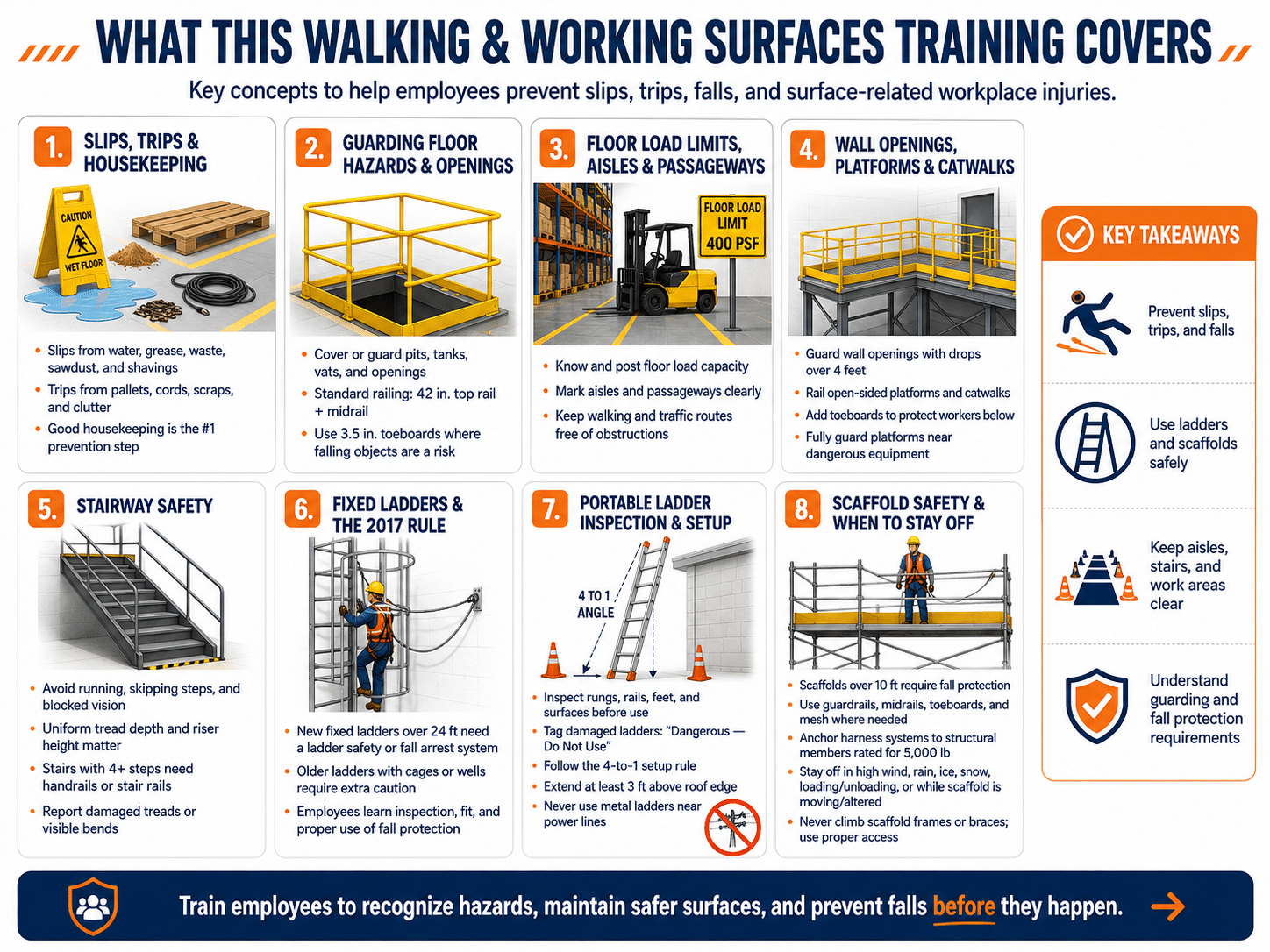
Slips, Trips, and Housekeeping – The program starts where most incidents start — at floor level. Employees learn that almost anything between the sole of a shoe and the floor can cause a slip: rainwater tracked through an entrance, grease and oil near equipment, process waste, and dry materials like sawdust and metal shavings. Even discarded packing material and scraps of cardboard are enough. Trips are framed the same way, as objects that appear in front of a foot unexpectedly — a pallet left in a walkway, an extension cord run across a floor, materials scattered around a construction site. The point the training drives home is that the single most effective control for the largest category of workplace injury is ordinary, consistent housekeeping.
Guarding Floor Hazards and Openings – Some hazards can’t be cleaned up or put away. Ditches, open pits, tanks, and vats have to be covered or surrounded by a railing, and employees learn that this practice — guarding — is what stands between a routine walkway and a fall. The training details the standard railing: a top rail 42 inches high, a midrail at half that height, and vertical uprights to support them, installed around the perimeter of any opening large enough for a person to fall through. It also explains why railings alone aren’t always sufficient. Tools and materials dropped through an opening can injure workers below or land in machinery and energized equipment, creating secondary hazards, which is why toeboards at least 3½ inches tall are required wherever falling objects are a concern.
Floor Load Limits, Aisles, and Passageways – You can’t tell how strong a floor is by looking at it. Employees learn that installing large equipment, storing heavy materials, or driving a loaded forklift across a floor all depend on knowing the load bearing capacity — and that where floor-stressing activities take place, that limit must be posted conspicuously rather than guessed at. The training then addresses traffic. In a busy facility, foot traffic, running equipment, and material handling all compete for the same space, which is why aisles and passageways must be clearly marked. Marking does double duty: it tells people where it’s safe to walk, and it establishes exactly which areas must stay free of clutter and obstruction.
Wall Openings, Platforms, and Catwalks – Openings in walls can be every bit as dangerous as openings in floors. The training covers OSHA’s requirement that wall openings large enough to fall through, with a drop of more than four feet, must have barriers installed across them. Catwalks and other open-sided platforms get the same treatment: standard railings are required whenever a platform or catwalk is four feet or more above the ground, with toeboards added to protect anyone working or passing underneath. Employees also learn the exception that matters most — platforms located above or next to dangerous equipment must be fully guarded regardless of height.
Stairway Safety – Studies have shown that 90% of stairway falls result from the behavior of the people using the stairs, not from a defect in the stairs themselves. The training addresses that directly: running, skipping steps, and carrying loads too large to see over are what put people on the ground. It then covers the design requirements that reduce risk — uniform riser height and tread depth, since irregularities are a leading cause of stair falls, and handrails or stairway rails on any stairway with four or more steps, mounted 30 to 34 inches above the tread surface with at least three inches of clearance for a secure grip. Employees working around heavy-duty permanent stairways also learn that these structures must support at least five times their expected load with a minimum of 1,000 pounds, and that damaged treads or any visible bend need to be reported to a supervisor before they cause a fall.
Fixed Ladders and the 2017 Rule – Fixed ladders are permanently attached to buildings, equipment, and structures, and they can run a considerable distance. For years, cages and wells were considered adequate protection. In 2017, OSHA concluded they were not. Employees learn that any new fixed ladder more than 24 feet long must now incorporate a personal fall arrest system or ladder safety system into its design — typically a body harness connected to a ladder-mounted braking mechanism or a self-retracting lifeline. The training is candid about the transition: many facilities still have older fixed ladders protected only by cages or wells, and those require extra caution on every climb. Where fall arrest systems are installed, employees need to know how to inspect, maintain, don, and use them.
Portable Ladder Inspection and Setup – Portable ladders are convenient precisely because they go where fixed access doesn’t, and the training treats that convenience as something that has to be earned through inspection and setup. Employees learn to check the full ladder before every use — sharp edges and splinters, broken or missing steps, rungs, and cleats, the condition of the feet, and any grease or oil accumulated on rungs and rails. Any ladder that fails inspection comes out of service and gets tagged or marked “Dangerous — Do Not Use.” Setup gets the same detail: both ends firmly positioned, level feet with boards or a ladder jack on uneven ground, fiberglass or wood ladders near power lines or energized equipment and never metal, cones or caution tape in traffic areas, and never a setup outside a door that opens outward unless it’s locked, blocked, or guarded. The training gives employees the practical version of the 75.5-degree rule — the 4-to-1 ratio, placing the base one foot out for every four feet of height — plus the requirement to extend the ladder at least three feet above a roof edge, and a clear prohibition on using a ladder horizontally as a makeshift scaffold or work platform. Portable ladders also have a kit of their own: ladder safety training for general industry goes deeper on selection, inspection and setup.
Scaffold Safety and Fall Protection – Scaffolds are temporary raised platforms supporting workers, tools, and materials, and the training divides them into the two categories employees will encounter: supported scaffolds, held up from underneath, and suspended scaffolds, hung from above. Regardless of type, fall protection is mandatory. Employees learn that scaffolds more than 10 feet off the ground require open sides protected by railings with midrails and toeboards, and that mesh must be installed between the toeboard and guardrail wherever people work or pass underneath. The program then covers personal fall protection in detail — a full-body harness connected to a lanyard anchored to a structural member, or connected to a lifeline or deceleration device secured to an anchor point on the structure being worked on. OSHA requires those anchor points to be substantial structural elements like a girder or I-beam, capable of supporting a minimum dead weight of 5,000 pounds.
When to Stay Off the Scaffold – Sometimes using a scaffold safely means not being on it. Rain increases the chance of a slip, and a strong wind can knock a worker off balance, especially while carrying materials. Ice and snow require clearing and sanding of the planking before anyone steps on. Employees also learn the situational rules that get violated most often: never remain on a platform that’s being moved or altered in any way, stay off during loading and unloading, replace any guardrail that was opened once the work is complete, and never climb the frame or braces of a supported scaffold to reach the platform — use the attached stairs or a ladder.hese 5 key areas is discussed in detail with a focus on avoiding slips, trips, and falls.
Walking and Working Surfaces Training Delivery Methods:
This Walking and Working Surfaces Training is available in English or Spanish language, is available in DVD or USB Stick, and has a run time of just over 18 minutes. We also offer this course as part of our online safety training platform with more than 250 courses at your fingertips.
This Complete Walking and Working Surfaces Training Program Includes These Items:
- Full-length Walking & Working Surfaces safety training video
- Employee quiz and answer sheet
- A “Presenter’s Guide” if you are going to do this training in person
- A printable training sign-in sheet to keep track of your training program
- A printable Certificate of Completion. You can print as many copies of the Certificate as you need
Walking and Working Surfaces Training Video – Full Length Preview:
FAQs on Walking and Working Surfaces Safety Training
Answered by our in-house OSHA Authorized Trainer – Jason Hessom

Have a question for us? Give us a call at 800-859-1870 or, Contact Us Via Email
The program covers the requirements in OSHA’s Walking-Working Surfaces standard, 29 CFR 1910 Subpart D (1910.21–1910.30), including floor and wall openings, guarding, stairways, and ladders. It also addresses scaffold and fall protection requirements found in 29 CFR 1910.27 and 1910.140, along with the construction industry equivalents in 29 CFR 1926 Subparts L, M, and X.
Yes. The training explains that cages and wells are no longer considered adequate fall protection on their own, and that new fixed ladders over 24 feet must be equipped with a personal fall arrest system or ladder safety system. It also addresses what employees should do when working on older fixed ladders still protected only by a cage or well.
With the USB or DVD there are no per-seat fees. One purchase covers your entire organization, whether you’re training five employees or five hundred.
The quiz verifies comprehension of the core concepts — slip and trip hazard recognition, railing and toeboard requirements, floor load limits, stairway rules, ladder inspection and setup, and scaffold fall protection. Completed quizzes can serve as documentation that training was conducted and understood.
This program covers only general industry, however, we do have a specific training program for construction walking and working surfaces safety.
9 reviews for Walking and Working Surfaces Training – [Complete Video Kit]
![Walking and Working Surfaces Training - [Complete Video Kit]](https://www.safetyvideos.com/wp-content/uploads/2022/02/products-61-2-150x150.png.webp)


Liked it a lot
An OSHA focal point so we got some training under our belt. This was good
Essential for avoiding slips and falls.
Our staff liked the video
No complaints at all