
Backhoe Safety Training & Certification – [Full Video Kit]
$239

A backhoe weighs thousands of pounds and can tip, swing, strike, or crush — often with little warning.
Most backhoe accidents aren’t caused by mechanical failure. They’re caused by operators who moved too fast, misjudged their capacity, lost track of a ground worker, or skipped their pre-shift inspection. These are preventable mistakes, and the difference between preventing them and not is knowledge.
This training program covers how backhoes work, how to keep them stable, and what operators and spotters need to know to protect themselves and everyone else on the job site.
Run other loaders too? We also have a Skid Steer Loader Training Video and a Front End Loader Training Video.
WHAT EMPLOYEES WILL LEARN:
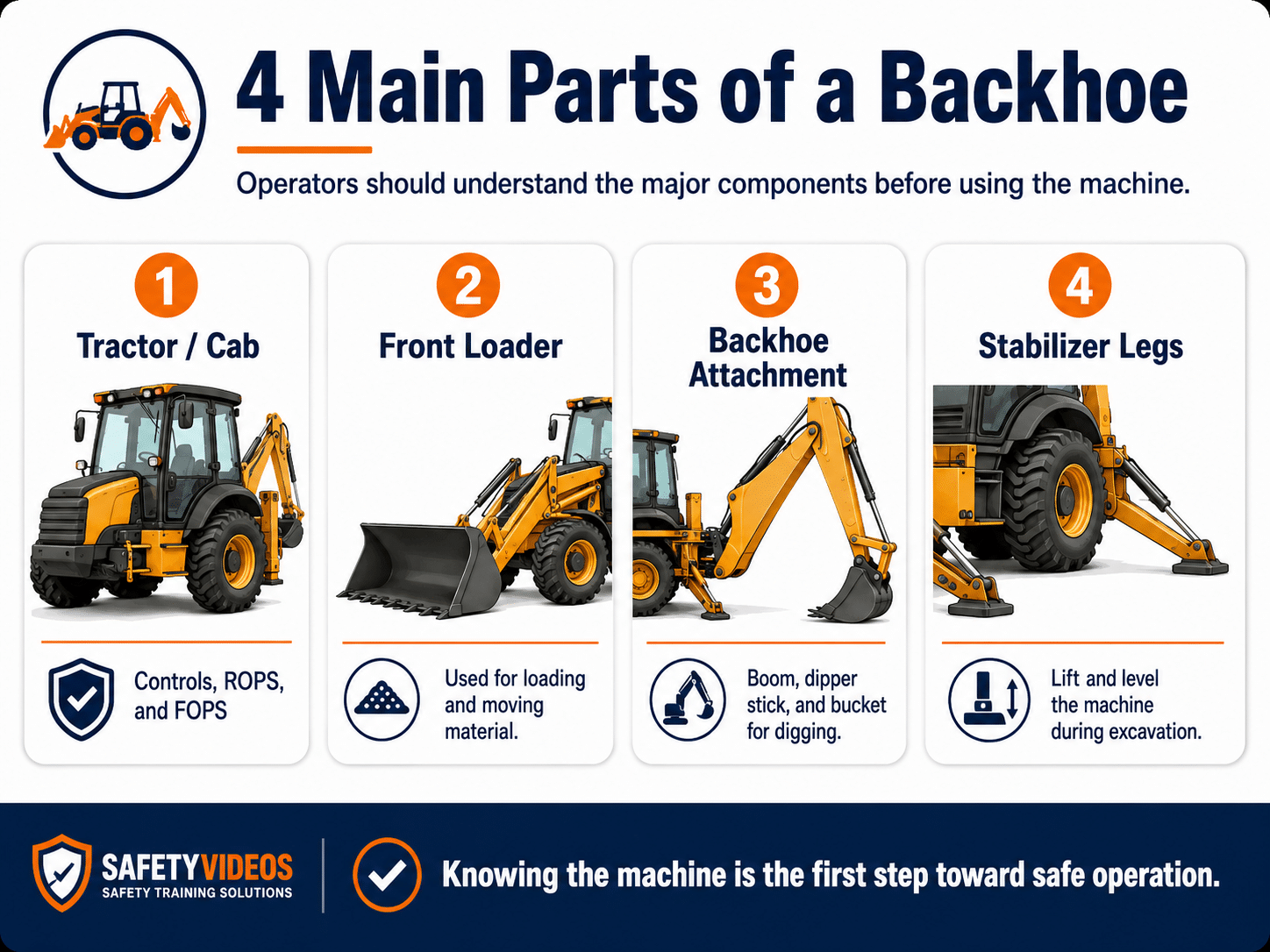
- Identify the major components of a backhoe — tractor, front loader, backhoe attachment, and stabilizer legs — and understand how each affects safe operation
- Understand the purpose and function of the rollover protective system (ROPS) and falling object protective system (FOPS) built into the cab
- Distinguish between a backhoe and similar equipment such as excavators, and know which machine is appropriate for which task
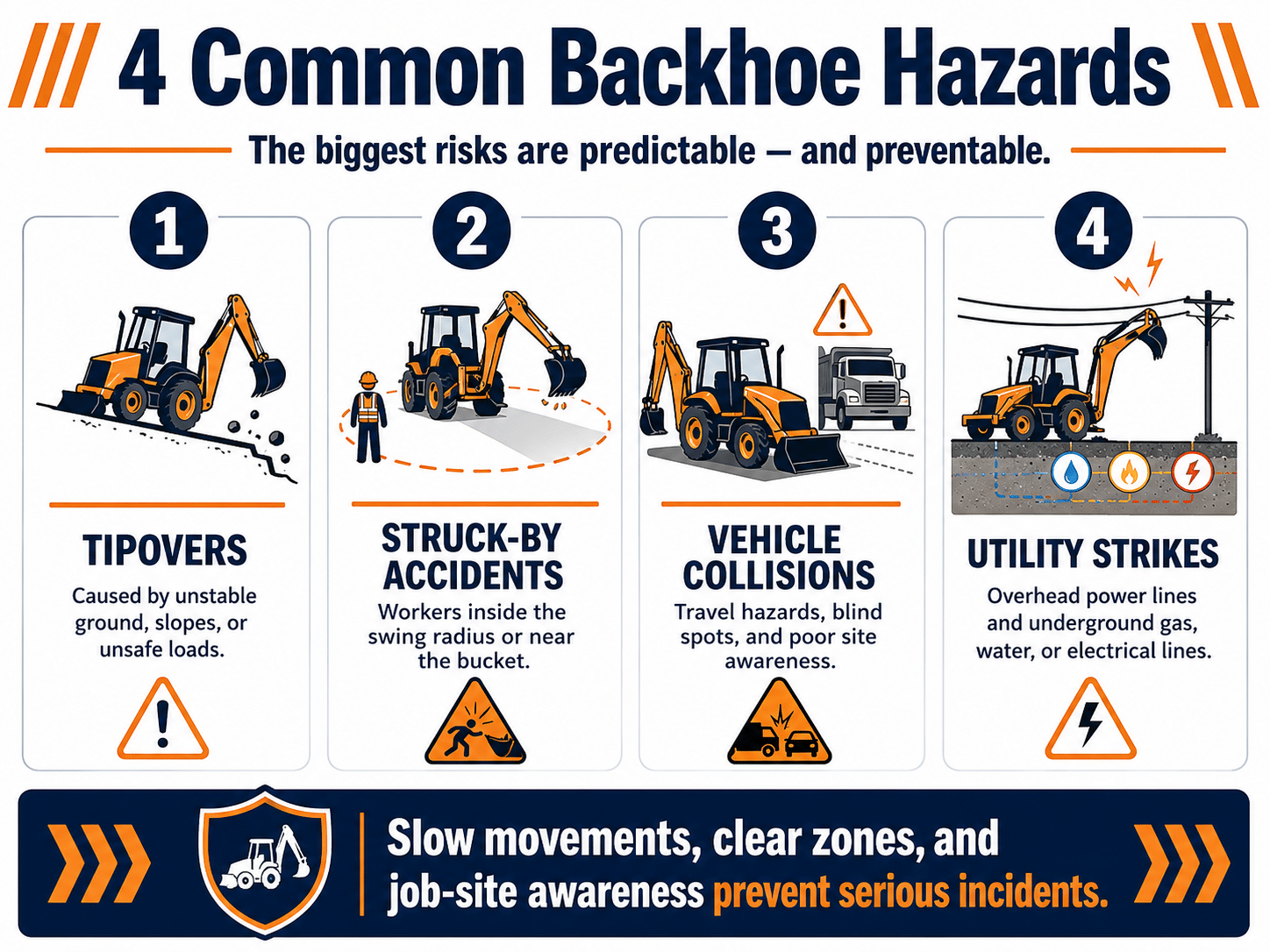
- Recognize the hazards most commonly associated with backhoe operation: tipovers, struck-by accidents, vehicle collisions, and utility strikes
- Know the difference between tipping capacity and rated operating capacity, and stay within safe load limits
- Conduct a thorough pre-shift inspection — including checking hydraulic cylinders using the cardboard test, fluid levels, attachment function, lights, signals, and backup alarm
- Mount and dismount a backhoe safely using three points of contact at all times
- Travel safely on a job site, including proper attachment height, slope navigation, and right-of-way rules
- Deploy stabilizer legs correctly and prevent cave-ins when working near trenches
- Know exactly what to do if the backhoe contacts overhead power lines or begins to tip
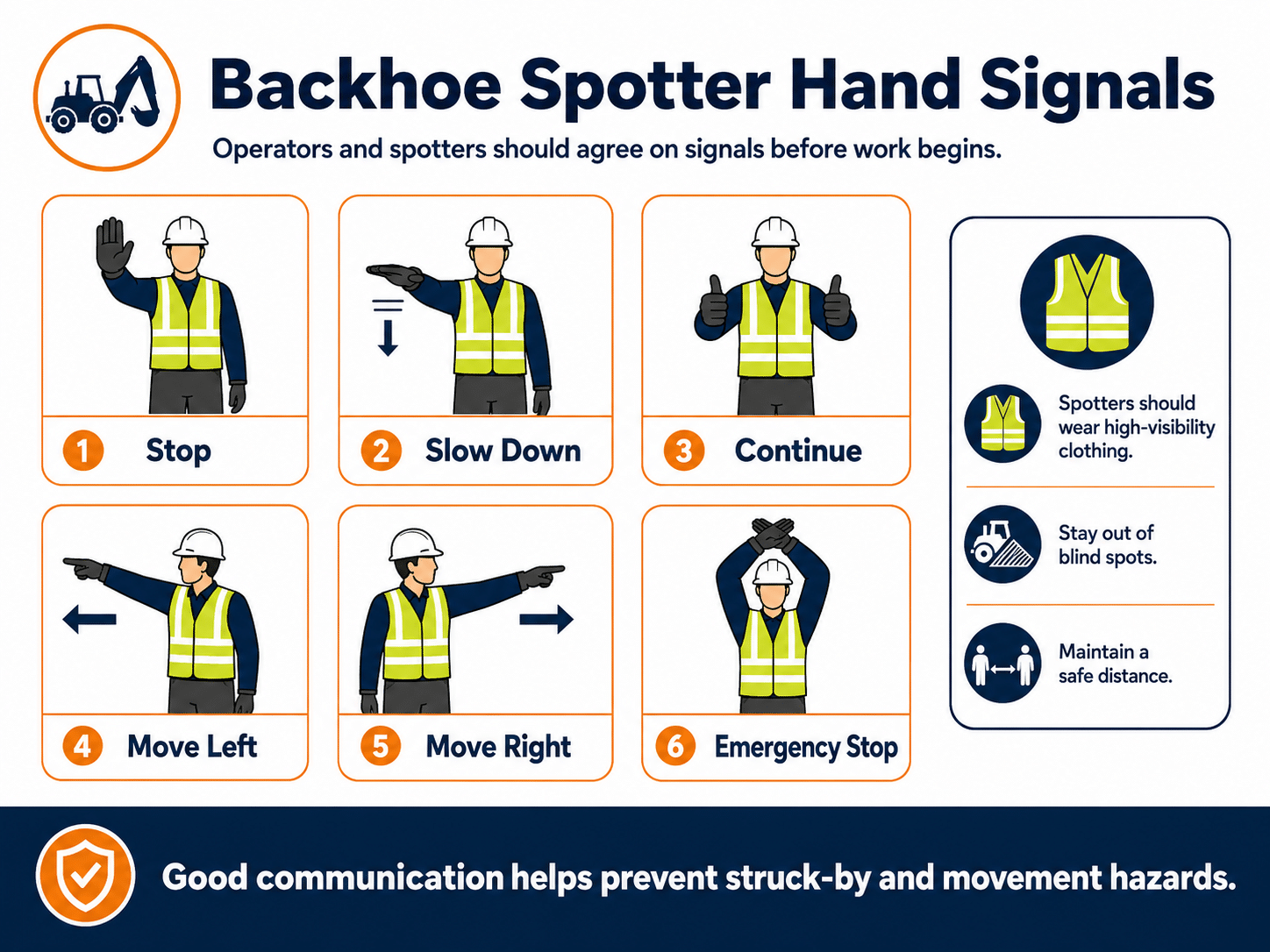
- Communicate effectively as a spotter, including standard hand signals for stop, slow down, move right, move left, continue, and emergency stop
COURSE TOPICS:
Backhoe Components and Functions Before operators can use a backhoe safely, they need to understand what they’re operating. The training covers the four main components: the tractor (cab, controls, ROPS, and FOPS), the front loader, the backhoe attachment (boom, dipper stick, and bucket), and the stabilizer legs that raise the rear wheels to create a level platform during excavation. Employees also learn about common add-on attachments — pallet forks, augers, snowplows, rippers — and why each attachment requires its own separate training before use.
Stability and Load Management Tipovers are among the most dangerous and common backhoe accidents on construction sites. The program explains the two load limits operators must know: tipping capacity — the theoretical maximum in perfect conditions — and rated operating capacity, typically half the tipping capacity, which is the actual safe working limit. Employees learn how ground conditions, slope, load positioning, and travel speed all affect stability, and why slow, consistent movements are always the standard. If a tipover does begin, the training makes clear that staying in the cab with the seatbelt fastened is the correct response — attempting to jump out is far more likely to cause a fatality than staying put.
Common Hazards: Struck-By, Collisions, and Utility Strikes The training covers the three hazard categories that account for the majority of serious backhoe incidents. Struck-by accidents occur when the machine or its load makes contact with a worker — these require constant situational awareness and immediate stops any time a person enters the operating zone. Collisions with other vehicles and structures are addressed through proper travel practices: keeping attachments low, moving slowly, and understanding that loaded equipment has the right of way. Utility strikes — both overhead and underground — receive detailed attention. Employees learn what to do if the backhoe contacts a power line (stay in the cab, call for help, never exit unless there’s fire), and how to identify and mark underground gas, water, and electrical lines before any digging begins.
Pre-Shift Inspection Operators learn to conduct a structured inspection before every shift. With the motor off, this includes checking fluid and oil levels, inspecting hydraulic cylinders using the cardboard test (never bare hands), and looking for loose, worn, or damaged components and illegible cab labels. With the motor running, the inspection continues: exercising controls one at a time, verifying lights and signals, confirming the backup alarm is audible above job site noise, and testing the parking brake. Any failure during inspection means the machine is tagged out of service — period.
Safe Operation: Mounting, Traveling, and Digging The program walks employees through every phase of operating a backhoe safely. Mounting and dismounting require three points of contact at all times. Traveling the job site means keeping attachments low, moving slowly on rough or uneven surfaces, and driving backward up slopes because of the machine’s rear-heavy weight distribution. During excavation, stabilizer legs must have a solid footing — plywood under them if the soil is soft — and no one should ever stand under a raised boom or within its swing radius. Spoil piles go at least three feet from any excavation edge to prevent cave-ins.
Spotter Roles and Hand Signals When operator visibility is limited, a spotter becomes critical — and a spotter who doesn’t know what they’re doing creates new hazards instead of reducing them. The training covers the pre-operation plan that operators and spotters must establish before work begins: agreed-upon hand signals, identified blind spots, known hazards, and the planned movement path. Standard hand signals are covered in detail: stop (closed fist or open palm), continue (bent-elbow arm wave), move right/move left (extended arm with directional point), slow down (palm-down hand wave), and the universal emergency stop (crossed hands pointing in and out repeatedly toward the chest). Spotters learn to wear high-visibility clothing, stay out of blind spots, maintain a safe distance, and keep their attention on both the machine and their own footing.
This Complete Backhoe Safety Training Program Includes These Items:
- Full-length Backhoe Safety training video
- Employee quiz and answer sheet
- A “Presenter’s Guide” if you are going to do the training in person
- A Printable Certificate of Completion. You can print as many copies of the certificate as you need
- A backhoe hands-on operator evaluation form
- Printable operator wallet cards to indicate your operators are certified
- A Backhoe pre-shift inspection form that you can reprint and reuse as many times as you need
- A printable training sign-in sheet to keep track of your training program
- A customizable PowerPoint presentation with talking points
Providing training to your backhoe operators is a key step in reducing injuries and maintaining OSHA compliance. Our training package is available on a USB stick or DVD in English or Spanish. We also offer an online training option that will allow access to our full library of safety training courses.
Full-Length Backhoe Safety Training Video Preview:
WHY THIS TRAINING MATTERS:
Construction accounts for one of the highest rates of heavy equipment fatalities in any industry. Backhoe-related incidents — tipovers, struck-by accidents, and utility strikes — are consistently represented in OSHA enforcement actions and fatality investigations. Beyond the human cost, a single serious incident can trigger OSHA citations, stop-work orders, and liability exposure that far exceeds the cost of training your entire crew. This program gives operators and spotters the knowledge they need before anyone gets behind the wheel.
WHO NEEDS THIS TRAINING:
Any employee who operates or works near a backhoe on a job site, including:
- Backhoe operators and equipment operators in construction and excavation
- Site supervisors responsible for overseeing heavy equipment operations
- Laborers and ground workers who work near operating backhoes
- Spotters assigned to guide backhoe movement
- Utility and pipeline crews performing excavation work
- Landscaping and site preparation crews using backhoe-equipped equipment
Backhoe Certification & OSHA Requirements:
“Backhoe certification” doesn’t mean a government-issued license — OSHA has no backhoe operator card the way many people assume. What OSHA does require is that employers permit only trained, competent employees to operate earthmoving equipment, and that the employer be able to demonstrate that training happened. In other words: the employer certifies the operator, and the documentation is the proof.
That’s exactly what this kit produces. Your operator watches the full training, passes the included quiz, signs the training log, and receives the printable Certificate of Completion — a documented record that you trained and evaluated them on backhoe safety. Pair it with hands-on evaluation on your specific machine (which no video alone can replace) and you have a defensible operator-qualification file.
FAQs on Backhoe Safety Training
Answered by our in-house OSHA Authorized Trainer – Jason Hessom

Have a question for us? Call us at 800-859-1870 or Contact Us Via Email
OSHA has no backhoe-specific training standard. On construction sites, 29 CFR 1926.21(b)(2) requires employers to train each employee to recognize the hazards of their work, 1926.602 sets the operating rules for earthmoving equipment, and 1926.20(b)(4) limits equipment operation to employees qualified by training or experience. This program supports those requirements for backhoe operation: hazard recognition, pre-shift inspection, stability and load limits, safe operating procedures, spotter signals, and emergency response. Pair it with a hands-on evaluation on your own machine and a review of the operator’s manual to complete each operator’s qualification file.
There are no per-seat fees. One purchase covers your entire organization, whether you’re training a single operator or an entire crew across multiple job sites.
The quiz tests comprehension of the core content from the video — backhoe components, stability and load limits, pre-shift inspection steps, safe operation procedures, hazard recognition, and spotter hand signals. Completed quizzes provide documentation that training was delivered and understood.
Yes. The program includes dedicated instruction for spotters, covering hand signals, positioning, blind spots, high-visibility requirements, and the pre-operation communication plan. Both roles are addressed in a single training package.
The core safety principles — stability, load limits, hazard awareness, and pre-shift inspection — apply across configurations. However, the program notes clearly that each specific attachment type requires its own additional training. This course establishes the foundational knowledge every backhoe operator needs, regardless of what attachment they’re running.
There is no government-issued backhoe license for general worksite operation. OSHA requires that only trained, competent operators use earthmoving equipment, and it’s the employer’s job to provide that training and document it. This kit provides the training, quiz, and printable certificate that form the documented half of operator qualification; hands-on evaluation on your machine completes it.
Yes — the training and knowledge-check portion can be completed online through our online course option, or via DVD/USB in a group session. Whichever format you choose, follow it with hands-on familiarization on the specific backhoe your operator will use; equipment-specific evaluation is part of any defensible qualification program.
24 reviews for Backhoe Safety Training & Certification – [Full Video Kit]
![Backhoe Safety Training & Certification - [Full Video Kit]](https://www.safetyvideos.com/wp-content/uploads/2020/09/backhoe2-small-150x150.png.webp)


Best heavy equipment video we have bought.
Covers rated operating capacity versus tipping capacity — exactly what our operators were confused about on site.
Really appreciated the spotter hand signals section. Our ground crew needed this more than the operators did.
The three points of contact rule for mounting and dismounting and slope travel techniques were presented really well.