
Mental Health in the Workplace Training for Managers & Supervisors
$239

Mental health training for managers and supervisors: this 26-minute video teaches the people who run a team how their own choices and behavior affect employee mental health, how to change the work itself when it is doing the damage, how to build a mental health safety plan, how to approach an employee who is struggling and refer them to help without acting as a therapist, and how a leader protects their own mental health while carrying everyone else’s.
A recent poll cited in the program found that about 70% of employees say their boss affects their mental health more than their doctor or their therapist. That is the premise of this video: a supervisor is the single biggest workplace influence on how a team feels, and most supervisors were never trained for it. The program treats mental health as part of the health, safety and well-being a supervisor is already responsible for, and gives them a practical method rather than a lecture.
It is the companion to our mental health training for employees, which covers the worker’s side: warning signs, self-care and using company resources. The two scripts share an opening definition of mental health and then go in different directions; this one spends most of its running time on work design, the difficult conversation, EAP referral and the leader’s own limits. Sold as a DVD or USB kit with the quiz, sign-in sheet and certificate you need to document the session.
What the Manager Mental Health Training Covers
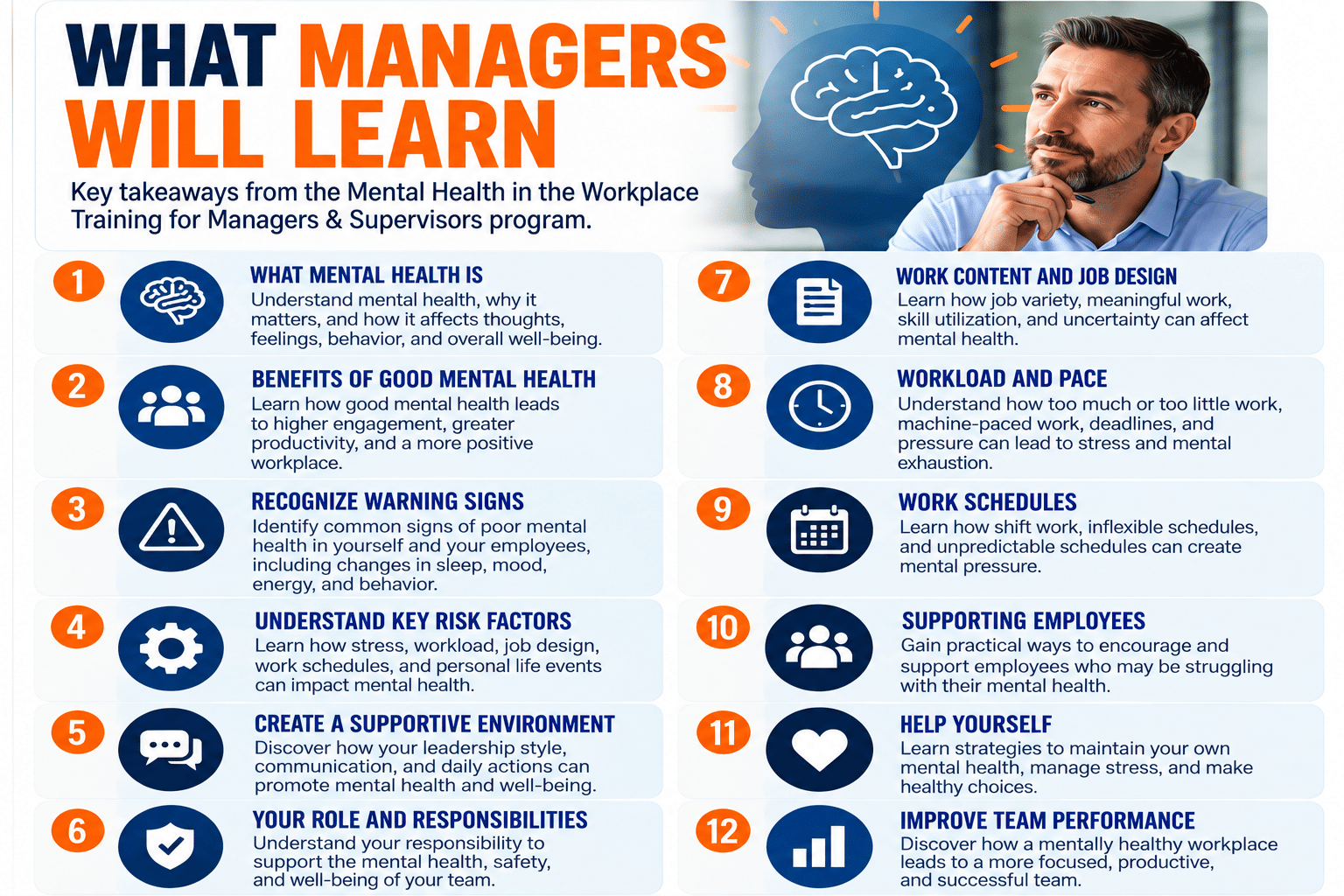
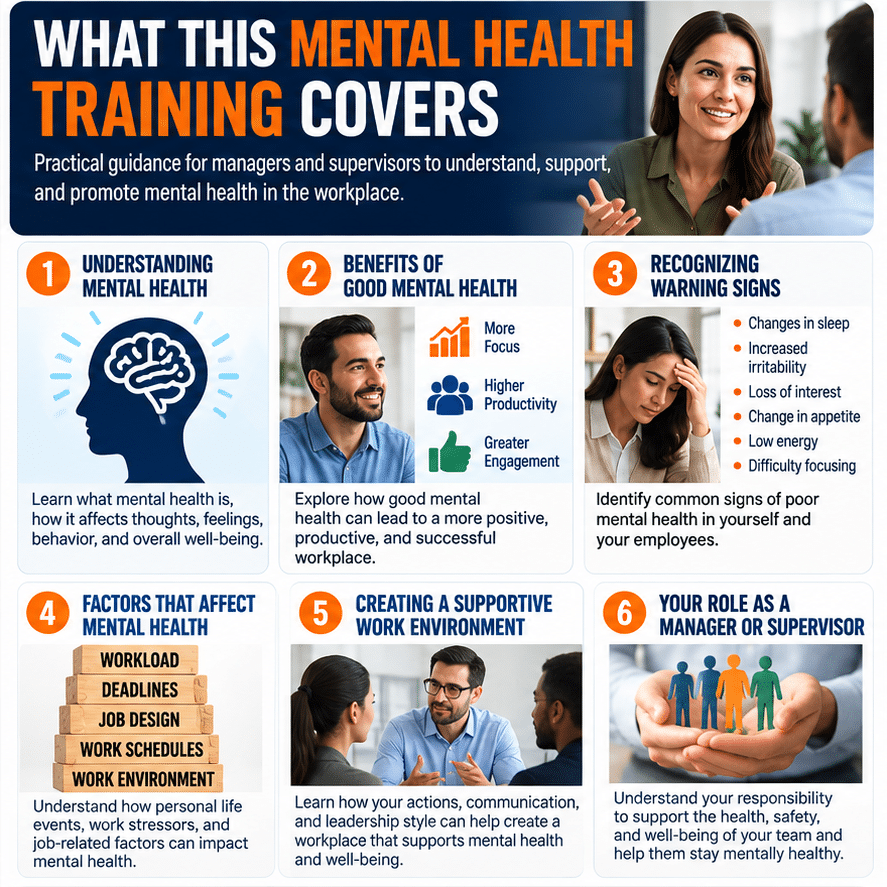
- What mental health is and why a supervisor has a responsibility to support it as part of the health, safety and well-being of the team
- The red flags of poor mental health in an employee, and in yourself: sleep problems, irritability, withdrawal from things they enjoyed, appetite and energy changes, confusion, forgetfulness, mood swings and missed responsibilities
- How the physical environment affects mental health: dirty, crowded or unsafe conditions, and why they cost productivity as well as well-being
- The work content and design factors that exhaust employees: no variety, short cycles, fragmented or meaningless tasks, underused skills and high uncertainty
- Workload, pace and schedules: too much or too little to do, machine-paced work, constant deadlines, shift work, inflexible or unpredictable hours, night shifts and isolation
- A practical method for fixing what you can: identify the elements of the job that hurt, ask employees what creates the most stress, and make adjustments to the work process
- Building a mental health safety plan with employees: clear policies on work-related mental health concerns and a route to support
- Bullying, harassment and abuse as a mental health hazard: setting a zero tolerance policy, publishing the consequences, encouraging reports and taking every complaint seriously
- Why open, honest and consistent communication of expectations lowers anxiety, and why being visibly accessible motivates a team
More Topics in the Mental Health for Managers Video
- Reading the behavior that signals a struggle: a drop in work quality, erratic behavior, or a reliable employee who starts calling out
- Why employees hide mental health problems from their supervisor, how stigma works, and when the manager should make the first move
- How to respond when the employee brings it up first: thank them, then ask what you can do to help
- How to initiate the conversation: pick a quiet, private time and place, explain the concern, describe what you have seen and heard factually, and let the employee explain in their own words what is happening and what they need
- The line a supervisor does not cross: listen and support, do not diagnose and do not play therapist; point the employee to the right resource
- Using the employee assistance program: suggesting the EAP as a first step, and when and how to make a formal EAP referral for evaluation
- Staying professional: being clear and honest about job expectations and the consequences of not meeting them, while still providing the resources to meet them
- Building an action plan with the employee: the adjustments you will make, a timeline for performance improvement and a schedule of follow-up meetings
- When to involve human resources: accommodation requests beyond your authority and company policy on supporting employees with mental health conditions
- The EAP’s behavioral health professional as a resource for managers who need advice on handling a situation
- Building a mentally healthy team culture: mindfulness and meditation seminars, health and wellness materials, healthy snacks, outdoor lunches and after-work activities
- The full menu of company resources, from EAP assessments and counseling to brochures, workshops and mental health apps, and how to use them to educate the team
- The leader’s own mental health: why the pressures of leadership make it harder, delegating to reduce your load and develop your team, and when to go to another leader or your own supervisor for support
- Leaving work at work: setting boundaries between your professional and home life, practicing self-care, and why a leader should never be afraid to ask for help
What Is in the Manager Mental Health Training Kit:
- Full-length Mental Health in the Workplace training video for managers and supervisors (26:46, English)
- Employee quiz and answer sheet
- A “Presenter’s Guide” if you are going to do this training in person
- A printable training sign-in sheet to keep track of your training program
- A printable Certificate of Completion. You can print as many copies of the Certificate as you need
How You Can Deliver the Training
The kit ships on DVD or USB stick. Run it in a supervisor meeting, a new-manager onboarding class or a leadership workshop, hand out the quiz, and file the answer sheet, sign-in sheet and certificate with your training records. Everything in the kit can be reused for every newly promoted supervisor and every refresher. If you would rather assign the course online with automatic completion tracking, this program is also in our online safety training library of 250+ courses.
Mental Health in the Workplace Training Video for Managers & Supervisors – Full Length Preview:
Mental Health Training Requirements for Managers and Supervisors
What OSHA and the EEOC Expect of a Supervisor
No OSHA standard requires mental health training for managers. The employer’s obligation comes from the General Duty Clause, Section 5(a)(1) of the OSH Act, which requires a workplace free from recognized hazards, and OSHA lists workplace stress among them on its Workplace Stress page, with guidance written specifically for employers and managers. The supervisor is the person who carries that duty on the floor, which is why this program focuses on work design, scheduling, communication and the conditions a supervisor controls.
The conversation and accommodation sections of the video touch a second set of rules. Under the Americans with Disabilities Act, an employee with a mental health condition may be entitled to a reasonable accommodation, and a supervisor who learns of a condition has to keep it confidential and route accommodation requests through the process the company and HR have set up. The video’s instruction to stay professional, focus on work-related issues, not diagnose, and go to HR when a request exceeds your authority is how a supervisor stays on the right side of that law. This kit supports the employer’s General Duty Clause and ADA obligations and documents the training; it does not make a supervisor a counselor or an HR specialist.
Who Needs This Training
- Every first-line supervisor, lead and foreman, the people employees actually report to day to day
- Newly promoted supervisors, before they run their first team meeting
- Department managers, shift managers and site managers who set workloads, schedules and pace
- HR staff and safety managers who field the referrals and accommodation requests this program teaches supervisors to make
- Owners and executives of small companies who supervise directly
How Often to Train
No regulation sets an interval. The schedule most employers use:
- On promotion or hire into any supervisory role
- Once a year as a refresher, which is what the quiz and presenter’s guide are built for
- Before a reorganization, a schedule change or a layoff, when the team’s mental health is about to be tested
- After an incident: a complaint, an EAP referral that went badly, or a critical event on site
Which Version Do You Need?
This is the managers and supervisors version. The employee version is a separate 28-minute program written to the worker: recognizing their own warning signs, the workplace factors that affect them, self-care at work and at home, and how to use the EAP and other resources. Most companies run both, the employee program for the workforce and this one for the people who lead it. Three of the hazards this video names have their own programs: our workplace stress training for the stress topic in depth, our harassment training for managers and supervisors for the zero tolerance policy the video calls for, and our workplace violence training for the point where a toxic workplace becomes a dangerous one. All of our people-side programs are in the Human Resources category.
FAQs on Mental Health Training for Managers and Supervisors
Answered by our in-house OSHA Authorized Trainer – Jason Hessom

Have a question for us? Call us at 800-859-1870 or Contact Us Via Email
This 26-minute program teaches supervisors how their behavior and decisions affect employee mental health, how to spot the red flags in an employee, how to change work design, workload and schedules that are doing harm, how to build a mental health safety plan and a zero tolerance policy for bullying and harassment, how to approach an employee who is struggling and refer them to the EAP, how to build an action plan with follow-up, when to involve HR, and how a leader protects their own mental health. It comes with a quiz, answer sheet, presenter’s guide, sign-in sheet and certificate.
No OSHA standard requires it. The employer’s duty comes from the General Duty Clause of the OSH Act, which OSHA applies to workplace stress as a recognized hazard, and from the Americans with Disabilities Act, which governs how a supervisor handles an employee’s mental health condition and any accommodation request. This program supports both obligations and documents the training; it does not claim to meet a standard that does not exist.
The employee version is written to the worker and spends its time on self-awareness, self-care and using company resources. This version is written to the supervisor and spends its time on the things only a supervisor controls: the design and pace of the work, schedules, the safety plan, the conduct policy, the one-on-one conversation, the EAP referral, the action plan and the HR hand-off. It also has a section on the leader’s own mental health that the employee version does not. They are two different scripts.
Yes, step by step. If the employee raises it, thank them and ask what you can do. If you raise it, pick a quiet, private time and place, say why you are concerned, describe factually what you have seen and heard, and let the employee explain what is happening and what they need. Listen, show support, do not diagnose, point them to the EAP, then build an action plan with a timeline and follow-up meetings while staying clear about job expectations.
No, and the video is explicit about it. A supervisor’s job is to notice, to listen, to adjust what they can in the work, and to refer the employee to the EAP or another professional resource. Diagnosing, counseling or trying to be a therapist is outside the role and creates legal exposure under the ADA.
Go to human resources. The video tells supervisors to ask HR about the company’s policy for supporting employees with mental health conditions whenever a request exceeds their authority, and to use the EAP’s behavioral health professional for advice on handling the situation. Accommodation decisions under the ADA belong to the process the company has set up, not to an individual supervisor.
A 26-minute 46-second English video on DVD or USB stick, plus the trainee quiz and answer sheet, a presenter’s guide, a sign-in sheet and a Certificate of Completion that is editable (name and date) and reusable for every supervisor. The same program is available in our online training library.
Yes. The last section is about the leader: why the pressures of leadership make it harder to stay mentally healthy, delegating to reduce your own load and develop your team, going to another leader or your own supervisor for support, setting boundaries between work and home, practicing self-care, and using the EAP yourself instead of treating it as something for other people.


![California Workplace Violence Training - [Complete Video Kit]](https://www.safetyvideos.com/wp-content/uploads/2024/08/California-Workplace-Violence-Preview.png.webp)
Reviews
There are no reviews yet