
Personal Protective Equipment (PPE) Training Video – [Complete Kit]
$239

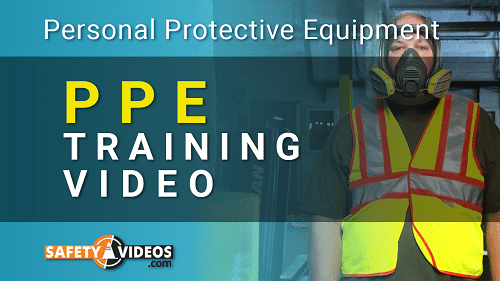
The OSHA Standard for Personal Protective Equipment is an important one to teach your employees the ins and outs of Personal Protective Equipment, also known as PPE. This PPE training video will teach your workers the importance of using proper Personal Protective Equipment while performing their daily job tasks. PPE is defined as anything you wear to prevent injuries, which can include hard hats, safety glasses, gloves, hearing protection, and proper footwear.
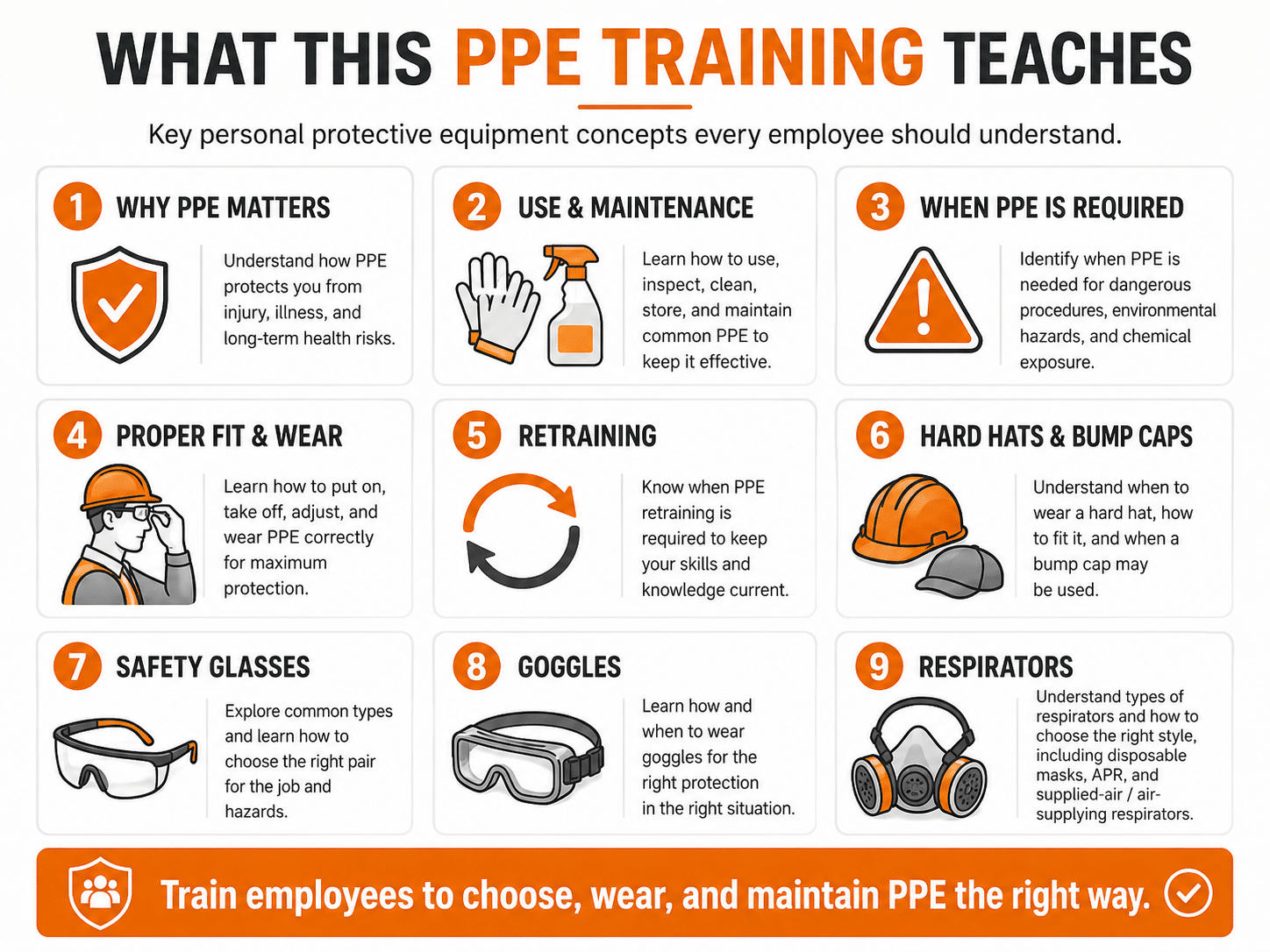
This Personal Protective Equipment Training Will Teach Your Employees These Key Concepts:
- Why do employees need to wear Personal Protective Equipment?
- How to use and maintain common pieces of PPE
- What are the conditions in which PPE would be required? (i.e. Dangerous procedures, areas with environmental hazards, using chemicals on the job, etc)
- How to properly put on, take off, adjust and wear your Personal Protective Equipment
- How often is re-training necessary when it comes to Personal Protective Equipment?
- Under what conditions should you wear a hard hat, how to properly fit a hard hat, and when might a bump cap be used?
- What are the most common types of safety glasses and how to select a proper pair for the jobs you do and the hazards you might encounter
- How and when to wear goggles
- What are the different types of respirators that are available and how to choose the proper style for the work you are doing (disposable masks, Air Purifying Respirators (APR), Air Supplying Respirators (ASR), etc
PPE Training Additional Topics of Discussion:
- What is a self-contained breathing apparatus and how do you use one?
- What are the different advantages and disadvantages of each respirator type?
- What are the different types of gloves available and how are they selected and used? (leather, metal mesh gloves, disposable gloves, rubber and plastic gloves, etc)
- How to inspect your PPE to ensure that it is safe to use
- What are the different types of foot protection available and how to select and use them (boots, conductive footwear, toe guards, foot and shin guards, leggings, etc)
PPE Training Delivery Options:
This PPE safety training program ships on DVD or USB stick, in English or Spanish, and the video runs about 18 minutes — short enough to fit a shift meeting or a new-hire orientation, and long enough to cover every category of protective equipment your employees are likely to be issued. The same program works for first-time training and for refresher training, and because you own it outright there is no per-employee fee and no expiration date on the materials.
If you would rather not manage discs, this training is also available as an online course — either on its own or as part of our online library of 250+ safety training courses. The online version tracks completions for you and issues each employee a certificate automatically, which suits companies training across multiple sites or onboarding people one at a time.
This Complete PPE Safety Training Program Includes These Items:
This is a complete PPE training program, not just a video. Everything below comes with the one-time purchase and is yours to keep and reuse — for every new hire, every refresher, and every time you add a new piece of protective equipment to the job.
- The full-length PPE safety training video — 18 minutes, on DVD or USB, in English or Spanish
- An employee quiz to document that each worker understood the training
- The answer sheet for the quiz
- A Presenter’s Guide for leading the session in person
- A printable training sign-in sheet to record who attended and when
- An editable Certificate of Completion — fill in the employee’s name and the training date and print as many copies as you need, for as many employees as you need
Why OSHA Requires PPE Training
Personal protective equipment is the last line of defense on a job site. Every other control — engineering the hazard out, guarding it, changing how the work is done — happens before PPE is ever issued. By the time a worker is putting on a hard hat or pulling on chemical-resistant gloves, that equipment is all that stands between them and the hazard. Which is why OSHA does not simply require employers to hand out PPE. It requires them to train the people who wear it.
The rule is 29 CFR 1910.132(f)(1), and it is unusually specific about what employees have to come away knowing. Each employee required to use PPE must be trained to know at least five things: when PPE is necessary, what PPE is necessary, how to properly don, doff, adjust and wear it, the limitations of the PPE, and the proper care, maintenance, useful life and disposal of the PPE.
This program covers all five. It works through the conditions that require protective equipment — dangerous procedures, environmental hazards, chemical and radiological hazards, and mechanical irritants — then takes each major category of equipment in turn: head, eye and face, respiratory, hand, and foot and leg protection. For each one it shows how to put the equipment on, adjust it and take it off, what that type can and cannot protect you against, how to inspect it before use, and how to recognize when a piece of equipment has reached the end of its useful life and needs to be taken out of service.
Two responsibilities stay with you as the employer, and no training program from any vendor can take them on. The first is the hazard assessment: 1910.132(d)(1) requires you to survey your own workplace, decide which hazards call for PPE, select equipment that properly fits each affected employee, and communicate those selections — and 1910.132(d)(2) requires you to verify that assessment through a written certification. The second is the demonstration step: under 1910.132(f)(2), each affected employee must demonstrate an understanding of the training and the ability to use PPE properly before being allowed to do work that requires it. The program tells your employees that step is coming, but the quiz in this kit documents the understanding and you confirm the hands-on ability at your own site.
There is no expiration date on PPE training and no fixed retraining interval in the standard. Instead, 1910.132(f)(3) requires retraining whenever changes in the workplace or in the types of PPE used make previous training obsolete, or whenever an employee’s knowledge or use of assigned PPE shows they have not retained the skill. Because this program is yours to keep, the same materials cover the retraining as many times as you need them.
One point worth settling before you train: with narrow exceptions, the employer pays. Under 1910.132(h)(1) the protective equipment used to comply with OSHA’s standards must be provided by the employer at no cost to employees, and the employer must pay for replacement PPE unless an employee lost it or damaged it on purpose. The exceptions are limited — non-specialty safety-toe footwear and non-specialty prescription safety eyewear that employees are allowed to wear off the job site, everyday clothing, and ordinary weather gear. If that question comes up in your workplace, our article on whose responsibility it is to provide and pay for PPE goes through it in detail.
Who Needs PPE Training
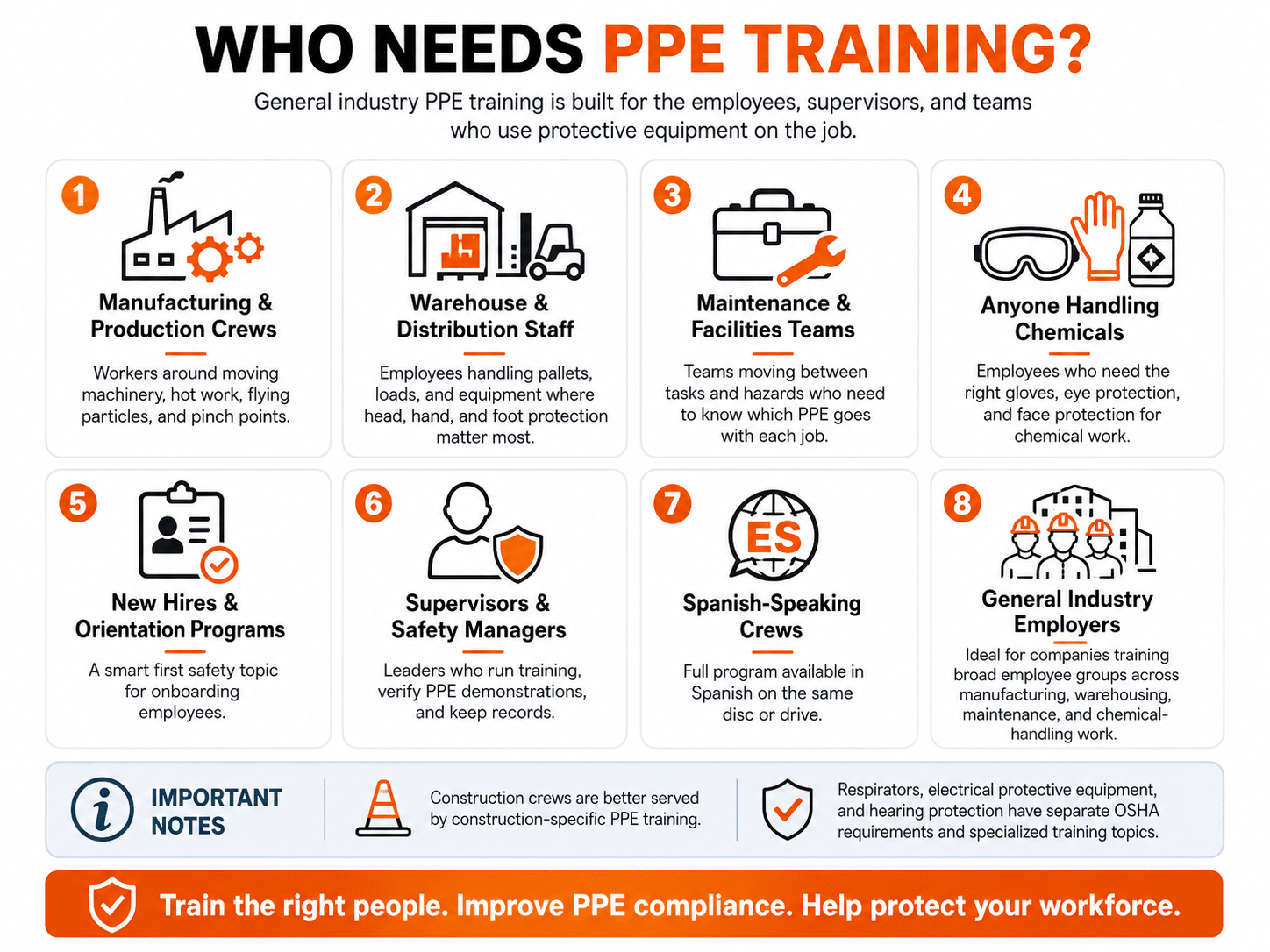
PPE cuts across every industry, which is why this program is written for general industry rather than for one trade. It is built for:
- Manufacturing and production crews working around moving machinery, hot work, flying particles, and pinch points
- Warehouse and distribution staff handling loads, pallets, and equipment where head, hand, and foot protection matter most
- Maintenance and facilities teams who move between tasks and hazards in a single shift and need to know which equipment goes with which job
- Anyone handling chemicals — glove selection, eye and face protection, and the limits of each are covered directly
- New hires and orientation programs, where PPE is usually the first safety topic a worker is given
- Supervisors and safety managers who have to run the training, verify the demonstration required by 1910.132(f)(2), and keep the records
- Spanish-speaking crews — the full program is available in Spanish on the same disc or drive
- Construction crews, who are better served by our construction PPE training video — same subject, written for the job site
Two categories of protective equipment carry their own OSHA standards and their own training requirements, and this program introduces them rather than covering them in full. Respirators are one: if your employees wear them, 29 CFR 1910.134 requires a written program, medical evaluation and fit testing, and our respiratory protection training is built for that. Electrical protective equipment is the other — rubber insulating gloves and sleeves fall under 1910.137, and crews working on or near energized equipment need arc flash safety training as well. Hearing protection is not covered here at all; noise exposure is a separate standard, and hearing conservation training handles it. Our full range of PPE training videos covers each of these.
PPE Training Video – Full Length Preview:
Frequently Asked Questions About PPE Training
Answered by our in-house OSHA Authorized Trainer – Jason Hessom

Have a question for us? Call us at 800-859-1870 or Contact Us Via Email
It covers everything the training rule requires your employees to know, and one step stays with you. Under 29 CFR 1910.132(f)(1), each employee required to use PPE must be trained to know at least five things: when PPE is necessary, what PPE is necessary, how to properly don, doff, adjust and wear it, the limitations of the PPE, and the proper care, maintenance, useful life and disposal of the PPE. This program covers all five, and the quiz documents that each employee understood them. What no video can do for you is paragraph (f)(2), which requires each affected employee to demonstrate an understanding of the training and the ability to use PPE properly before being allowed to perform work requiring PPE. The program tells your employees that step is coming, but you are the one who confirms it, at your own workplace, with the equipment your people actually wear.
It introduces both, but neither in the regulatory sense, and the distinction matters. The program covers the three types of respirators, the cartridges air-purifying respirators use, the difference between a self-contained breathing apparatus and a supplied air respirator, and what a fit test is and why it matters. It also covers rubber insulating gloves and sleeves, including daily inspection and how to spot the damage that takes them out of service. That is PPE awareness, so employees understand where this equipment fits among what they may be issued. It is not a respiratory protection program and it is not an electrical safety program. OSHA keeps both separate: 29 CFR 1910.132(g) states that the PPE hazard-assessment and training paragraphs do not apply to sections 1910.134 and 1910.137. If your employees wear respirators, 29 CFR 1910.134 requires a written respiratory protection program, a medical evaluation before an employee is fit tested or required to use a respirator, fit testing for tight-fitting facepieces before first use and at least annually after that, and respirator-specific training. Our Respiratory Protection Safety Training program is built for that, and our Arc Flash Safety Training covers work on or near energized equipment.
The program works through the categories most employees are issued in general industry. Head: when a protective helmet is required, how to fit one so it is neither too tight nor too loose, hard hats rated for electrical hazards, ANSI compliance, and why a light-duty bump cap must never be used where conditions call for a hard hat. Eye and face: safety glasses and side shields, filter lenses and shade numbers for welding and laser work, goggles including wearing them over prescription glasses, contact lens considerations, face shields, and welder’s helmets. Respiratory: the three types of respirators, why the wrong cartridge can be the same as no cartridge at all, and what a fit test is. Hand: cloth, leather and aluminized, metal mesh, disposable, and rubber and plastic gloves, including how to spot the damage that puts an insulating glove out of service. Foot and leg: steel toes, puncture-resistant insoles, heat-resistant soles, non-conductive boots, conductive footwear, toe guards, tarsal guards, shin guards, and leggings. It also covers the conditions that require PPE in the first place, and how to inspect each type of equipment before you put it on. The video runs 18 minutes.
OSHA does not set an expiration date or a fixed interval for PPE training. 29 CFR 1910.132 has no annual requirement. What it has instead is paragraph (f)(3), which requires the employer to retrain an employee whenever there is reason to believe that employee no longer has the understanding and skill the standard calls for. The standard names three situations specifically: when changes in the workplace make the previous training obsolete, when changes in the types of PPE being used make it obsolete, and when inadequacies in an employee’s knowledge or use of assigned PPE show they have not retained what they learned. Many employers also refresh PPE training annually as a matter of policy. Because this program is a one-time purchase that you keep, you can run it as often as you need at no additional cost.
No to both, and it is worth being precise about it. There is no OSHA PPE certification for employees. No such credential exists, and no training provider can issue one. And unlike some other OSHA standards, 29 CFR 1910.132 does not require any written certification of training: paragraph (f) covers the training content, the employee demonstration, and retraining, and stops there. The written certification required by 1910.132(d)(2) is for your workplace hazard assessment, not for training. The Certificate of Completion included in this kit is therefore a voluntary training record, but it is still the simplest way to show an inspector, an insurer or a client who was trained and when. It is editable and completely reusable: fill in the employee’s name and the training date, print it, and use it again for the next person.
No, and nothing can. Under 29 CFR 1910.132(d)(1), the employer must assess the workplace to determine whether hazards are present, or likely to be present, that make PPE necessary. If they are, the employer must select the types of PPE that will protect each affected employee, communicate those selection decisions to them, and select PPE that properly fits each affected employee. Paragraph (d)(2) then requires you to verify that the assessment was done through a written certification that identifies the workplace evaluated, the person certifying it, the date or dates of the assessment, and the document itself as a certification of hazard assessment. That is an assessment of your site, your processes and your people, and it is the one PPE document OSHA requires in writing. This program picks up where the assessment leaves off: once you know which equipment your employees need, it teaches them to use it properly.
The program ships on DVD or USB stick, in English or Spanish, and the video runs about 18 minutes. The purchase includes the full-length video, an employee quiz with its answer sheet, a Presenter’s Guide for leading the session in person, a printable training sign-in sheet, and an editable Certificate of Completion. It is a one-time purchase with no per-employee fee, so you can train as many employees as you need, as many times as you need, and reuse the materials for refresher training.
Yes. The same PPE training is available as an online course, either on its own or as part of our online library of 250+ safety training courses. The online version suits companies training people across several locations or onboarding one employee at a time, because completions are tracked automatically and each employee receives a certificate when they finish. The DVD and USB version suits group training, where a supervisor runs the session in a room using the Presenter’s Guide and the sign-in sheet. The training content is the same either way.
17 reviews for Personal Protective Equipment (PPE) Training Video – [Complete Kit]
![Personal Protective Equipment (PPE) Training Video – [Complete Kit]](https://www.safetyvideos.com/wp-content/uploads/2022/02/products-82-2-150x150.png.webp)


Comprehensive and clear, perfect for all employee levels. Highly recommend.
Provides good overview of Personal Protective Equipment. Our staff liked it.