
Respirable Crystalline Silica: The Exposure Limits and Employer Requirements I Wish Every Contractor Knew

Quick Answer: What Is OSHA’s Exposure Limit for Respirable Crystalline Silica?
OSHA caps worker exposure to respirable crystalline silica at a permissible exposure limit (PEL) of 50 µg/m³, averaged over an 8-hour day, with an action level of 25 µg/m³ (also an 8-hour average) that triggers exposure monitoring and medical surveillance. The rules live in 29 CFR 1926.1153 (construction) and 1910.1053 (general industry).
What Is Respirable Crystalline Silica, Exactly?
The word that matters is respirable. We are not talking about the sand you can see and brush off your sleeve. Respirable crystalline silica is the fraction so fine it gets past your body’s defenses and lodges deep in the lungs, and you generate it whenever you cut, grind, drill, or crush materials that contain silica. That means concrete, brick, block, stone, mortar, and engineered stone countertops, which are some of the worst offenders I have ever sampled.
Here is the part I stress to crews: the dangerous dust is the dust you cannot really see hanging in the air. By the time the visible cloud is thick, the respirable fraction has been elevated for a while. People judge their exposure by what they can see, and with silica that instinct is exactly backward.
What Is Table 1, and Why Should You Be Using It?
| Task / equipment | Specified control (Table 1) | Respiratory protection |
|---|---|---|
| Stationary masonry saw | Integrated water delivery (wet cutting) | Table 1 specifies the respirator by task and by duration (commonly a ≤4 hours/shift vs >4 hours/shift split). Read the respirator column directly off the current Table 1 for each task — do not assume. |
| Handheld masonry / cut-off saw | Integrated water delivery (wet cutting) | |
| Walk-behind saw | Integrated water delivery (wet cutting) | |
| Handheld grinder — mortar removal (tuckpointing) | Commercial dust shroud + HEPA vacuum dust collection | |
| Handheld grinder — uses other than mortar removal | Water delivery or shroud + vacuum | |
| Handheld / stand drills | Shroud or cowling + HEPA vacuum dust collection | |
| Jackhammers / handheld powered chipping | Water delivery or dust collection system | |
| Dowel drilling rigs (concrete) | Shroud + HEPA vacuum; plus respirator | |
| Walk-behind milling / surfacing machines | Water delivery or vacuum dust collection |
This is the question I wish more construction employers asked me, because Table 1 in 1926.1153 is, frankly, a gift. It lists common construction tasks, the saws, drills, grinders, and so on, and pairs each one with a specified control method, things like a water delivery system on the saw or a vacuum dust collection shroud, plus the respiratory protection required for that task.
The reason it matters is this: if you fully and properly implement the control for your task as Table 1 spells it out, you are deemed to be in compliance, and you do not have to do exposure monitoring for that task. That is a real break. Follow the recipe completely, and you skip the air sampling. The catch is the word fully. I see people run the saw with the water turned off, or use the vacuum without the right filter, and then assume they are still covered by Table 1. You are not. Partial compliance with Table 1 is just non-compliance with extra steps.
If your task is not on Table 1, or you choose not to follow it, then you are on the alternative path: assess actual exposures and keep them at or below the PEL through your own controls.

When Is Medical Surveillance Required?
This is one of the most commonly missed pieces, so know the trigger. Under the construction standard, you have to offer medical surveillance to any employee who is required to wear a respirator for silica for 30 or more days in a year. Under the general industry standard, the trigger is exposure at or above the action level for 30 or more days a year. The exam includes things like a work and medical history, a physical, a chest X-ray read by a qualified reader, and a pulmonary function test.
The mistake I see is employers tracking respirator use loosely, or not at all, so they genuinely do not know when an employee crossed the 30-day line. If you are putting people in respirators for silica work, count the days. That number is not just paperwork, it is the thing that determines whether you owe someone a medical exam that could catch early disease.
What Has To Be In a Written Exposure Control Plan?
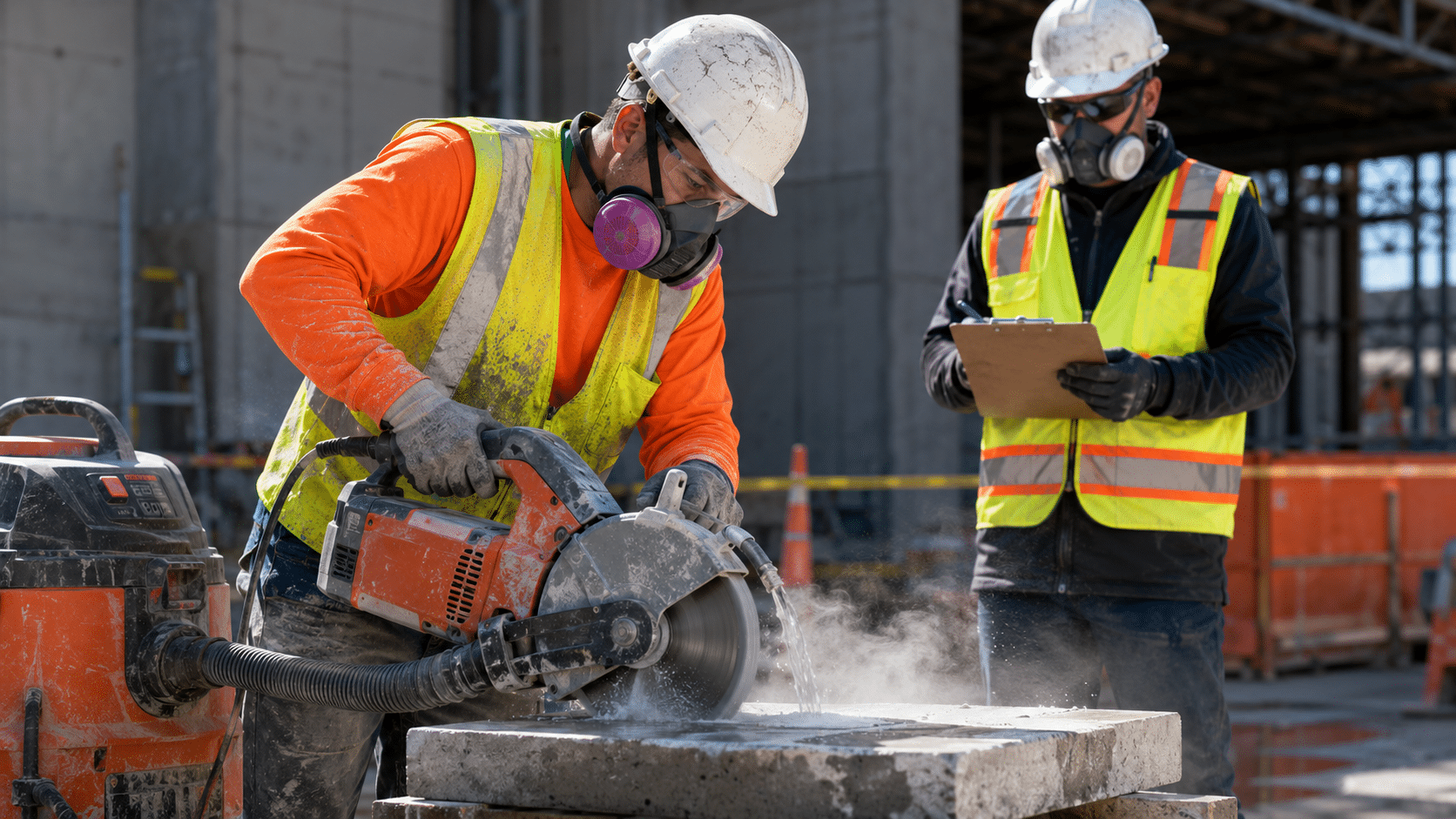
Both standards require a written exposure control plan, and it is not a fill-in-the-blank afterthought. It needs to describe the tasks that involve silica exposure, the engineering controls, work practices, and respiratory protection you use for each task, and the housekeeping measures you use to limit exposure. On construction sites you also have to designate a competent person to make frequent and regular inspections and to implement the plan. Construction companies need to have very robust safety training plans to remain compliant with OSHA.
My honest take after reading a lot of these: a control plan that just restates the regulation in general terms is close to useless. The good ones are specific to the actual tasks the crew performs and the actual equipment they run. If I cannot match a line in your plan to the saw I just watched someone use, the plan is decoration.
The Housekeeping Habits That Quietly Blow Your Compliance
Two practices undo a lot of otherwise decent silica programs, and both are about cleanup. The standard restricts dry sweeping and dry brushing where it could contribute to exposure if a wet method or HEPA-filtered vacuuming is feasible. It also restricts using compressed air to clean surfaces or clothing unless it is used with proper ventilation to capture the dust or there is no feasible alternative. I cannot tell you how many times I have seen a crew do everything right at the saw and then blow themselves down with an air hose at the end of the shift, putting all that respirable dust right back into the air they breathe. The control at the point of cutting does not matter if the cleanup recreates the exposure.
If you want a quick field reference, I built a one-page summary of the Table 1 tasks and their required controls, plus the medical surveillance and plan triggers, that you can keep in the trailer. Use it to check your own jobs, because silica is one of those hazards where the disease shows up decades later, and the person it shows up in is counting on the decisions you make today. Want to get your whole crew trained on how to protect themselves from Silica dust? We have a full silica safety training course.
Frequently Asked Questions About Respirable Crystalline Silica:
50 µg/m³ averaged over an 8-hour day (TWA), with an action level of 25 µg/m³, also an 8-hour average. The limits are set in 29 CFR 1926.1153 (construction) and 1910.1053 (general industry), which share the same PEL.
Table 1 in 1926.1153 pairs common construction tasks (saws, grinders, drills, jackhammers) with a specified control such as water delivery or HEPA-vacuum dust collection, plus the respiratory protection for that task. Fully and properly implement it and you are deemed compliant with the PEL, with no exposure monitoring required for that task.
Under the construction standard, for any employee required to wear a respirator for silica 30 or more days a year. Under the general industry standard, for anyone exposed at or above the action level 30 or more days a year. The exam includes a work and medical history, a physical, a chest X-ray read by a qualified reader, and a pulmonary function test.
The tasks that involve silica exposure, the engineering controls, work practices, and respiratory protection used for each task, and the housekeeping measures used to limit exposure. On construction sites, the employer must also designate a competent person to make frequent and regular inspections and implement the plan.
Silicosis, lung cancer, and kidney disease. The respirable fraction is generated when you cut, grind, drill, or crush silica-containing materials such as concrete, brick, block, stone, mortar, and engineered stone. The most dangerous dust is the fine fraction you cannot easily see hanging in the air.
