
DOT Reasonable Suspicion Training for Supervisors – [Video Kit]
$239

If you employ Commercial Drivers, then your Manager and Supervisors need to know how to handle “Reasonable Suspicion” testing situations. If you have a Commercial driver’s License holder, then you know that testing for suspected drug or alcohol use is a Department of Transportation and CMCSA requirement. That is why this DOT Reasonable Suspicion Training is so important. It will teach your management team how to proceed when a reasonable suspicion for testing issues comes into play.
Reasonable Suspicion Training – Included Discussion Points:
- What is reasonable suspicion, and why is it important for Commercial Drivers and their employers? (the most obvious one is that drugs and alcohol impair driving abilities)
- What does Reasonable Suspicion testing allow the employer to accomplish:
- It allows managers to take action if they feel a driver is under the influence, even if they don’t have hard evidence to prove it
- It allows the employer to take visual cues, like the employee’s behavior or appearance, to provide clues that a driver might be using or abusing drugs or alcohol
- Referring the employee for testing helps identify those employees who might need help but also prevents the driver from getting behind the wheel where they might cause an accident.
- The Reasonable Suspicion testing program also protects an employer or motor carrier from the potential of legal or financial liability or the lowering of their safety rating with FMCSA
- What are some areas that Managers might struggle with Reasonable Suspicion when it comes to employees, how to handle these situations, etc:
- It might lead to an employee being angry at the Manager for referring him or her for testing for drug or alcohol influence
- It might raise privacy issues or lead to the employee filing a complaint
- It might lead to future problems between the employee and their manager
- What happens after a reasonable suspicion determination has been made?
Other Topics Covered in this DOT Reasonable Suspicion Training:
- The above reasons are why implementing a Reasonable Suspicion training program with your managers is so important (that’s where this training comes in)
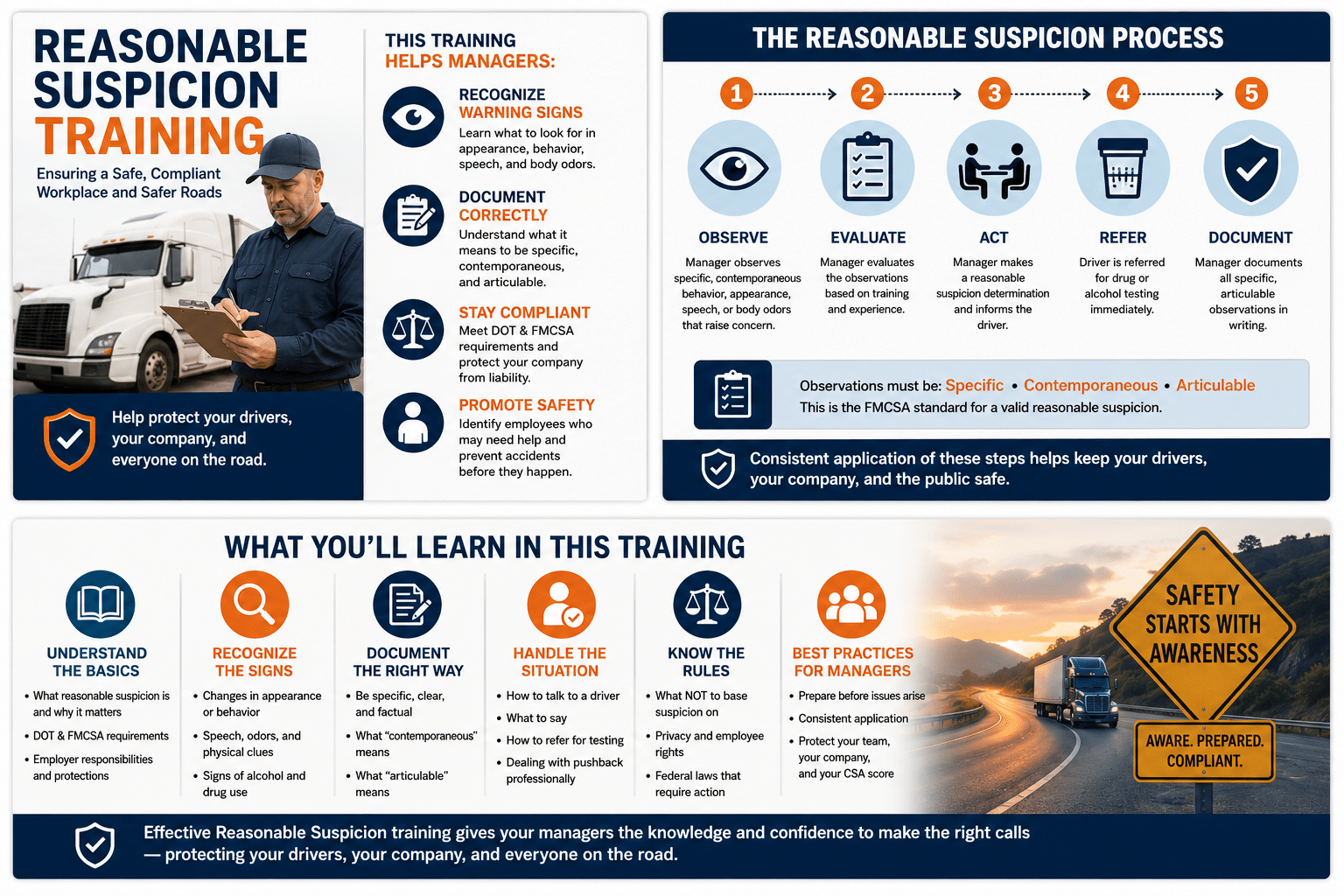
- What does the FMCSA specify about the types of observations that would lead to “reasonable suspicion determination” to send a driver for testing? (The FMCSA states that to meet the threshold of “reasonable suspicion”, a referral for testing must be based on “specific, contemporaneous, articulable observations concerning the appearance, behavior, speech or body odors of the driver)
- What are some examples of things NOT to base a reasonable suspicion testing on? (an example would be you should never make a drug testing referral based on a “gut feeling” or “intuition” about an employee. Instead, your suspicion must be based on how that employee looks, acts, smells or talks)
- What are some other examples of a scenario where reasonable suspicion for alcohol or substance abuse might be indicated? These are called “specific” observations by the FMCSA:
- The employee is using breath mints all the time (not a dead giveaway by any means but it instead is a “clue”)
- The employee is laughing unexplainably or without cause
- The driver is talking fast, erratic, or isn’t making sense with their speech
- The driver might have an odor of alcohol or marijuana or other signs of drug abuse or alcohol abuse
- What are the best practices a Manager should follow when referring an employee for testing?
- How should managers document their suspicions when referring an employee for testing?
- What does contemporaneous mean when it comes to reasonable suspicion?
- Can or should you refer a driver for drug or alcohol testing if another employee states they observed them using? (No, because per FMCSA you have to see them for yourself, firsthand and in person, and also, they must be “contemporaneous,” which is a judgment by the Manager/Employer about the facts of the driver and the way they look or act at the present time)
- What does “articulable” mean when it comes to DOT Reasonable Suspicion? (it means the Manager or Employer must be able to articulate exactly what they saw, heard, or smelled on the employee and put that documentation in writing when making the referral for testing)
- Are there Federal laws that “require” an employer to take action if they suspect their commercial driver has a problem or is under the influence? (Yes, the law requires the employer to refer the driver for an immediate drug or alcohol test)
Key Points in This Reasonable Suspicion Training That Managers Need to Know and Learn:
- How can Managers learn to recognize signs of drug or alcohol use or abuse?
- What clues does an employee’s change in personality provide if any?
- What are some signs that a driver might be under the influence of alcohol? (since it is a depressant, alcohol users might appear drowsy, slur their speech, have difficulty with balance, etc.)
- What are some signs that a commercial driver might be using drugs? (stimulants such as methamphetamine or cocaine increase the user’s metabolism so they might exhibit agitation, tremors, excessive talking, etc.)
- How should Managers prepare to send a driver for reasonable suspicion testing? (They need to have a thorough knowledge of the Company’s drug & alcohol policy, and they need to be aware of the federal drug and alcohol testing regulations)
- What is the reasonable suspicion process, and why must it be followed?
- What is a “self-admission” by an employee they are using drugs or alcohol, and what should the Manager do in that case?
- and much more
What DOT Reasonable Suspicion Training Requires:
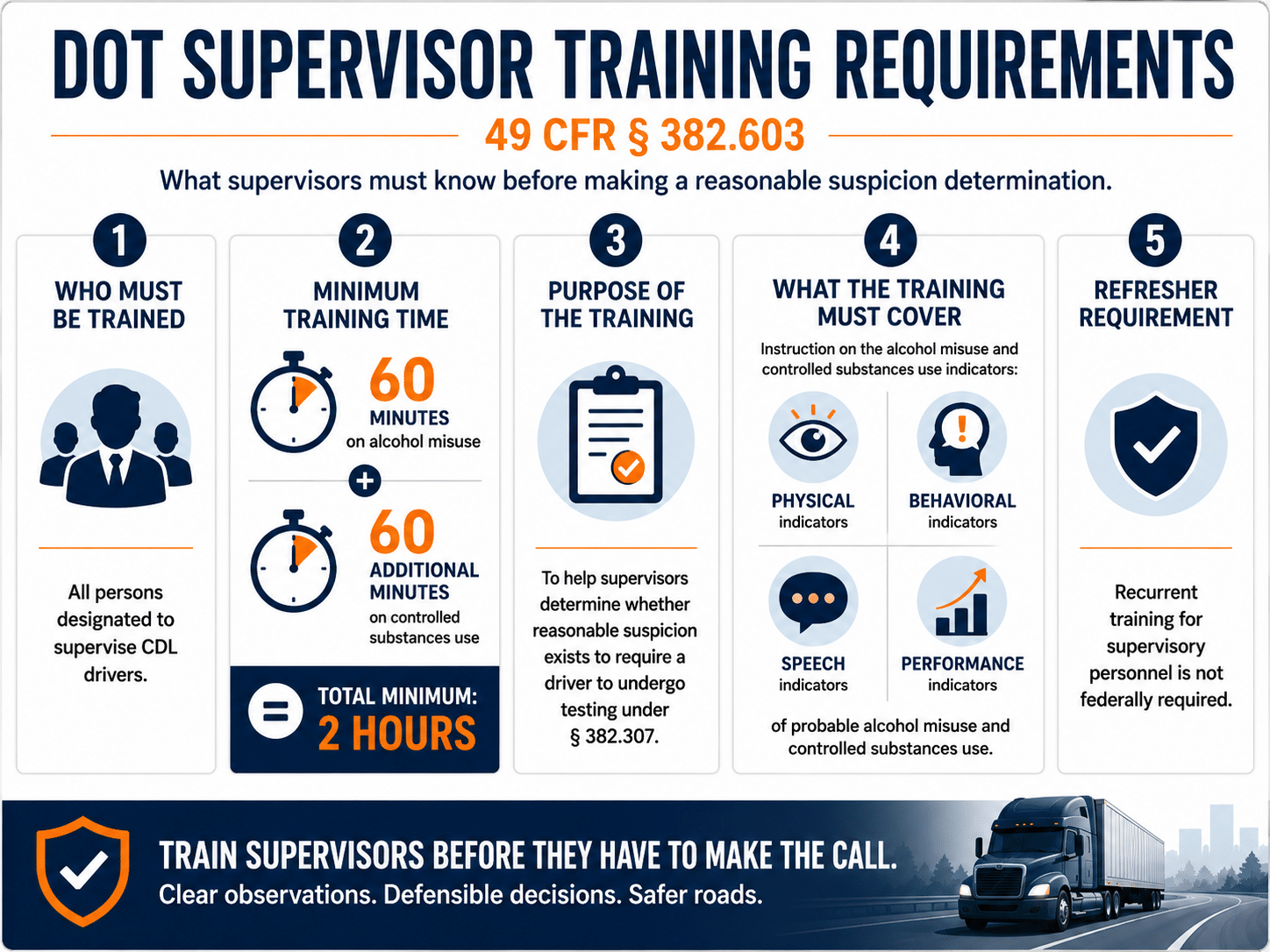
Under 49 CFR 382.603, every employer of CDL drivers must ensure that each person designated to supervise drivers receives at least 60 minutes of training on the signs and symptoms of alcohol misuse, plus at least another 60 minutes on controlled substance use. That training is what qualifies a supervisor to make a reasonable suspicion determination in the first place — a referral made by an untrained supervisor is the one that gets challenged.
The rule is equally specific about what a referral has to rest on. FMCSA requires “specific, contemporaneous, articulable observations concerning the appearance, behavior, speech or body odors of the driver.” In plain terms: you saw, heard, or smelled it yourself, in person, at the time — and you can write down exactly what it was. A gut feeling does not meet the standard. Neither does another employee’s report of what they saw.
That gap is where most carriers are exposed. The determination gets made in a yard or a hallway, under time pressure, by a supervisor who has done it maybe twice in their career. This program trains that supervisor on what to actually look for, how alcohol and different classes of drugs present differently, how to handle the conversation, and how to document the observation so it holds up later.
A word on the two-hour rule, because it matters: this video runs 16 minutes and is built to be the teaching centerpiece of your supervisor training session — it supports the 60-minute alcohol and 60-minute controlled-substance requirements rather than replacing them. Employers pair it with their own drug and alcohol policy review, discussion of the scenarios it raises, and additional material such as our Drug and Alcohol Awareness Training for Managers to reach and document the full time 382.603 calls for.
To keep a compliant and safe workplace, your Managers and Supervisors need Reasonable Suspicion training. This helps keep the employer from liability, keeps the employee safe, and helps prevent alcohol or drug-related accidents. This Reasonable Suspicion Training Video will teach your managers the ins and outs of this DOT requirement. Available as an English or Spanish-speaking DVD or USB Stick, the runtime of the training is 16 minutes.
Who Needs Reasonable Suspicion Training:
Anyone who could be the person who says “you need to go for a test”:
- Supervisors and managers designated to make reasonable suspicion determinations for CDL drivers
- Terminal, fleet, dispatch, and yard managers who see drivers report for duty
- Safety directors and Designated Employer Representatives who administer the testing program
- HR staff who handle the referral, the documentation, and what happens afterward
- Owner-operators and small carriers where the owner is also the supervisor
- Non-DOT employers who want supervisors held to the same observation and documentation discipline under a company policy
Most carriers train every frontline supervisor rather than just one or two people, so there is always a qualified decision-maker on site — including nights and weekends, when the call is most likely to be needed and hardest to make.
This Reasonable Suspicion Training For Managers Program Includes These Items:
- Full-length DOT Reasonable Suspicion Training for Managers and Supervisors training video
- Trainee quiz and answer sheet
- A “Presenter’s Guide” if you are going to do this training in person
- A printable training sign-in sheet to keep track of your training program
- A printable Certificate of Completion. You can print as many copies of the Certificate as you need
Reasonable Suspicion Training Video – Full Length Preview:
FAQs on Reasonable Suspicion Training
Answered by our in-house OSHA Authorized Trainer – Jason Hessom

Have a question for us? Give us a call at 800-859-1870 ext 2 or, Contact Us Via Email
Yes. Under 49 CFR 382.603, employers of CDL drivers must ensure that every person designated to supervise drivers receives at least 60 minutes of training on alcohol misuse and at least an additional 60 minutes on controlled substance use. Only a supervisor who has completed that training is qualified to make the reasonable suspicion determination that sends a driver for testing.
No, and we would rather tell you that plainly than have you find out during an audit. The rule sets a floor of 60 minutes on alcohol and 60 minutes on controlled substances. This video is designed to be the teaching centerpiece of that session — it covers the observation, decision, and documentation skills supervisors genuinely struggle with — and you combine it with your company policy review, discussion of the scenarios it raises, and additional material such as our Drug and Alcohol Awareness Training for Managers to reach and document the full required time.
Any supervisor or company official designated to determine whether a CDL driver must submit to reasonable suspicion testing. The practical test is simple: if a person could be the one to say “you’re going for a test,” they need the training first. Most carriers train every frontline supervisor so there is always a qualified decision-maker on site, including nights and weekends.
FMCSA requires that a referral be based on specific, contemporaneous, articulable observations of the driver’s appearance, behavior, speech, or body odors. In plain terms: you observed it yourself, in person, at that moment, and you can state exactly what it was. A hunch, a rumor, or a secondhand report from another employee does not meet the standard — and the video works through examples of both what qualifies and what does not.
Under 49 CFR 382.603 the 60-minute alcohol and 60-minute controlled-substance training is a one-time requirement, with no federally mandated refresher. In practice many carriers retrain periodically anyway, because supervisors use these skills rarely and an uncertain determination is the one most likely to be challenged. Check your state’s rules and any other modal agency requirements that apply to your operation, since those can differ.
Yes. The 382.603 mandate applies to employers of CDL drivers, but the underlying skills are identical for any company-policy testing program: recognizing the signs, basing the decision on observation rather than instinct, and documenting it defensibly. Non-DOT employers use the same training and simply follow their own written policy for what happens after the referral.
8 reviews for DOT Reasonable Suspicion Training for Supervisors – [Video Kit]
![DOT Reasonable Suspicion Training for Supervisors – [Video Kit]](https://www.safetyvideos.com/wp-content/uploads/2022/02/products-D16-2-150x150.png.webp)


Helped improve our drivers’ awareness about what happens if they are possibly under the influence (hint, it’s not good). This was also a good price for what you get.
Very helpful in meeting compliance requirements.
Well done
Really good information that all drivers need to understand. Messing around with drugs or alcohol can cost you your job real quick in this industry. Filled with good information for our staff.
Excellent training for CDL drivers as well as managerial staff.