
Confined Space Ventilation Requirements (OSHA 1910.146)

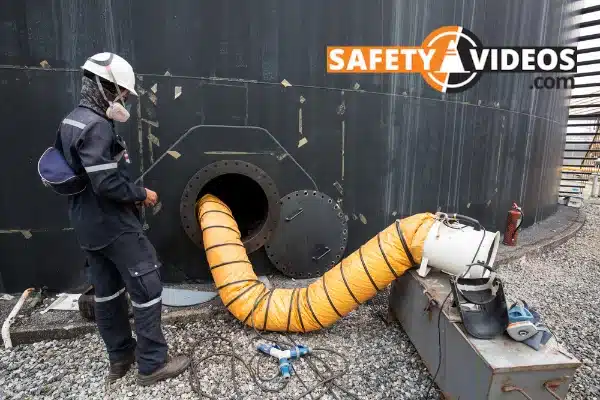
Quick Answer: Does OSHA Require Forced-Air Ventilation in Confined Spaces?
Yes — OSHA’s permit-required confined space standard, 29 CFR 1910.146, requires the atmosphere to be tested before entry, and when continuous forced-air (mechanical) ventilation is used to control a permit space’s atmosphere under 1910.146(c)(5), the air must be directed to where workers are and must keep running until everyone has left the space.
A safe atmosphere generally means oxygen between 19.5% and 23.5%, flammable gas or vapor below 10% of the lower flammable limit (LFL), and any toxic contaminants below their permissible exposure limits (PELs). The internal atmosphere is tested in a set order — oxygen first, then flammable gases and vapors, then potential toxic contaminants — and re-tested periodically while the work is underway. Ventilation never replaces testing: you test first, then ventilate, then keep testing to confirm the ventilation is doing its job.
Confined workspaces with limited entry pose various hazards, with a hazardous atmosphere being common and potentially lethal. Companies require permits detailing the atmosphere in the confined space to allow worker entry to do a job, and ventilation is necessary to drive out the hazardous atmosphere and supply enough oxygen. This information on confined space ventilation requirements is an excellent accompaniment to our comprehensive video-based confined space course.
What Are OSHA’s Acceptable Atmosphere Levels for a Confined Space?
| Test (in order) | Acceptable range | Why it matters |
|---|---|---|
| 1Oxygen (O₂) | 19.5% – 23.5% | Below 19.5% is oxygen-deficient; above 23.5% is oxygen-enriched and sharply increases fire risk. |
| 2Flammable gas / vapor | < 10% of LFL | At or above 10% of the lower flammable limit, entry is prohibited until the space is ventilated down. |
| 3Toxic contaminants | Below the PEL | Gases such as hydrogen sulfide (H₂S) and carbon monoxide (CO) must read below OSHA’s permissible exposure limit. |
Do All Confined Spaces Require Ventilation?
The OSHA standard (1910.146 Permit Required Confined Spaces) stipulates that personnel entry to a space where a gas detector indicates a hazardous atmosphere is forbidden. These permit-required confined space situations require additional precautions, including ventilation.
OSHA regulations designate a space as having a hazardous atmosphere if a toxic gas or something that results in limited oxygen is present.
A confined space is more likely to have a hazardous atmosphere. To eliminate the hazard, such areas must be supplied with forced air ventilation before worker entry.
A gas monitor must test the air quality in the space; the readings serve as a baseline. If any hazards are detected, it is necessary to ventilate the area for at least 30 minutes, preferably 60, before retesting.
This ventilation must continue as long as there are still employees in the space and must be directed toward the immediate areas where an employee is performing their job.
Continue to test until the last employee leaves the space; if readings indicate an atmospheric hazard, evacuate the workers.
Important Considerations to Note
The air used for forced air ventilation must be clean and fresh. If any idling vehicles or generators run in the vicinity, the air quality may not be good enough.
Should the ventilation system fail for any reason, initiate a response to evacuate your employees immediately.
Some areas have flammable materials or gases; such an area is designated a hazardous location in the National Electrical Code (NEC).
Ensure that you use flame and explosion-proof ventilation blowers and ducts.
How Must a Confined Space Be Ventilated?
- 1Ventilate before anyone enters. No worker may enter until forced-air ventilation has removed any hazardous atmosphere.
- 2Aim the air where workers are. The forced air is directed to the immediate area where employees are present in the space.
- 3Keep it running until everyone is out. Ventilation continues without interruption until every worker has left the space.
- 4Use a clean air source. The supply air comes from a clean source and does not itself add hazards to the space.
- 5Keep testing to confirm it works. The atmosphere is tested periodically to verify the ventilation is preventing a hazardous atmosphere.
What Are the Two Ways to Ventilate a Confined Space?
Ventilation of confined spaces is essential; what type of ventilation is used in a confined space? You should know that ventilation is a key component of any confined space rescue plan as well.
Confined space ventilation falls into two different kinds: forced air ventilation, which is common, and local exhaust extraction, which is only used sometimes.
Forced Air Ventilation
Forced air ventilation boils down to pushing fresh air through the entrance of the area where employees are working. This is done using confined space ventilation blowers.

Confined Space Ventilation Blowers
Equipment used to ventilate may be powered by mains electricity, gasoline, or pneumatic systems. In specific niches, DC electric or diesel-powered equipment is required.
Blower equipment may be 8-inch, 12-inch, and even 16-inch, with capacities ranging from 960 CFM (cubic feet per minute) to 2500 CFM.
A blower with a radial configuration, which moves air in a circular motion, and expels it at right angles to the entry, has the advantage of compact size; it is also the only option for engine-driven blowers.
On the other hand, a blower with an axial configuration is like a fan that sits in the entry of the blower duct and thrusts air through in a straight line; although they are bulkier, they also achieve higher CFM rates.
Local Exhaust Extraction
If employees use chemicals that create a hazardous atmosphere, it may be necessary to ventilate the area by extraction.
In this case, local exhaust ventilation (LEV) sucks the atmospheric hazard out of the space as clean air comes in.
In extreme cases, an employee may need to use self-contained breathing apparatus (SCBA), equipment similar to scuba divers.

How Much Ventilation Required in Confined Space?
Knowing that you need ventilation blowers isn’t enough. You must also determine how much air to push into the confined space. Several factors impact the optimal solution.
The Metrics You Need
The blower’s cubic feet per minute (CFM) rate denotes the flow rate, with a higher figure indicating faster turnover.
Determine the air volume of the space in cubic feet, and find out how many air changes per hour (ACH) are required in the state where you are operating.
As this figure differs from state to state, companies working across state lines would be well advised to select the highest ACH value stipulated across all states.
Not all states define ACH, and neither does OSHA. The industry-accepted guidance is 20 ACH.
Safety managers should use their discretion to provide enough ventilation to deal with an atmospheric hazard.

How to Calculate the Ventilation Required
Multiplying the volume in cubic feet by the AH gives you the total CFM delivery rate; dividing this figure by 60 gives you the minimum CFM required.
For example, a 10 000 cubic foot space that needs eight air changes per hour will have an 80 000 CFM per hour delivery requirement. Dividing by 60 gives a minimum CFM of 1333.
We advise you to buy a blower that exceeds the minimum required by around 15%, as this gives you a safety margin and clears toxins out of the space faster.
It’s much better to supply “too much” ventilation than too little.
Volume and Shape of the Confined Space
The size and shape of the confined space matter. A larger space will require more ventilation. A long or deep space will need longer blower ducting; placing the duct outlet at the farthest point of the space is a good idea.
However, greater duct length reduces airflow, as do any bends. Depending on the length of the ducting and the number of bends, you may have to opt for a larger blower than would otherwise be the case.
Booster blowers can help overcome these problems. You may even have to use multiple blower units and ducts, ensuring you do not block the entry point.
Manufacturers often include these considerations when rating their products’ CFM; ensure you understand how they arrived at the figure they quote.

Confined Space Ventilation Requirements: The Bottom Line
Confined space ventilation is essential to safeguard workers’ health and lives. When deciding upon the details of a ventilation system, it is best to err on the side of caution and over-ventilate rather than under-ventilate. The requirements around confined space ventilation are many and based on OSHA regulations as well as the job site at hand. As always, OSHA will have the final say in what is necessary to do the job without putting employees in danger.
Frequently Asked Questions About Confined Space Ventilation:
OSHA 29 CFR 1910.146 requires the atmosphere to be tested first. Ventilation is required when it is needed to remove a hazardous atmosphere or to keep the atmosphere safe during entry; in many permit spaces, continuous forced-air ventilation is the control used to make and keep entry safe.
It is the use of a powered blower or fan to push fresh air into the space and dilute or displace hazardous gases and vapors, as opposed to natural ventilation. Under 1910.146(c)(5)(ii) it must run continuously, be aimed at where workers are, and continue until everyone has exited.
A safe (non-hazardous) atmosphere has oxygen between 19.5% and 23.5%. Below 19.5% is oxygen-deficient and above 23.5% is oxygen-enriched, which greatly increases fire and explosion risk.
Continuous forced-air ventilation must keep running the entire time anyone is inside and continue until all workers have left the space; it cannot be shut off while entry is ongoing.
No. You test first (oxygen, then flammables, then toxics), then ventilate, then keep testing periodically to confirm the ventilation is preventing a hazardous atmosphere. Ventilation never substitutes for testing.
