
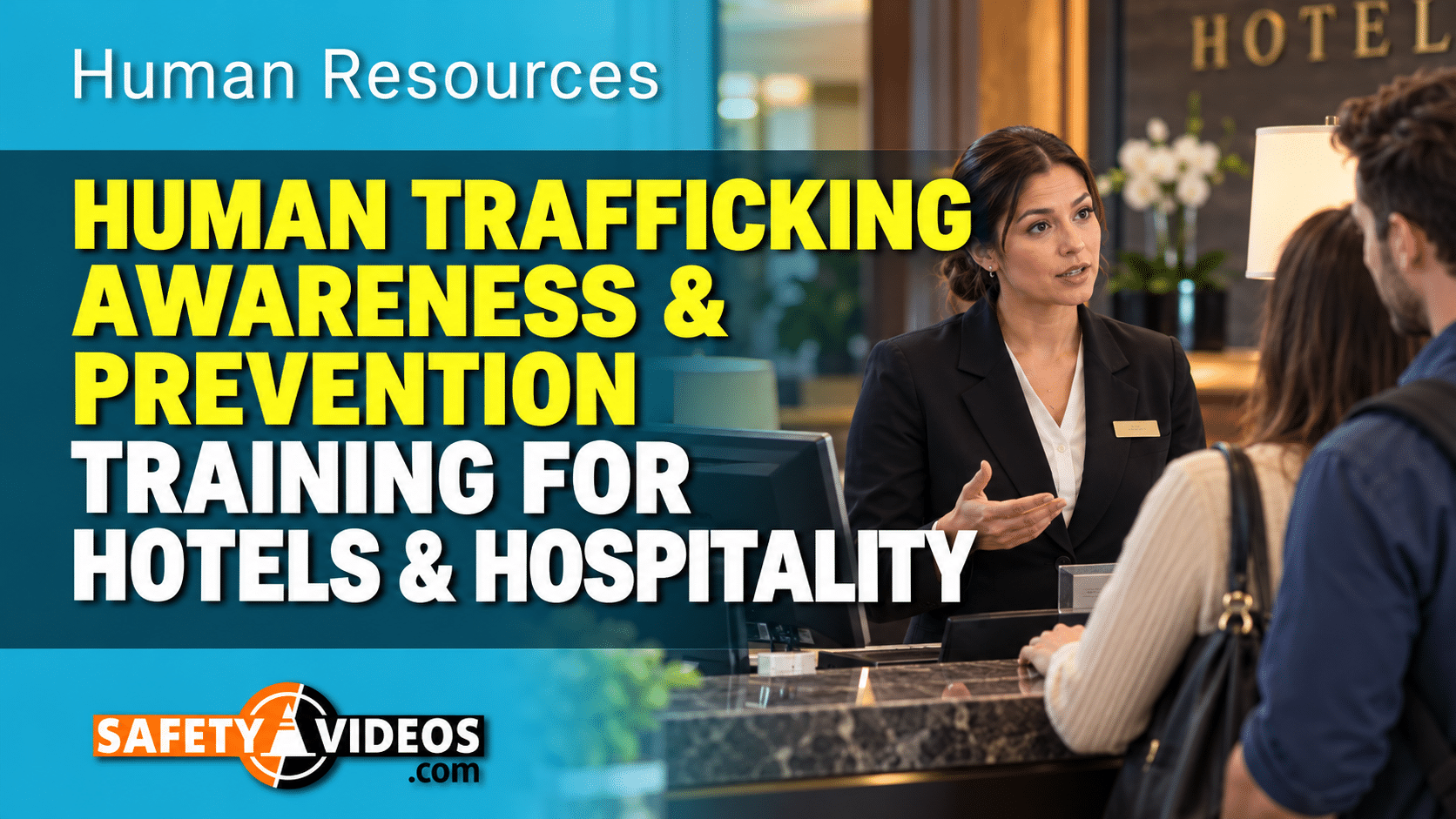
Human Trafficking Awareness & Prevention Training for Hotels & Hospitality [Complete Video Kit]
$239
This is the “Hotels & Hospitality” version. If you are looking for the version for restaurants, truck stops, transit, staffing and other workplaces, that can be found here:
Human Trafficking Awareness & Prevention Training for General Industry. Properties that also run a restaurant or bar can use both programs together.
Human trafficking happens in ordinary places, and hotels are among them. A room rented for cash night after night, a guest who never speaks for themselves, a contract laundry crew that is driven in and out together and never handles its own pay: the people most likely to notice are the people who work on the property.
That is why a growing number of states now require hotel and lodging employers to train their staff to recognize and report trafficking. California, Texas, Florida, Illinois, Hawaii, Georgia, Virginia, New York, Connecticut and Rhode Island all have hotel training laws, and each sets its own rules for who is trained and how often.
This program was written for that audience. It follows the California Government Code §12950.3 topic list and the Texas Attorney General and Florida DBPR lodging training standards, and it gives sex trafficking and labor trafficking equal weight. It teaches every role on the property what to watch for and what to do: observe, document and report, and never confront or detain anyone.
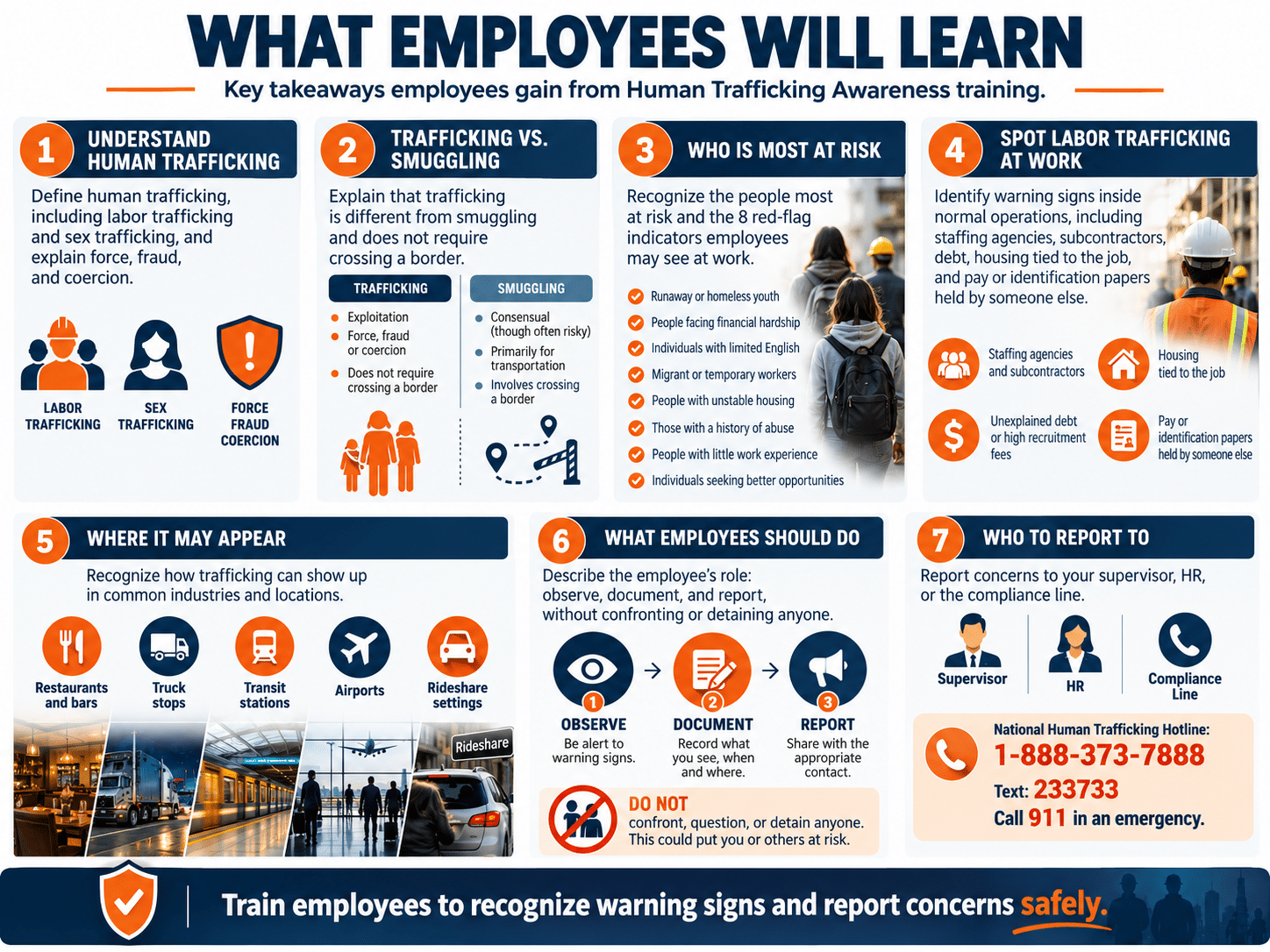
WHAT EMPLOYEES WILL LEARN
- Define human trafficking, including labor trafficking and sex trafficking, and explain force, fraud and coercion
- Tell trafficking apart from smuggling, and understand that trafficking does not require crossing a border
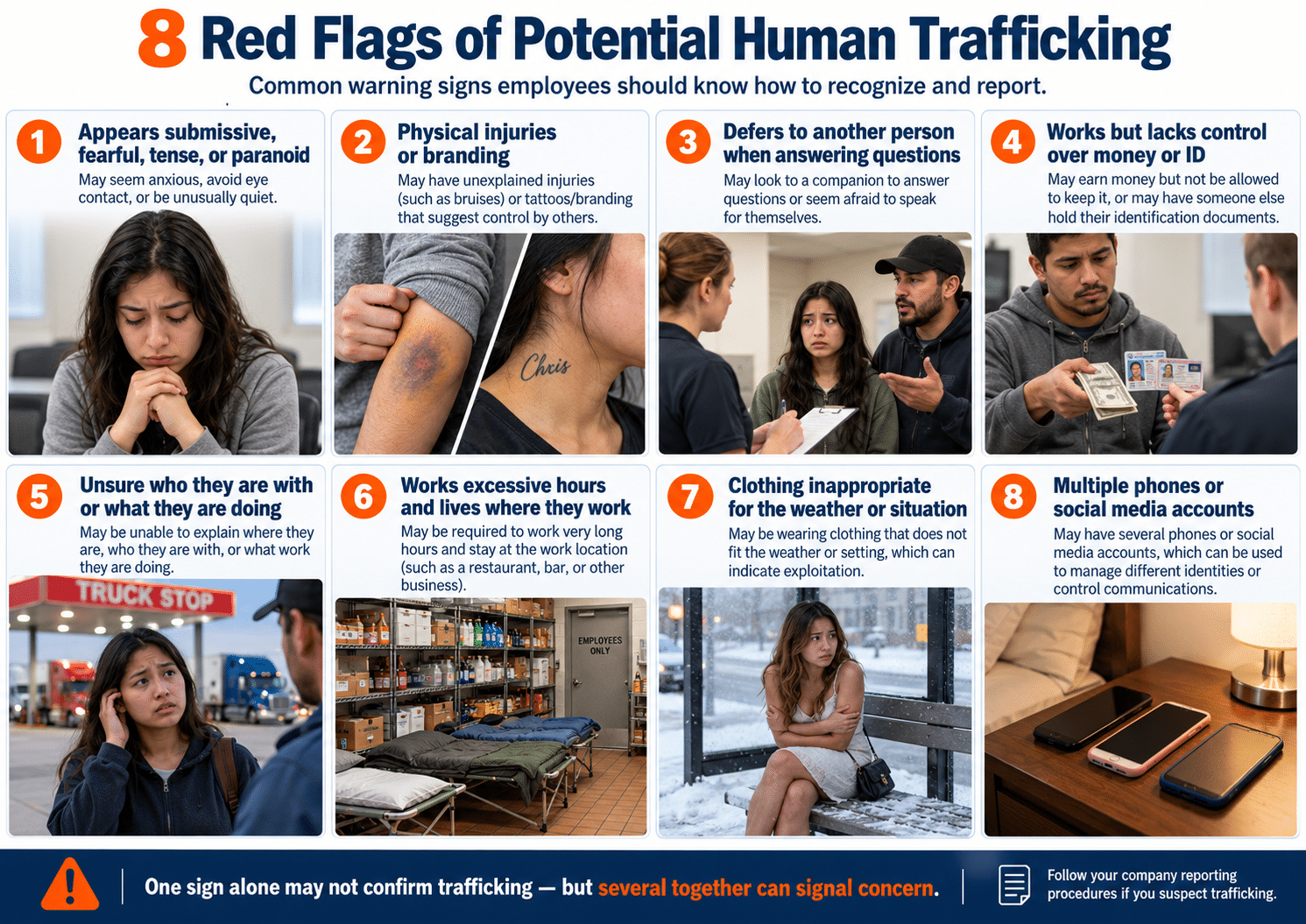
- Recognize the people most at risk and the eight red-flag indicators they may see at work
- Identify how trafficking shows up in hotels: at the front desk, in guest rooms and among contract workers
- Describe their role: observe, document and report, without confronting or detaining anyone
- Contact the right help: 911 in an emergency, the National Human Trafficking Hotline at 1-888-373-7888 or text 233733, and their manager
- Follow the property’s reporting protocol, including what to do if someone asks them for help
COURSE TOPICS
What Human Trafficking Is The federal definitions of sex trafficking and labor trafficking, with a plain example of force, fraud and coercion. The four forms (labor and sex, adult and child), why a minor in commercial sex is a victim even without force, fraud or coercion, and why trafficking is about control, not transportation. Cards separate trafficking from smuggling, and sex trafficking from labor trafficking.
Who Is at Risk and What Victims Experience Traffickers target vulnerability: youth, poverty, debt, addiction, homelessness, prior abuse, unstable immigration status and isolation. Most victims know the person exploiting them. This section describes what victims go through in respectful, survivor-informed terms and explains why they rarely ask for help.
The Eight Red-Flag Indicators Each of the eight indicators named in the Texas Attorney General’s lodging training standards gets its own card and scene, from deferring to another person and lacking control of money or ID to living at work and carrying multiple phones. The key lesson: one indicator means little. A pattern is what you report.
Labor Trafficking in the Workplace Labor trafficking hides inside normal operations such as contracted cleaning, landscaping, construction and temporary staffing. Employees learn the signs of debt bondage (recruitment fees, housing deductions, workers who never see their own pay) and that a contractor’s crew is reported the same way as anyone else.
Your Role: Observe, Document, Report What to write down (time, place, description, room or vehicle) and what never to do: confront, accuse, detain, follow, photograph the person’s face or alert the suspected trafficker. Also covered: how to respond if someone asks for help, when to call 911, and the no-retaliation message for good-faith reports.
What Happens After a Report The hotline assesses a report, connects victims to services and refers to law enforcement when appropriate. Employees will usually not hear the outcome, and a report is information, not an accusation.
Why Hotels Hotels offer what traffickers look for: anonymity, short stays, cash transactions and a steady flow of strangers. They also rely on contract labor for housekeeping, laundry, landscaping and renovation. A chart of National Human Trafficking Hotline data, with its source and date, shows where hotels and motels sit among reported venues.
Front Desk and Reservations A third party who pays cash, holds the guest’s ID and answers for them; rooms renewed day by day; local guests with no luggage; heavy foot traffic to one room; a minor with an unrelated adult. A separate card covers the controller: the person who holds the IDs, pays for others and speaks for them.
Housekeeping, Maintenance and Security In the rooms: Do Not Disturb for days alongside constant requests for towels and linens, multiple phones and little luggage. On patrol: the same vehicle and the same visitors every night. In the back of house: contract workers who live on site, are driven in and out together and never handle their own pay or papers.
Hotel Reporting Protocol and Three Scenarios The property protocol, step by step: observe, document, tell the manager on duty, the manager calls the hotline or police, and anyone calls 911 if someone is in danger. Three what-would-you-do scenarios (front desk, housekeeping and security) each give a 15-second countdown to decide before the answer appears.
Your State’s Requirements The program closes with a state card that shows who the law covers, how often training repeats and where to report. Choose the national card or one of ten state-specific cards when you order.
WHY THIS TRAINING MATTERS
Hotel employees are often the only outsiders who see a trafficking situation up close, and many victims never ask for help. A front-desk agent, a housekeeper or a night security officer who knows the indicators and the reporting steps can be the person who changes the outcome.
Hotel training laws are also spreading. Illinois began enforcement on October 1, 2026, Hawaii requires training by December 1, 2027, and several states accept only courses that appear on their approved lists. This program gives your staff training built to those state topic lists, runs longer than the common 20-minute minimum, and gives you the records to show it was done. Your state may set its own rules on who is trained and how often, so confirm your current requirements with your state agency.
WHO NEEDS THIS TRAINING
Every employee at hotels, motels, resorts and other lodging properties, including:
- Front desk, reservations and night audit
- Housekeeping and laundry
- Bell staff, valets and drivers
- Maintenance, engineering and security
- Food and beverage staff
- Managers and supervisors who receive reports
- Contract and staffing-agency workers with guest contact or room access
Available in either English or Spanish, and on either USB stick or DVD, this complete human trafficking awareness program will help you meet your state’s hotel training requirements. The English video runs 21:58 and the Spanish video runs 24:42; the Spanish version translates the on-screen text as well as the narration. One purchase of $239 covers your whole property, with no per-seat fees. This training is also available in our online training library; contact us for details.
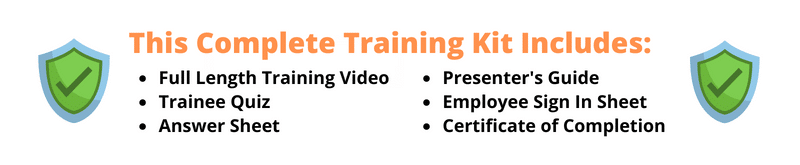
This Complete Human Trafficking Training for Hotels & Hospitality Program Includes These Items:
- Full-length Human Trafficking Awareness & Prevention training video for Hotels & Hospitality
- 10-question employee quiz and answer sheet
- A “Presenter’s Guide” if you are going to do this training in person, with an outline of the full narration, a compliance crosswalk (Appendix A), state requirements at a glance (Appendix B) and a training acknowledgment form (Appendix C)
- A printable training sign-in sheet to keep track of your training program
- A printable Certificate of Completion. You can print as many copies of the Certificate as you need
Full-Length Video Preview of the Human Trafficking Training for Hotels & Hospitality:
FAQs on Human Trafficking Training for Hotels & Hospitality
Answered by our in-house OSHA Authorized Trainer – Jason Hessom

Have a question for us? Call us at 800-859-1870 or Contact Us Via Email
Ten states covered by this program have hotel training laws. Texas, Florida, Georgia and Rhode Island call for training every year. California, Illinois, Hawaii and Virginia call for training every two years, with deadlines for new hires. New York calls for guest-contact employees to be trained within 60 days of hire, and Connecticut calls for training at hire with an annual certification. Who is covered varies by state, from every employee to guest-facing roles only. Choose your state in the State Specific option and the closing card shows your state’s statute, who it covers and how often. Always confirm your state’s current requirement.
Not yet. Texas and Florida publish lists of approved courses, and Georgia, Virginia and Hawaii have approval or review processes of their own. This program was written to the Texas Attorney General’s commercial lodging training standards and the Florida DBPR lodging requirements, including the eight red-flag indicators, a runtime over 20 minutes and a source and date on every statistic. We are pursuing listings with the Texas Office of the Attorney General, Florida DBPR, the Georgia Attorney General, Virginia DCJS and the Hawaii Attorney General. Until a listing is granted, check your state’s current list before you rely on this program for that state’s requirement.
California Government Code §12950.3 calls for at least 20 minutes of classroom or other effective interactive training for hotel and motel staff who interact with the public, every two years and within six months for new hires. This program is designed to satisfy that requirement: the English video runs about 22 minutes, it follows the section’s topic list, and the quiz adds an interactive element. Be sure to have someone available during the video to answer questions and make it u0022interactiveu0022. Choose the California Specific option so the closing card names the statute.
Only the state requirements card near the end of the video. Every version shares the same core training, hotel module, scenarios and summary. The Standard version closes with a national card: your state may require this training, call 911 in an emergency, and the National Human Trafficking Hotline at 1-888-373-7888 or text 233733. Each state-specific version replaces that card with your state’s statute, who it covers, how often training repeats and where to report, so it runs slightly longer. The quiz, answer sheet and Presenter’s Guide are the same for every state, and Appendix B of the guide summarizes all ten states.
Everyone who could see something. The program is written for front desk and reservations, housekeeping and laundry, bell staff, valets and drivers, maintenance, security, food and beverage, and managers. Contract and staffing-agency workers with guest contact or room access belong in the session too. They are among the workers most exposed to labor trafficking, and Hawaii’s law names staffing contractors. There are no per-seat fees, so one purchase covers your whole team, whether that is ten people or several hundred.
Yes, with equal weight. California’s §12950.3 topic list covers both, and hotels can be labor-trafficking sites as well as sex-trafficking sites. The program covers debt bondage, recruitment fees, housing deductions, held passports and IDs, and contract crews in housekeeping, laundry, landscaping and renovation. Hotel scenes show back-of-house indicators, and one card focuses on the contract workers most at risk. Employees learn to report a contractor’s crew the same way they would report a concern about a guest.
The kit gives you several records. Each employee completes the 10-question quiz, which you grade with the answer sheet. The printable sign-in sheet records who attended each session, and the printable Certificate of Completion can be issued to every employee who finishes. Appendix C of the Presenter’s Guide is a training acknowledgment form. Florida asks lodging employers to keep a signed, dated acknowledgment for each employee, and the form works as a record in any state. Keep these records for as long as your state requires.
| State Specific | Standard, California Specific, Connecticut Specific, Florida Specific, Georgia Specific, Hawaii Specific, Illinois Specific, New York Specific, Rhode Island Specific, Texas Specific, Virginia Specific |
|---|


