
Table Saw and Radial Saw Safety Video
$219
Walk through most woodworking shops and you’ll notice the same problem: saws running without blade guards. Operators remove them thinking they’re in the way — and then rely on reaction time to stay safe. That’s not a workable plan when a table saw can throw a piece of lumber back at an operator with enough force to cause a serious or fatal injury before anyone even registers what happened.
Saw-related injuries are among the most preventable in any shop environment, and almost every one of them traces back to removed guards, improper technique, or a blade that should have been replaced. This training program addresses all of it — covering both table saws and radial arm saws, from setup and PPE to kickback prevention and safe cutting procedures.
WHAT EMPLOYEES WILL LEARN
- Understand why blade guards must remain in place during standard operations — and the correct procedure when a guard must be temporarily removed for cuts like rabbeting, dadoing, or molding
- Identify the components of the guard assembly, including the splitter, anti-kickback fingers, and blade guard, and understand what each one does
- Recognize the leading causes of kickback — including dull blades, warped stock, a misaligned rip fence, and worn anti-kickback fingers — and how to eliminate each risk
- Select and use the correct tool for the cut: push sticks for ripping widths between two and six inches, and push blocks for widths narrower than two inches
- Wear appropriate PPE for saw operation, including safety goggles, hearing protection, and proper clothing — and understand why gloves and street glasses create additional hazards
- Inspect, clean, and maintain saw blades and guard components to keep equipment operating safely
- Set up and operate radial arm saws safely, including proper hand placement and controlled feed rate
- Keep the work area clean and organized to reduce fire risk and maintain a safe cutting environment
COURSE TOPICS:
The Blade Guard: The Single Most Important Safety Device The training opens with the issue that causes more saw injuries than any other: guard removal. Employees learn that the perception that guards obstruct vision or workflow is a misconception — a properly measured workpiece and a correctly set rip fence eliminate the need to monitor work near the blade. The video establishes clearly that guards are to remain in place during standard operations, and that when removal is unavoidable for specialty cuts, the guard goes back on immediately when that operation is complete.
Understanding the Guard Assembly Employees get a detailed look at how the guard assembly actually functions. The splitter keeps the kerf open behind the blade to prevent binding. The anti-kickback fingers catch material if it starts to travel backward toward the operator. The blade guard itself — whether clear plastic or metal — shields against direct contact. The training covers when to replace worn or scratched components and what to do if a guard is missing from the equipment entirely.
Kickback: Causes, Consequences, and Prevention Kickback is the most dangerous event in saw operation, capable of launching material at the operator with tremendous and unexpected force. The program breaks down every contributing factor: a dull or gummy blade, a rip fence that isn’t parallel to the blade, ripping warped or twisted stock, worn anti-kickback fingers, and releasing material before it has fully cleared the blade. Employees learn to eliminate each of these conditions before they make a cut.
Safe Cutting Techniques Proper technique is covered for both table saws and radial arm saws. For table saws, employees learn the correct use of the miter gauge for angled cuts, when to use outfeed tables for oversized material, and how clamps can improve both safety and control. For radial arm saws, the training covers controlled feed rate — pulling too quickly is identified as a leading cause of accidents — proper hand placement with the palm flat on the table, and the importance of a spring-return mechanism to bring the saw back to its resting position after a cut.
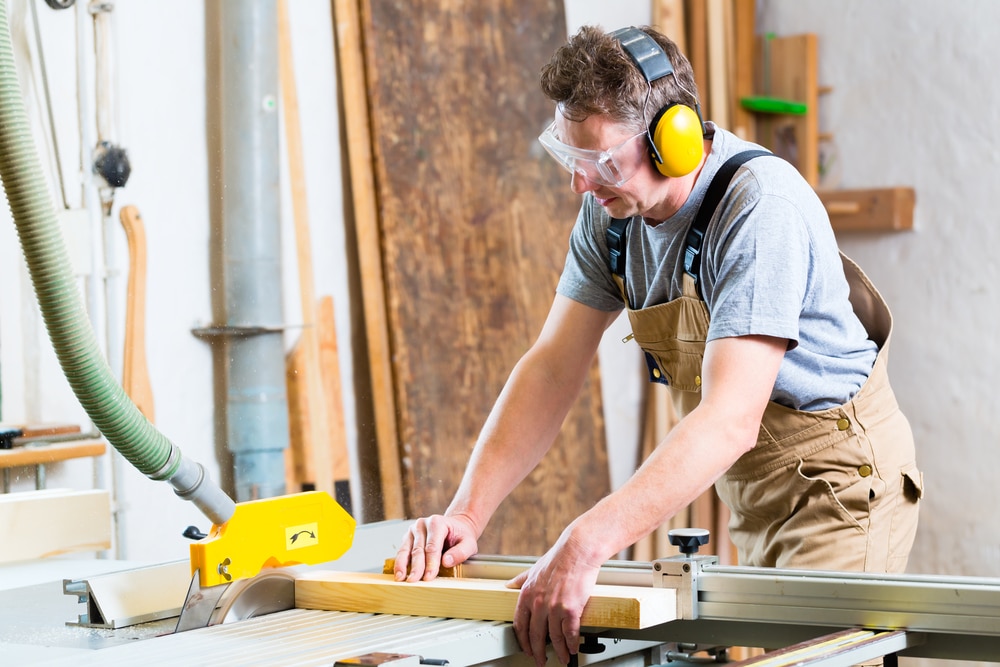
Personal Protective Equipment Employees learn exactly what PPE is required and why. Safety goggles — not street glasses, which provide no protection against flying debris — are mandatory. Hearing protection is required given the noise levels saw operation generates. Long sleeves must be rolled above the elbow, and gloves are specifically prohibited: loose material near a spinning blade creates a pull-in hazard. Body and face positioning relative to the blade line is also addressed.
Equipment Setup, Maintenance, and Housekeeping Table saws must be secured to the floor or work surface to prevent movement during use. Blades must be kept sharp — a dull blade that binds creates the conditions for kickback. The saw and surrounding area must be kept clear of sawdust and debris, both for safety and fire prevention. The training also covers proper grounding requirements and the correct startup procedure when equipment has been unplugged.
WHY THIS TRAINING MATTERS
Saw injuries frequently result in lacerations, amputations, and fractures — injuries that trigger workers’ compensation claims, OSHA recordable incidents, and potential citations under 29 CFR 1910.213, OSHA’s woodworking machinery standard. The most common factor in these incidents isn’t equipment failure — it’s operators who were never properly trained on guard use and kickback prevention. This program closes that gap before an injury occurs.
WHO NEEDS THIS TRAINING
Any employee who operates or works near table saws or radial arm saws, including workers in:
- Woodworking and millwork shops
- Cabinet and furniture manufacturing
- Construction and finish carpentry
- Pallet and crate manufacturing
- School and vocational training environments
- General manufacturing facilities with on-site cutting operations


