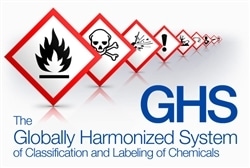
This GHS Container Labeling Training Video will help your employees understand the six types of information on a Globally Harmonized System (GHS) label and how to understand the nine types of pictograms used in a GHS labeling program. This training video was created specifically to help you with the OSHA GHS compliance standard. If you are looking for an introduction to GHS training video we have that too.
The training video will help employees understand the following:
How should chemicals be labeled under the GHS Standard?
How do you read a GHS pictogram?
What are the key components of any GHS labeling program?
This GHS Container Labels Training Teaches The Following Key Concepts:
What is the history of the GHS program under OSHA?
Why was GHS implemented over the old SDS protocol?
What are the six major pieces of information on the GHS label?
What are the nine standard pictograms that are used in any GHS program?
How do you read and interpret container labels?
This is important training for anyone in your facility that deals with chemical labeling. Since all companies must be in compliance with the GHS Standard, ensuring that all employees receive adequate training is paramount to success and compliance.
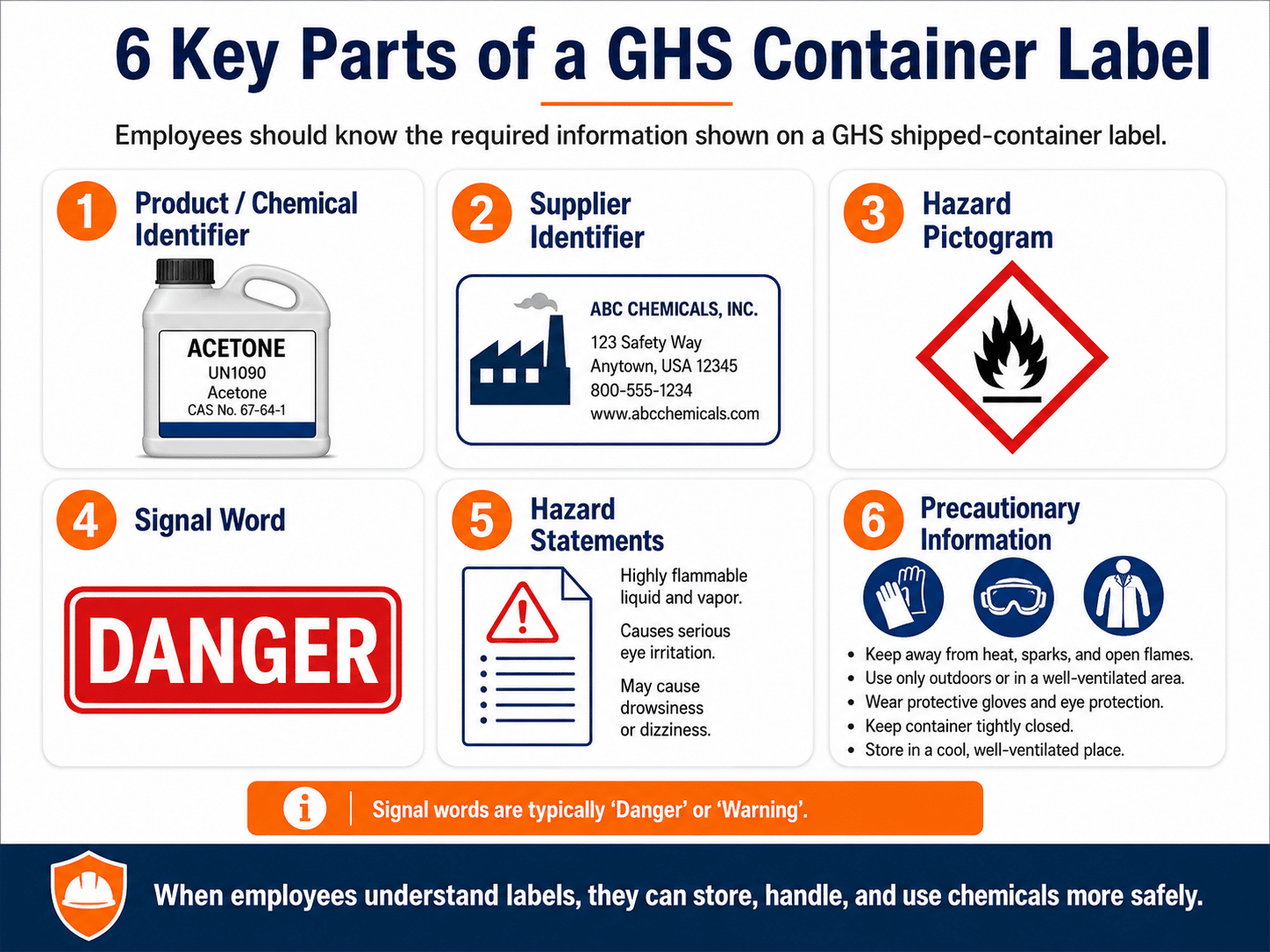
This training video will teach the following 6 key parts of a GHS container label:
The product or chemical identifier (This appears at the top of the GHS label and is the name of the chemical that appears on the Safety Data Sheets or SDS
The “Signal Word” which describes the level of severity of the chemical’s hazards and could be “warning” or “danger”
The Hazard Statement associated with the chemical. These are based on the chemical’s Class and Category and can be found in the GHS “Purple Book.”
The Precautionary Statement section of the label usually takes up the bulk of the text on any GHS label. There are four distinct types of information in this section of the label including exposure prevention, how to respond in case of a spill or exposure to the chemical, safe storage protocols for the chemical, and finally, how to properly dispose of the chemical
The Supplier Identifier on the label which addresses the name, address, telephone number and producer of the chemical
The Pictogram section of the label which includes pictures of any health, physical or environmental hazards associated with the chemical
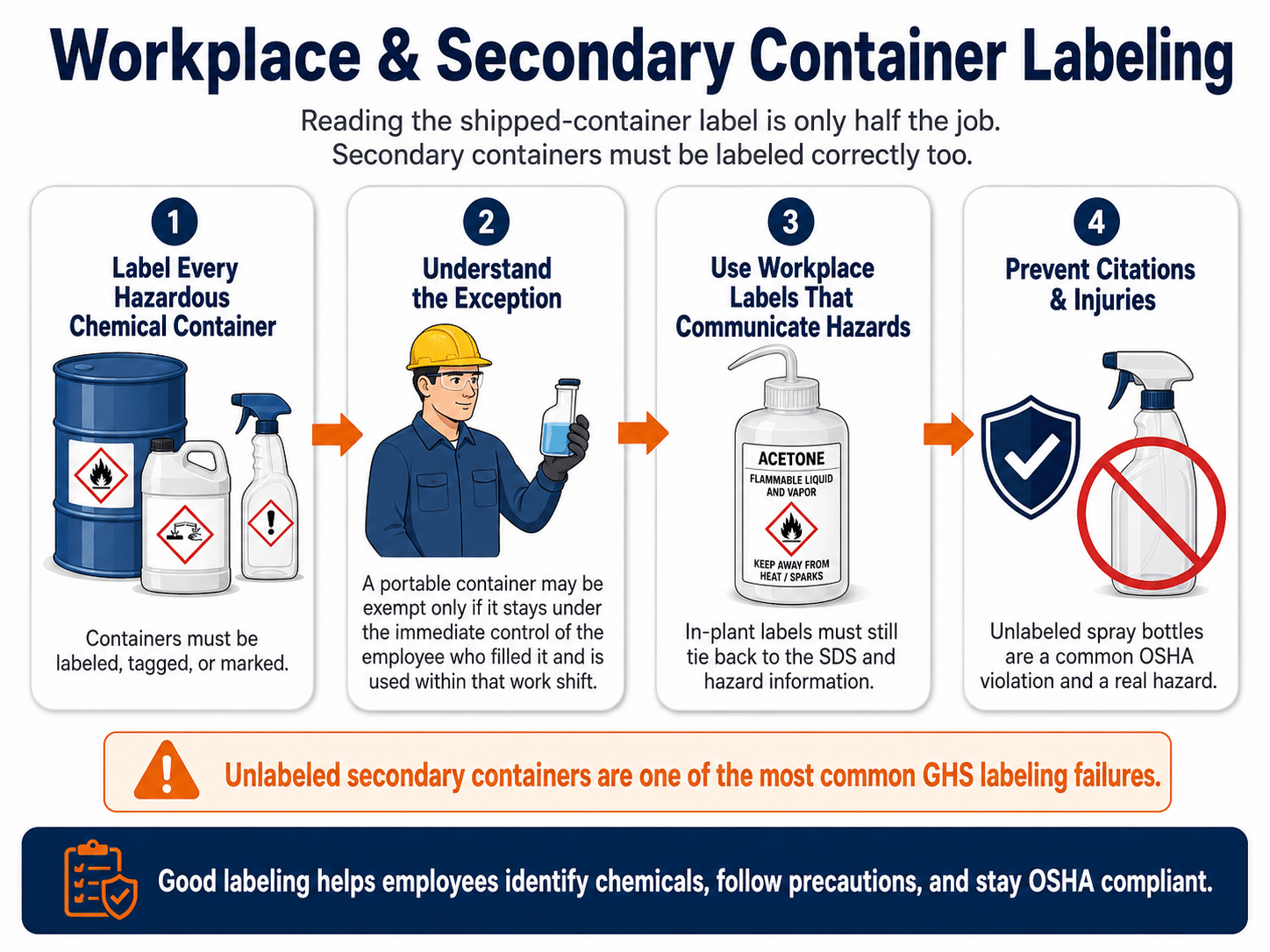
Workplace and Secondary Container Labeling
Reading a shipped-container label is only half the job. The most common labeling failures OSHA finds aren’t on the manufacturer’s drum — they’re on the spray bottle someone filled from it and never labeled. This training teaches employees the rules for workplace labeling, including:
Why every container of a hazardous chemical must be labeled, tagged, or marked — including secondary containers like spray bottles, jugs, and transfer tanks
The one narrow exception: a portable container filled from a labeled container is exempt only when it stays under the immediate control of the employee who filled it and is used within that work shift
What a compliant workplace label needs to communicate, and how simplified in-plant labeling systems must still tie back to the full GHS information on the SDS
The training will also teach viewers how to decipher the 9 different pictograms outlined as follows:
The Health Hazard pictogram which is the image of a person’s upper body with a star inside of it and indicates whether a chemical is carcinogenic, mutagenic, has reproductive toxicity, has respiratory sensitivity, has target organ toxicity, or has aspiration toxicity
The Flame which would indicate the chemical may be flammable, pyrophoric, self-heating, emits flammable gas, is self-reactive or is an organic peroxide.
The Exclamation Point which would indicate the chemical could be a skin or eye irritant, be a skin sensitizer, be acutely toxic, have narcotic effects, be a respiratory tract irritant, or be hazardous to the ozone layer
The Gas Cylinder pictogram which indicates whether or not the chemical is a gas under pressure
The Test Tube picture which would indicate whether the chemical causes skin corrosion or burns, eye damage, or be corrosive to metals
The Explosion image would tell you whether or not the chemical is explosive, a self-reactive, or is an organic peroxide
The Flame Over a Circle which indicates whether or not the chemical is an oxidizer
The images of a Tree and Fish which indicates whether the chemical poses an environmental hazard or has an aquatic toxicity
The Skull and Crossbones image which indicates whether the chemical should be considered acutely toxic, and possibly lead to toxicity or even death
These 9 components of the GHS label which are the in the pictogram section are critical to understanding how the chemical should be handled, stored, and respected.This Container Label Training Video is available as a DVD or on a USB Stick.
Why Container Labeling Training Matters:
Hazard communication is year after year among OSHA’s most frequently cited standards, and labeling violations — unlabeled secondary containers above all — are a leading reason. Every unlabeled spray bottle is a potential citation and, worse, a genuine hazard: an employee who can’t tell degreaser from disinfectant is one splash away from an injury. An employee who can read all six GHS label elements and all nine pictograms at a glance is the cheapest safety control you can buy.
This Complete GHS Container Labeling Training Program Includes These Items:
Full-length GHS container labeling safety training video
Employee quiz and answer sheet
A “Presenter’s Guide” if you are going to do this training in person
A printable training sign-in sheet to keep track of your training program
A printable Certificate of Completion. You can print as many copies of the Certificate as you need
GHS Container Labels Training Video – Full Length Preview:
FAQson GHS Container Labeling
Answered by our in-house OSHA Authorized Trainer – Jason Hessom
What are the six required elements of a GHS label?
A GHS-compliant shipped-container label carries the product identifier, the supplier identifier (name, address, phone), the signal word (“Danger” or “Warning”), hazard statements, precautionary statements, and the hazard pictograms. This training walks employees through each element and how to read them together.
Do secondary containers need GHS labels?
A GHS-compliant shipped-container label carries the product identifier, the supplier identifier (name, address, phone), the signal word (“Danger” or “Warning”), hazard statements, precautionary statements, and the hazard pictograms. This training walks employees through each element and how to read them together.
What are the nine GHS pictograms?
The nine hazard pictograms are: flame (flammables), flame over circle (oxidizers), exploding bomb (explosives), corrosion, gas cylinder (gases under pressure), skull and crossbones (acute toxicity), health hazard (carcinogens and similar chronic hazards), exclamation mark (irritants and less severe hazards), and environment (aquatic toxicity — the one pictogram OSHA doesn’t mandate). The video teaches employees to recognize all nine on sight.
What is the difference between “Danger” and “Warning” on a chemical label?
They’re the two GHS signal words, and only one ever appears on a label. “Danger” flags the more severe hazard categories; “Warning” flags the less severe ones. Employees should treat the signal word as an instant severity read before they open the SDS.
Is GHS label training required by OSHA?
Yes — OSHA’s Hazard Communication Standard requires employers to train employees on the label elements and safety data sheet format at initial assignment and whenever new hazards are introduced. This kit includes the quiz, sign-in sheet, and printable certificate to document that training.
8 reviews for GHS Container Labeling Training – [Complete Video Kit]
4.3
Based on 8 reviews
5
50
50%
4
25
25%
3
25
25%
2
0%
1
0%
1-5 of 8 reviews
Earl Watson
Verified Buyer
There is a lot of information on a GHS label. Having your employees understand that information is important to a complete safety program.
(0)(0)
David Hunt
Verified Buyer
We’ve had a lot of problems lately with employees putting chemicals in bottles with no label (a big no-no). We even had an employee spray what he thought was water into his face on a hot day and ended up with bleach in his eyes. We have a lot of training to do and this is a good start.
(0)(0)
Frederick Flores
Verified Buyer
Our manager liked that it came with a quiz so that we could make sure the information was absorbed by our employees
(0)(0)
Justin Jones
Verified Buyer
Good info, good price, complete package of training materials on container labels.
(0)(0)
Mitchell Alexander
Verified Buyer
Lots of information on what goes on a container label and what it means
(0)(0)
Sorry, no reviews match your current selections
Add a review
GHS Container Labeling Training – [Complete Video Kit]



![GHS Container Labeling Training – [Complete Video Kit]](https://www.safetyvideos.com/wp-content/uploads/2022/02/products-51-2-150x150.jpg.webp)


There is a lot of information on a GHS label. Having your employees understand that information is important to a complete safety program.
We’ve had a lot of problems lately with employees putting chemicals in bottles with no label (a big no-no). We even had an employee spray what he thought was water into his face on a hot day and ended up with bleach in his eyes. We have a lot of training to do and this is a good start.
Our manager liked that it came with a quiz so that we could make sure the information was absorbed by our employees
Good info, good price, complete package of training materials on container labels.
Lots of information on what goes on a container label and what it means