
DOT Commercial Motor Vehicle Inspection – [Video Training Kit]
$239

DOT inspection training for CDL drivers: this 17-minute video teaches the vehicle inspections a commercial driver is responsible for under the Federal Motor Carrier Safety Regulations, the pre-trip inspection, the en-route checks, the post-trip inspection and the driver’s vehicle inspection report (DVIR), and shows how each one keeps a mechanical or cargo problem from turning into a breakdown, a roadside violation or a crash.
An estimated 15.5 million trucks operate on the roads in this country. To keep them safe, the Department of Transportation requires every motor carrier, from a single-truck operation to a national fleet, to run a program of regular inspection and maintenance, enforced by the Federal Motor Carrier Safety Administration (FMCSA). Drivers are the front line of that program. The inspections they perform before, during and after every trip are how problems get found and fixed before the truck goes back out.
This is the updated version of the program. It follows a driver through a working day: reviewing the last DVIR before the pre-trip, walking the checklist, checking the load, re-checking cargo on the road, handling a roadside inspection, and closing the day with a post-trip DVIR the next driver will rely on. Sold as a DVD or USB kit in English or Spanish with the quiz, sign-in sheet and certificate you need to document the training.
What the DOT Inspection Training Covers
- Why FMCSA requires motor carriers to implement an inspection and maintenance program, and the driver’s role in it
- The five types of inspections a commercial motor vehicle undergoes: the FMCSA periodic (annual) inspection, the pre-trip inspection, en-route inspections, roadside inspections and the post-trip inspection
- Who performs the periodic inspection (an FMCSA-qualified inspector), the report they submit to the carrier, and why the carrier keeps it on file
- Why CDL drivers are responsible for three of the five inspections, and why the CDL skills test requires a driver to demonstrate a vehicle and cargo inspection
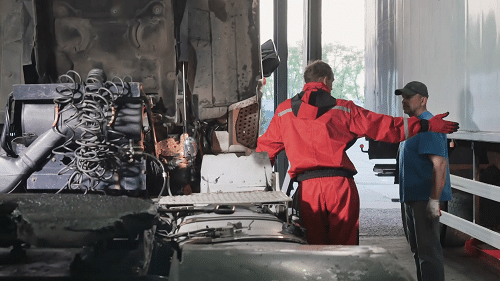
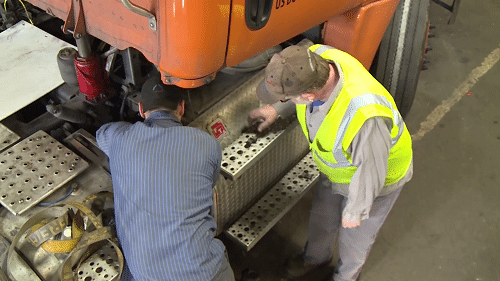
- What a pre-trip inspection has to establish: the truck is in safe mechanical condition, the load is positioned and secured correctly, and every problem noted on the last post-trip DVIR has been corrected
- What en-route inspections are for and why problems that develop during a trip must be caught before they become hazards
- What the post-trip inspection looks for and how the driver’s vehicle inspection report (DVIR) documents it, in hard copy or electronic form
- Who signs the DVIR and at what stage: the driver who finds the defect, the mechanic or service manager who corrects it, and the next driver who reviews it
- How long a carrier keeps DVIRs on file (a minimum of three months) and how a DVIR with defects is routed to maintenance
- Roadside inspections: who performs them, what they cover (the truck, the trailer, the cargo, the driver’s license and hours-of-service records), and what happens to the report
More Topics in the Commercial Motor Vehicle Inspection Training
- The first step of every pre-trip inspection: reviewing the previous post-trip DVIR and the signatures on it, and signing it yourself once you are satisfied the repairs were made
- Using the DVIR checklist to guide the pre-trip: steering system and horn, windshield wipers, lights, mirrors and reflectors, tires, wheels and rims, brakes and air systems, hoses, connectors and fasteners, emergency equipment, coupling equipment and fifth wheels
- Inspecting how the cargo was loaded and secured: placement and arrangement, the load deck, tie-downs, blocks and braces, and how the securement devices were installed and adjusted
- When the cargo-inspection requirement does not apply: sealed vehicles the driver has been told not to open, and loads packed so that inspection is impractical
- How often to re-check cargo securement on the road: within the first 50 miles, whenever duty status changes, and after every three hours or 150 miles of driving, whichever comes first
- The walk-around at every stop: lights, tires, wheel-bearing temperatures and emergency equipment, plus coolant, engine oil and washer fluid at fuel stops
- Roadside inspections: more than three million a year, conducted at weigh stations, for an observed equipment problem, or at random, and what an officer can check beyond the truck (the driver’s license, daily log and signs of drug or alcohol impairment)
- What happens when a roadside inspection finds serious problems: the truck does not move until they are resolved, and the report goes to the carrier
- Completing the post-trip DVIR: every item on the checklist, the carrier’s and the state’s additional inspection points, the remarks section, and the driver’s signature
- Why the post-trip DVIR matters to the next driver, and how the chain of signatures builds personal accountability for a safe truck
What Is in the DOT Inspection Training Kit
- Full-length DOT commercial motor vehicle inspection training video (17:35, English or Spanish)
- Trainee quiz and answer sheet
- A “Presenter’s Guide” if you are going to do this training in person
- A printable training sign-in sheet to keep track of your training program
- A printable Certificate of Completion. editable and reusable for every driver you train
How You Can Deliver the Training
The kit ships on DVD or USB stick in English or Spanish (each language is a separate kit). Play the video in driver orientation, at a safety meeting or one-on-one with a driver who has had a roadside violation, hand out the quiz, and file the answer sheet, sign-in sheet and certificate with the driver’s qualification file. Everything in the kit can be reused for every new driver and every refresher. If you would rather assign driver safety courses online with automatic completion tracking, this program is also in our online safety training library of 250+ courses.
DOT Commercial Motor Vehicle Inspection Training Video – Full Length Preview:
DOT Vehicle Inspection Training Requirements
What FMCSA Requires
The rules this video teaches are in 49 CFR Part 396 and Part 392. Section 396.3 requires every motor carrier to systematically inspect, repair and maintain the vehicles it controls. Section 396.13 requires the driver, before driving, to be satisfied the vehicle is in safe operating condition, to review the last driver’s vehicle inspection report, and to sign it when defects were noted to acknowledge the review and the certification of repairs. Section 392.7 lists the parts the driver must confirm are in good working order before the trip: service brakes and trailer brake connections, parking brake, steering, lights and reflectors, tires, horn, wipers, mirrors, coupling devices, wheels and rims, and emergency equipment.
Section 392.9 governs cargo: the driver must inspect the load and its securement before driving and re-examine it within the first 50 miles, whenever duty status changes, and every three hours or 150 miles thereafter, whichever comes first, unless the vehicle is sealed and the driver has been ordered not to open it or the load is packed so inspection is impracticable. Section 396.11 is the DVIR rule: at the end of each day’s work the driver reports on each vehicle operated, the carrier certifies repairs, the next driver reviews and signs, and the carrier keeps the report and certifications for three months. Since December 2014 a property-carrying driver is not required to submit a DVIR when no defect was found; passenger carriers still file one every day.
Section 396.9 covers roadside inspections: the driver delivers the inspection report to the carrier, and the carrier corrects the violations, certifies the corrections and returns the form to the issuing agency within 15 days. The periodic inspection every 12 months is Section 396.17, and the people who perform it must meet the inspector qualifications in Section 396.19. This kit supports a carrier’s training obligation under these sections and gives you the quiz, sign-in sheet and certificate to document it. It is not a DOT or FMCSA certification, and there is no federal “DOT inspection certificate” for drivers.
Is This the DOT Annual Inspector Certification?
No. The annual (periodic) inspection under 396.17 must be done by someone who meets the qualification requirements in 396.19: relevant training or experience, knowledge of Part 393, and the ability to use the tools and identify defects. That qualification is documented by the carrier, not issued by FMCSA, and it is a mechanic’s credential. This program is for the drivers who operate the truck every day: the pre-trip, en-route and post-trip inspections and the DVIR that Parts 392 and 396 assign to them. If you need to qualify a technician as an annual inspector, that is a different course.
Who Needs This Training
- Every CDL driver who operates a commercial motor vehicle in interstate commerce, during orientation and before the first solo run
- Owner-operators, who are the carrier and the driver at once and carry both sets of duties
- Drivers returning after a roadside violation, an out-of-service order or a DVIR-related citation
- Drivers moving to a new tractor, trailer type or cargo (flatbed securement, tankers, intermodal)
- Dispatchers, safety managers and maintenance staff who route and act on DVIRs
How Often to Train
FMCSA sets no fixed interval for vehicle-inspection training. The trigger points most carriers use:
- On hire, as part of driver orientation
- After a roadside inspection with violations, an out-of-service order or a CSA Vehicle Maintenance BASIC alert
- When equipment changes: a new tractor, a different trailer or coupling system, a new cargo type
- Once a year as a refresher, which is what the presenter’s guide and quiz are built for
Which DOT Training Do You Need?
This program covers the driver’s inspections and the DVIR. For securing the load itself, use our DOT cargo securement training kit, which teaches the tie-down, blocking and bracing rules the en-route checks are meant to verify. For what happens when an inspection fails, our DOT out-of-service criteria training walks drivers through the conditions that put a truck or a driver out of service. Hours-of-service records are part of every roadside inspection; that program is our hours of service training video. The full library of trucking programs is in the Trucking & Distribution category.
FAQs on DOT Inspection Training
Answered by our in-house OSHA Authorized Trainer – Jason Hessom

Have a question for us? Call us at 800-859-1870 or Contact Us Via Email
Federal regulations put a commercial motor vehicle through five kinds of inspection: the periodic inspection at least once every 12 months (49 CFR 396.17), performed by a qualified inspector; the driver’s pre-trip inspection (396.13 and 392.7); en-route inspections the driver makes during the trip, including the cargo re-checks in 392.9; roadside inspections by state or federal inspectors or law enforcement (396.9); and the post-trip inspection documented on a driver’s vehicle inspection report, or DVIR (396.11). This video covers all five and goes into detail on the three the driver performs.
Three of the five: the pre-trip inspection before the vehicle moves, the en-route checks during the trip, and the post-trip inspection with the DVIR at the end of the day. The driver must also review the previous DVIR before the pre-trip and sign it when defects were noted. That is why the CDL skills test includes a vehicle inspection.
A driver’s vehicle inspection report is required at the completion of each day’s work for each vehicle operated, and it must cover at least the parts listed in 49 CFR 396.11: service brakes including trailer brake connections, parking brake, steering mechanism, lighting devices and reflectors, tires, horn, windshield wipers, rear-vision mirrors, coupling devices, wheels and rims, and emergency equipment. Since December 2014 a property-carrying driver does not have to submit a report when no defect or deficiency was found; passenger-carrying drivers still file one every day. When defects are reported, the carrier certifies the repairs and keeps the report and certifications for three months.
Under 49 CFR 392.9 the driver inspects the cargo and its securement devices before driving, then re-examines them within the first 50 miles and adjusts as needed, and again whenever duty status changes or after three hours or 150 miles of driving, whichever comes first. The requirement does not apply to a sealed vehicle the driver has been ordered not to open or to a load packed in a way that makes inspection impracticable. The video also recommends a walk-around of lights, tires, wheel bearings and emergency equipment at every stop.
No. The annual inspection must be performed by someone who meets the inspector qualifications in 49 CFR 396.19, which the motor carrier documents; it is a technician’s qualification, and there is no FMCSA-issued certificate for it. This program trains the drivers who operate the truck on their own pre-trip, en-route and post-trip inspections and the DVIR. It supports your driver training obligation; it does not make anyone an annual inspector.
A 17:35 video in English or Spanish on DVD or USB stick, plus the trainee quiz and answer sheet, a presenter’s guide, an employee sign-in sheet and a Certificate of Completion that is editable (name and date) and reusable for every driver. English and Spanish are sold as separate kits.
FMCSA sets no interval. Train every driver on hire and before the first solo run, retrain after a roadside inspection with violations, an out-of-service order or a DVIR-related citation, when the driver moves to different equipment or cargo, and run the program once a year as a refresher. The kit is reusable, so the refresher costs nothing beyond the meeting time.
14 reviews for DOT Commercial Motor Vehicle Inspection – [Video Training Kit]
![DOT Commercial Motor Vehicle Inspection - [Video Training Kit]](https://www.safetyvideos.com/wp-content/uploads/2022/02/DOT-Commercial-Motor-Vehicle-Inspections-Training-Copy-150x150.png.webp)


A must for any commercial driver. Our drivers know how important a pre-shift inspection is and this training helped them understand what to look for, what to do, and more. The quiz was also very helpful.
Our drivers thought it was good and we liked the price!
CDL drivers need this information
If you have a fleet, your employees need this training
Helpful to our drivers