
Construction Worker Heat Stress Training – [Complete Video Kit]
$239

Your construction workers need training on heat stress, and this complete kit covers your needs. Construction workers operate in all types of weather, but heat is one where precautions are needed. This Construction Worker Heat Stress training will teach your crew the ins and outs of heat-related illnesses and will help keep them from getting sick.
This Construction Worker Heat Stress Training Covers:
- What is heat stress, and why is it important to learn how to prevent heat-related illnesses?
- An overview of how the body works when exposed to high heat conditions
- How much can a construction worker sweat while performing their job duties on a hot day? (Up to 1 quart of water and electrolytes per hour) This is the reason why construction workers need to stay hydrated throughout their workday.
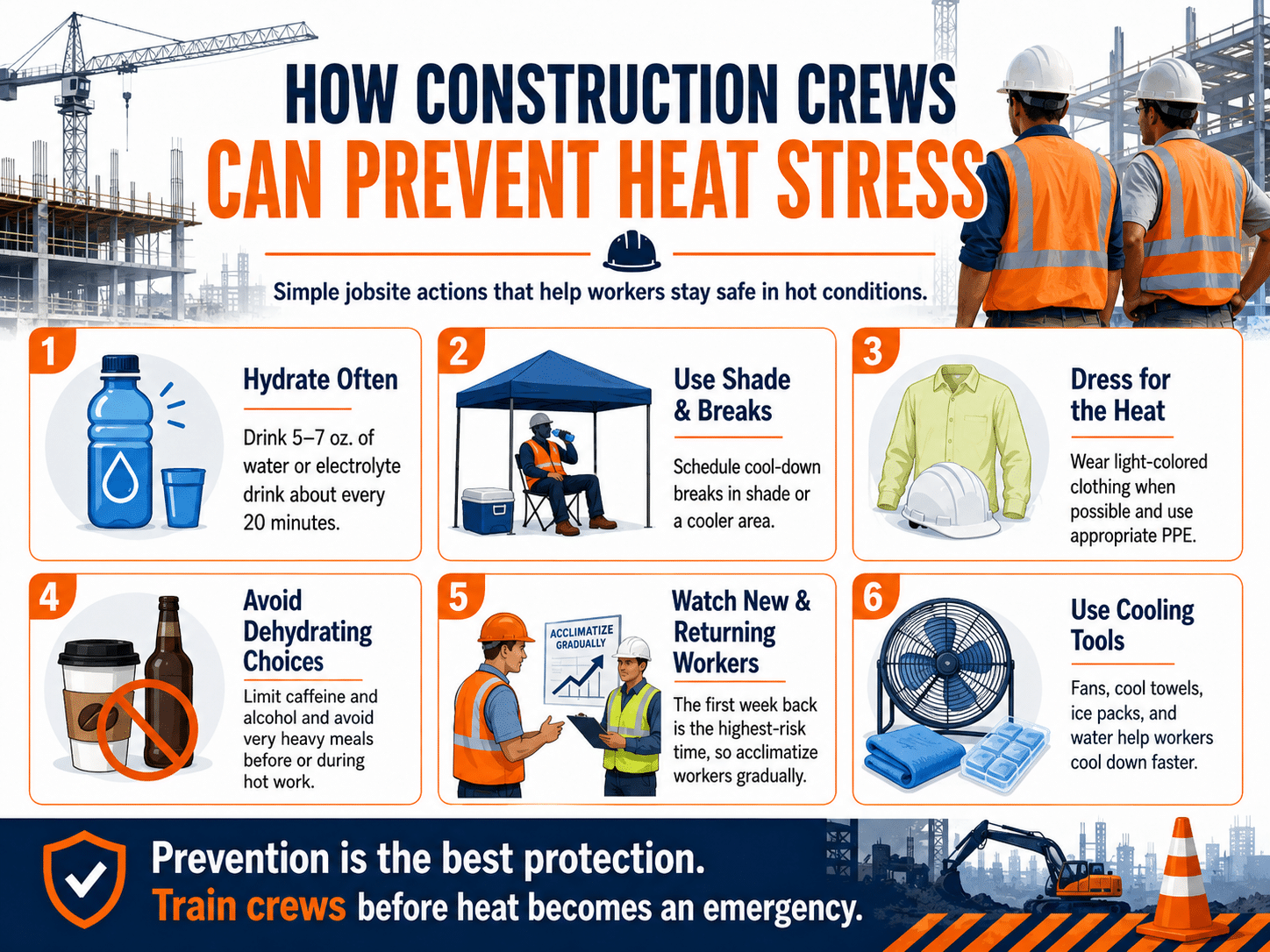
- How much liquid should a construction worker drink during a typical workday when exposed to high heat, sun, or humidity? (A worker should consume 5 to 7 ounces of water or Gatorade-style liquids every 20 minutes or so). Importantly, caffeine should also be avoided since it makes the body lose water faster.
- Does food play a role in helping our bodies fight heat stress? (Yes, lighter meals allow the body to circulate more blood, and the body’s internal “Air conditioning system” works much better than when faced with a heavy meal)
- What are some examples of heat-related illnesses that construction workers might face while they work? (Heat stroke, heat exhaustion, heat syncope, or heat cramps just to name a few)
- What is heat syncope, and what are the signs it is affecting our bodies? (This is the lack of blood flowing to parts of our body, and it might cause dizziness, a rapid heartbeat, and ultimately lead to fainting)
Construction Heat Stress Training Additional Topics Covered:
- What are the symptoms of heat cramps, and how can they be avoided? (Heat cramps are due to not drinking enough liquids, and symptoms include involuntary jerking of muscles as well as cramping)
- What are the symptoms of heat exhaustion? (Weakness, dizziness, excessive sweating, and a feeling of confusion are all signs of heat exhaustion)
- What are the signs and symptoms of heat stroke? (Heat stroke occurs when your body’s systems start to shut down, including your ability to sweat. Symptoms include rapid heartbeat, nausea, vomiting, headache, and skin that is very flushed or red)
- What are the dangers to construction workers if they have heat stroke? (Damage to the body’s internal organs can occur if the heat stroke is not controlled immediately)
- What should construction workers do if they have a co-worker who is affected by heat stroke? (Have the construction worker lie down and rest, provide them with plenty of water or electrolyte replacement (Gatorade or the like), get them out of the sun or heat if at all possible, wet down their clothing, etc.)
- and much more…
Give your construction workers the training they need to help prevent heat-related illnesses on the job. This Construction Worker Heat Stress Training kit will help educate your staff on how to prevent the effects of heat, how to prevent heat stress, and ultimately how to help a co-worker who has heat-related sickness. Available as an English or Spanish-speaking DVD or on a USB stick.
Why Construction Crews Need Heat Stress Training
Construction puts every risk factor for heat illness in one place: direct sun, heavy physical exertion, protective clothing that traps heat, and surfaces like fresh asphalt and roofing membrane that radiate it straight back up at the crew. Add a schedule that does not slow down when the forecast does, and heat stops being a discomfort and becomes the hazard most likely to put one of your people in an ambulance this summer.
The most dangerous week is a worker’s first. OSHA reports that nearly three out of four heat-illness fatalities happen during a worker’s first week on the job, before the body has had a chance to acclimatize to working in the heat. On a trade with constant crew turnover, that means the risk resets every time a new hand shows up — which is exactly why this training belongs in your onboarding, not just your summer safety meeting.
Heat illness is also progressive, and that is the part crews miss. Heat cramps and heat syncope are warnings. Heat exhaustion is the body losing the fight. Heat stroke is the point where the body stops sweating and organs begin to shut down — and it can arrive within minutes of a worker who “just seemed tired.” Training crews to recognize the earlier stages in themselves and in each other is what keeps a hot afternoon from becoming a fatality.
On the regulatory side, there is no final federal heat standard — OSHA enforces heat hazards under the General Duty Clause, and in April 2026 it renewed its National Emphasis Program for outdoor and indoor heat hazards for a further five years, which keeps construction sites squarely in scope for inspection. A federal heat rule has been in rulemaking since 2024 but has no finalization date. Several states, including California, already run their own heat illness prevention standards with specific water, shade, rest, and training requirements. Documented training protects your crew under all of it.
Who Needs This Training:
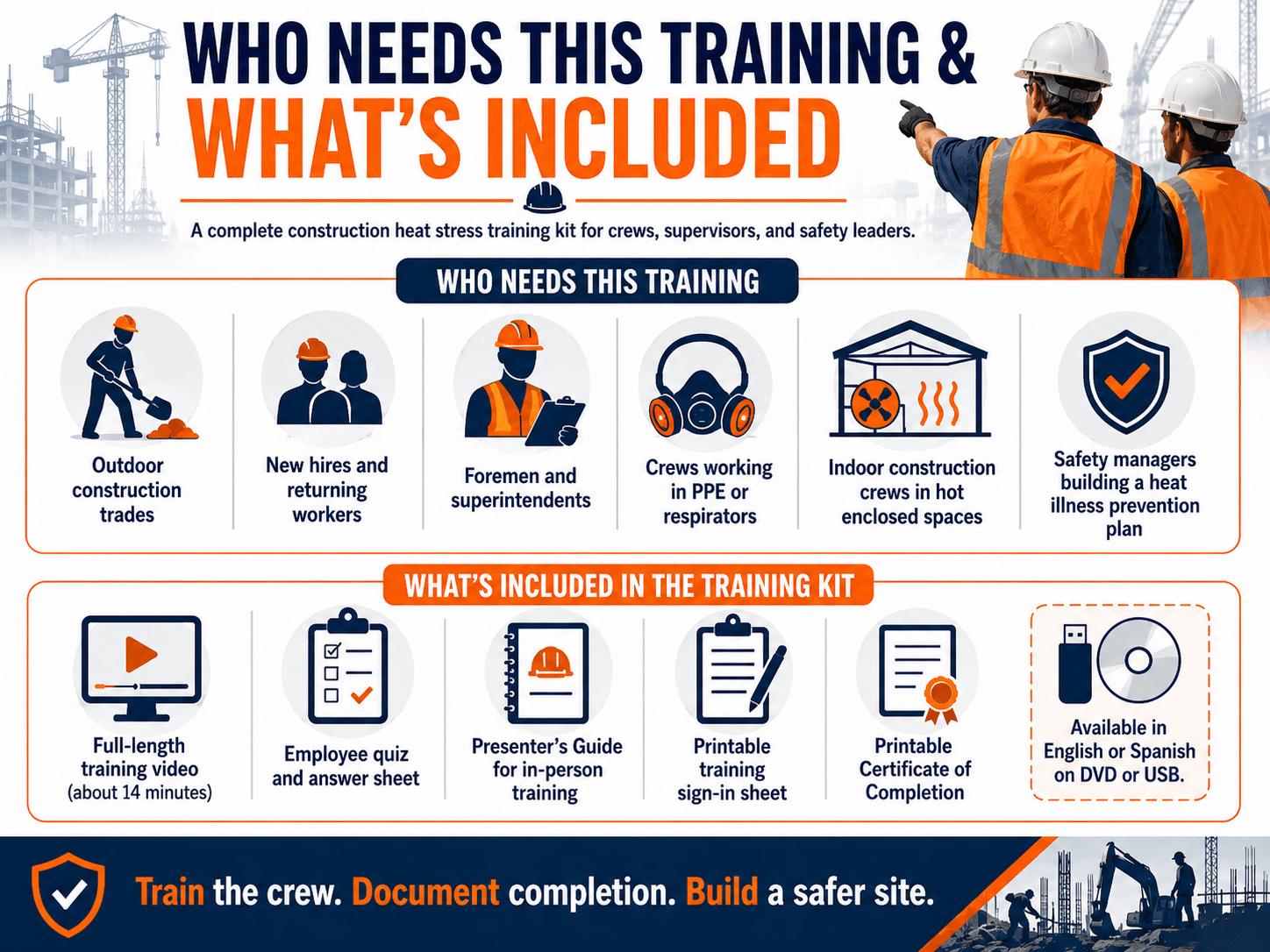
- Outdoor construction trades — roofing, paving and concrete, framing, excavation, utilities, and landscaping crews
- New hires and anyone returning after a week or more away, before their first hot shift
- Foremen and superintendents who schedule the work, the water, and the rest breaks
- Crews in PPE, respirators, or Tyvek, where the gear itself drives up heat load
- Indoor construction trades working in attics, crawlspaces, mechanical rooms, and enclosed slabs, where there is heat without sun
- Safety managers building or refreshing a written heat illness prevention plan
Not a construction crew? Our general heat stress training video covers the same illnesses and response steps for warehouse, manufacturing, and general industry workforces.
This Complete Construction Heat Stress Training Program Includes These Items:
- Full-length Construction Worker Heat Stress training video (about 14 minutes)
- Employee quiz and answer sheet
- A “Presenter’s Guide” if you are going to do this training in person
- A printable training sign-in sheet to keep track of your training program
- A printable Certificate of Completion. You can print as many copies of the Certificate as you need
Heat Stress Training for Construction Workers – Full Length Preview:
FAQs on Construction Heat Stress Training
Answered by our in-house OSHA Authorized Trainer – Jason Hessom

Have a question for us? Give us a call at 800-859-1870 or, Contact Us Via Email
There is no final federal heat standard, but that does not mean heat is unregulated. OSHA enforces heat hazards under the General Duty Clause, which requires employers to protect workers from recognized hazards, and in April 2026 it renewed its National Emphasis Program for outdoor and indoor heat hazards for another five years — so heat-related inspections of construction sites are active policy, not a possibility. Several states run their own heat illness prevention standards with explicit training requirements. Training your crew and documenting it is how you meet the duty under any of these.
OSHA proposed a federal standard, Heat Injury and Illness Prevention in Outdoor and Indoor Work Settings, in August 2024. Public hearings concluded in July 2025 and the post-hearing comment period closed that October, but the rule has not been finalized and currently has no target date. If it is finalized as proposed, it would require covered employers — including construction — to have a written heat injury and illness prevention plan covering water, shade or cooling, rest breaks, acclimatization for new workers, and employee training. Building those habits now means the rule will not catch you flat-footed.
Heat illness escalates. Heat cramps come from not replacing fluids and show up as involuntary muscle jerking and cramping. Heat syncope is reduced blood flow causing dizziness, rapid heartbeat, and fainting. Heat exhaustion brings weakness, dizziness, heavy sweating, and confusion — the worker needs shade, rest, and fluids immediately. Heat stroke is the emergency: the body stops sweating, and rapid heartbeat, nausea, vomiting, headache, and flushed red skin follow, with organ damage if it is not controlled at once. This training walks crews through recognizing each stage in themselves and in a co-worker.
More than thirst suggests, and on a schedule rather than all at once. A construction worker can lose up to a quart of water and electrolytes per hour of sweat on a hot day, so the training teaches drinking roughly 5 to 7 ounces of water or an electrolyte drink every 20 minutes throughout the shift. Caffeine should be avoided because it makes the body shed water faster, and lighter meals help — the body circulates blood and sheds heat far more efficiently than it does after a heavy one.
Because acclimatization takes days that a new hire has not had yet. OSHA reports that nearly three out of four heat-illness fatalities occur during a worker’s first week on the job. A body accustomed to working in heat sweats sooner and more efficiently; a body that is not simply overheats faster. Train new and returning workers before their first hot shift and phase them into full exertion over their first several days rather than putting them straight onto the hottest task on the site.
Yes, and that is one of the most effective ways to run it. The video runs about 14 minutes — short enough to play at a morning tailgate meeting at the start of a hot stretch, and long enough to give every crew member the same vocabulary for the warning signs so they can watch each other through the day. Many contractors show it at the beginning of the season, then repeat it whenever a heat wave is forecast or a new crew rotates onto the site.
25 reviews for Construction Worker Heat Stress Training – [Complete Video Kit]
![Construction Worker Heat Stress Training - [Complete Video Kit]](https://www.safetyvideos.com/wp-content/uploads/2022/02/products-C9-2-150x150.png.webp)


This training will be used annually for our staff that works outdoors. So far, we are very happy!
A must-have course for working outdoors. OSHA takes heat stress training very seriously where we are in Arizona so this is an important piece of our training going forward.
Perfect for us
Good product at a great price
Our employees liked it