
Hawaii Human Trafficking Training Requirements for Hotels (Act 191, 2026): Who, How Often, What Counts


Quick Answer: When Do Hawaii Hotels Have to Start Human Trafficking Training?
Hawaii Act 191 (2026), H.B. 1960 requires transient accommodations employers and their staffing contractors to adopt a prevention policy by September 1, 2027, train guest-contact workers by December 1, 2027, then within 180 days of hire and every two years, and post signs by January 1, 2028.
Hawaii is the newest state on the list, and I have a personal stake in getting it right: the Waikiki and Maui properties I walk through on safety inspections are working through these deadlines now. The law was signed July 7, 2026 and took effect on approval, but its deadlines are staggered, so there is time to do it properly. The order matters. The written policy is due before the training, and the signs come last.
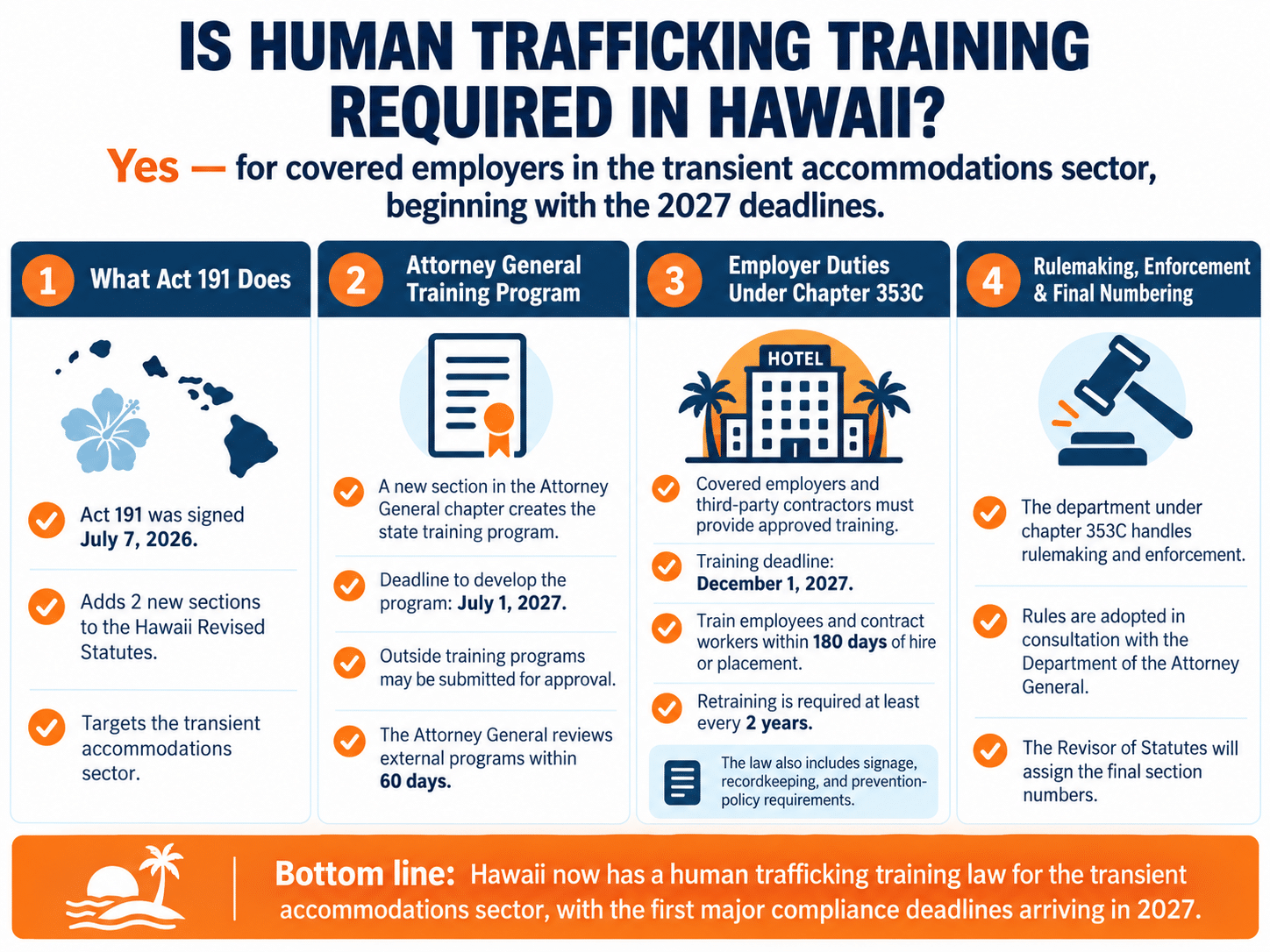
Is Human Trafficking Training Required in Hawaii?
Yes, starting with the 2027 deadlines. Act 191 adds two new sections to the Hawaii Revised Statutes. One, in the Attorney General’s chapter, creates a state training program and an approval path for outside programs. The other, in chapter 353C, puts the duties on employers and gives the department under that chapter the rule-making and enforcement role. The Revisor of Statutes will assign the final section numbers.
Who Has to Be Trained?
The Act reaches further than “hotels.” It covers transient accommodations employers: anyone who owns, operates, manages or controls transient accommodations in Hawaii and has at least one employee or uses contract workers. Transient accommodations follow the state’s transient accommodations tax definition, which takes in hotels, condo-hotels, timeshares and vacation rentals, not only resorts.
It also covers transient accommodations third-party contractors, the companies that furnish contract workers for a fee. That matters in Hawaii, where housekeeping, laundry and security are often contracted out. The workers who need training are employees and contract workers who have contact with guests or access to guest rooms.
How Often and by When?
- September 1, 2027: adopt and implement a written human trafficking prevention policy covering all employees and contract workers, with procedures for reporting to the National Human Trafficking Hotline or local law enforcement.
- December 1, 2027: provide the training to covered employees and contract workers.
- After that: new employees and placements within 180 days, and everyone at least every two years.
- January 1, 2028: post the awareness sign.
What Does the Training Have to Cover?
The Attorney General’s program, and any outside program it approves, has to include at least:
- Definitions of human trafficking and the commercial exploitation of children.
- How labor trafficking and sex trafficking differ as they relate to the transient accommodations sector.
- Indicators, including how to identify people who may be vulnerable to or victims of trafficking, and people who may be engaged in trafficking.
- Appropriate response and reporting procedures for transient accommodations workers.
- Contact information for the National Human Trafficking Hotline, both the toll-free number and the text line, and for local law enforcement.
Item 3 is the one most courses miss. Hawaii wants staff to recognize the person in control, not only the person at risk: the guest who holds everyone’s ID, pays in cash, answers for others and never leaves them alone. Item 2 matters too. On the properties I walk, the labor trafficking risk sits with contracted crews just as much as the sex trafficking risk sits with guest rooms.
How Does Attorney General Approval Work?
There are two paths. The Attorney General develops a state program, due by July 1, 2027. Or an employer or third-party contractor can submit an externally developed program to the Attorney General for approval. The Attorney General approves or disapproves it within 60 days of written receipt, and approves only a program that covers every one of the five topics.
Note who submits: the employer or contractor, not the vendor. If you choose our program, we will give you the compliance crosswalk that maps each of the five topics to the minute it is covered, to attach to your submission. Our Hotels and Hospitality course was written to that list; it has not been approved by the Hawaii Attorney General, and it can only be approved once an employer or contractor submits it.
Penalties and Enforcement
The employer section is enforced by the Department of Law Enforcement, the department that administers chapter 353C, which also writes the rules in consultation with the Attorney General. A violation is a fine of up to $100 per offense, and each day it continues is a separate offense. The fine is collected by civil action.
The Act also gives real protection. An employer, contractor, employee or contract worker who complies in good faith, or who reports suspected trafficking under the policy, is not civilly or criminally liable for a third party’s trafficking unless they knowingly assist it. Tell your staff that part out loud.
Signage and Records
Sign. By January 1, 2028, post human trafficking awareness signage in a conspicuous place staff can reach, in the form the department prescribes by rule, in English and in any other language spoken by at least 10% of employees and contract workers. The form is not out yet, so do not print one early.
Records. Keep records of completed training as the department’s rules require. The director may examine and copy them and ask for training information in any form the director prescribes. Until the rules arrive, keep name, role, employer or contractor, date, course title and length for every worker.
| Item | Hawaii rule |
|---|---|
| Statute | Act 191 (2026), H.B. 1960; new HRS ch. 28 and ch. 353C sections |
| Who | Transient accommodations employers and staffing contractors; staff with guest contact or room access |
| Policy | Written prevention policy by Sept. 1, 2027 |
| First training | By Dec. 1, 2027 |
| New hires | Within 180 days of hire or placement |
| Refresher | At least every 2 years |
| Minimum length | None stated |
| Approval path | AG state program, or employer submits an outside program; AG decides in 60 days |
| Penalty | Up to $100 per offense, each day separate |
| Sign | By Jan. 1, 2028, form set by rule; English plus 10% languages |
| Records | Per department rules; open to the director |
Human Trafficking Awareness and Prevention Training for Hotels and Hospitality. Written to the Act 191 topic list, including the controller indicators, with a Hawaii state card naming the good-faith protection and county police. About 22 minutes in English (Spanish sold separately). Kit includes a quiz and answer sheet, a Presenter’s Guide with a compliance crosswalk for your Attorney General submission, an attendance sheet and an editable certificate. USB or DVD $239, or by LMS subscription with a Hawaii course copy.
Other States
See the human trafficking awareness training hub for all ten states. Hawaii borrowed its topic list from California and its two-year cycle matches Illinois; Texas shows what a full state approval process looks like. In an emergency call 911. Otherwise call the National Human Trafficking Hotline at 1-888-373-7888 or text 233733. You can also call your county police.
Frequently Asked Questions
By December 1, 2027 under Act 191. The written prevention policy is due earlier, by September 1, 2027, and the signage by January 1, 2028.
Within 180 days of hire or placement, and then at least every two years.
It covers transient accommodations as defined for the transient accommodations tax, which includes more than hotels. Check your property type against that definition with your counsel.
Yes, if the employer or contractor submits it to the Attorney General and it is approved. The Attorney General decides within 60 days of written receipt.
A fine of up to 100 dollars per offense, with each day of a continuing violation a separate offense, collected by civil action.
