
Illinois Human Trafficking Training Requirements for Hotels, Restaurants and Truck Stops (820 ILCS 95): Who, How Often, What Counts


Quick Answer: Do Illinois Restaurants, Hotels and Truck Stops Need Trafficking Training?
Yes. The Lodging Services Human Trafficking Recognition Training Act, 820 ILCS 95, as amended by P.A. 104-0099, requires hotels, restaurants and truck stops to give public-facing employees at least 20 minutes of training within six months of hire and every two years after. Enforcement started October 1, 2026.
Illinois is the state that caught the most employers off guard this year. The Act has been on the books since 2019 for hotels, but the 2025 amendment, signed July 2, 2025, pulled restaurants and truck stops in by name and added a penalty section that switched on October 1, 2026. If you run a diner, a truck stop or a hotel with a restaurant, this one applies to you now.
Is Human Trafficking Training Required in Illinois?
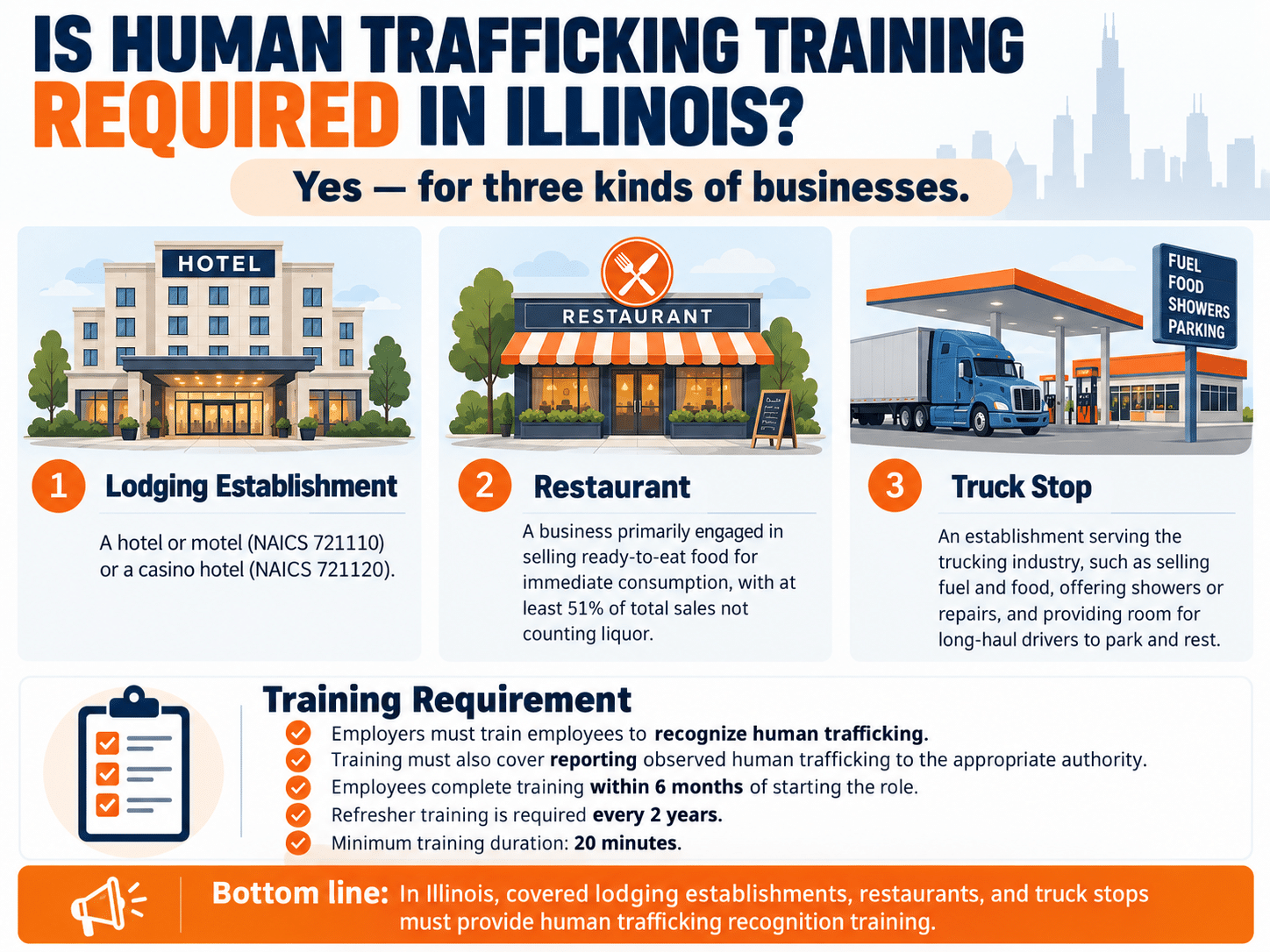
Yes, for three kinds of businesses. Section 10 says an employer “shall provide its employees with training in the recognition of human trafficking and protocols for reporting observed human trafficking to the appropriate authority.” The Act defines each covered business:
- Lodging establishment: a hotel or motel (NAICS 721110) or a casino hotel (NAICS 721120).
- Restaurant: a business primarily engaged in selling ready-to-eat food for immediate consumption, at least 51% of total sales, not counting liquor.
- Truck stop: an establishment serving the trucking industry, such as selling fuel and food, offering showers or repairs, and providing room for long-haul drivers to park and rest.
Who Has to Be Trained?
The Act covers employees “who have recurring interactions with the public.” It names the usual examples: people working in a reception area, housekeeping, anyone who helps customers move their possessions, and anyone who drives customers. At a restaurant that means hosts, servers, bartenders and cashiers. At a truck stop it means cashiers, fuel desk and shower attendants, food service and the shop counter. Back-of-house staff who never see the public are outside the definition, but they are often the ones who notice a coworker who never sees a paycheck.
How Often and by When?
- New hires: within six months of starting in the role.
- Refresher: every two years after that, while still employed.
- Length: at least 20 minutes.
The six-month window runs from the start of employment “in such role,” so a dishwasher promoted to host starts a new clock. Build the dates into whatever system tracks your food handler cards.
What Does the Training Have to Cover?
Section 15(a) lets you use your own program or a third party’s, as long as it includes at a minimum:
- A definition of human trafficking and commercial exploitation of children.
- Guidance on how to identify individuals who are most at risk for human trafficking.
- The difference between human trafficking for labor and for sex as the trafficking relates to the employer’s business.
- Guidance on the role of employees in reporting and responding to instances of human trafficking.
Read item 3 carefully. The 2025 amendment changed “lodging establishments” to “the employer’s business.” A course built only around hotel front desks does not speak to a truck stop. A restaurant needs content about kitchens and bars, where labor trafficking often shows up as workers who owe a recruitment debt, live in housing the boss controls and are paid in cash or not at all. A truck stop needs content about the lot, the fuel desk and the showers. Sex and labor trafficking both belong in it.
Is There an Approval Process or Vendor List?
No. Illinois is open curriculum. The Act says an employer using a program with the four required topics is “in full compliance.” The Illinois Department of Human Services was directed to publish its own curriculum by October 1, 2026 for employers that do not run a program of their own. Using the state version is optional; it is the fallback, not the only door.
Penalties and Enforcement
Section 20, new in the 2025 amendment, starts the clock. Beginning October 1, 2026, the Department of Human Services, a unit of local government that regulates the employer, or a law enforcement agency with jurisdiction may monitor and enforce the Act. The process:
- On finding a violation, the agency gives reasonable notice of noncompliance.
- The employer has 30 days to cure.
- If it is not cured, the Attorney General or State’s Attorney may bring a civil action. The violation is a business offense with a fine of up to $1,500 for each offense.
That 30-day cure is your safety net, but only if you can produce records fast. The local health department inspector who already visits your restaurant is one of the people who can now ask.
Signage and Records
The training Act does not have a signage section or spell out a recordkeeping format. Keep a completion record anyway: employee name, role, hire date, training date, course title and length. When a notice of noncompliance arrives, that record is how you show you were already compliant or cured inside 30 days. Illinois has separate laws on posted human trafficking notices for some businesses; check those with your counsel, because they are not part of 820 ILCS 95.
| Item | Illinois rule |
|---|---|
| Statute | 820 ILCS 95, as amended by P.A. 104-0099 (signed July 2, 2025) |
| Who | Hotels, motels, casino hotels, restaurants and truck stops; staff with recurring public contact |
| New hires | Within 6 months of starting the role |
| Refresher | Every 2 years |
| Minimum length | 20 minutes |
| Required topics | Four, listed in Section 15(a) |
| Approval path | None; own or third-party program; IDHS curriculum optional |
| Penalty | From Oct. 1, 2026: notice, 30-day cure, then up to $1,500 per offense |
| Sign | Not in this Act |
| Records | Not specified; keep completion records |
Two programs, one for each kind of Illinois employer. The Hotels and Hospitality kit covers the front desk, housekeeping and contract crews. The General Industry kit adds restaurants and bars, truck stops and trucking, transit and staffing, so Section 15(a)(3) is answered for the business you actually run. Each runs about 22 minutes in English (Spanish sold separately), with a quiz and answer sheet, a Presenter’s Guide with a compliance crosswalk, an attendance sheet and an editable certificate. USB or DVD $239 each, or by LMS subscription with an Illinois course copy.
Hotels: start with the Hotels and Hospitality kit. A hotel with a full restaurant can use both.
Other States
See the human trafficking awareness training hub for every state with a hotel training law, or compare California (also every two years), Texas (annual, approved list only) and Florida (annual, DBPR-approved). In an emergency call 911. Otherwise call the National Human Trafficking Hotline at 1-888-373-7888 or text 233733.
Frequently Asked Questions
Yes. Since the 2025 amendment, the Act covers restaurants and truck stops as well as hotels. Employees with recurring public contact train within six months of hire and every two years.
October 1, 2026. From that date the Department of Human Services, local regulators and law enforcement can enforce the Act, with a 30-day cure period before a fine.
If a violation is not cured within 30 days of notice, the Attorney General or State’s Attorney may sue, and the business offense carries a fine of up to 1,500 dollars for each offense.
No. An employer may use its own program or a third party program that covers the four topics in Section 15(a). The IDHS curriculum is for employers that do not have their own.
At least 20 minutes, completed within six months of starting the role and repeated every two years.
