
California Human Trafficking Training Requirements for Hotels (Gov. Code §12950.3): Who, How Often, What Counts


Quick Answer: Do California Hotels Have to Train Staff on Human Trafficking?
Yes. California Government Code §12950.3 requires hotels and motels to give at least 20 minutes of human trafficking awareness training to every employee likely to come into contact with victims: within six months of hire, then once every two years. The Civil Rights Department can seek a court order against an employer that skips it.
I get this question from California hotel managers more than any other state, usually right after a brand audit or an insurance renewal. The law is short, and it is open curriculum, which means the state does not keep an approved-vendor list. You pick a program that covers the five topics the statute names, you train the right people on the right clock, and you keep proof. This page walks through each piece, and then covers the separate transit-station rule in Civil Code §52.6.
Is Human Trafficking Training Required in California?
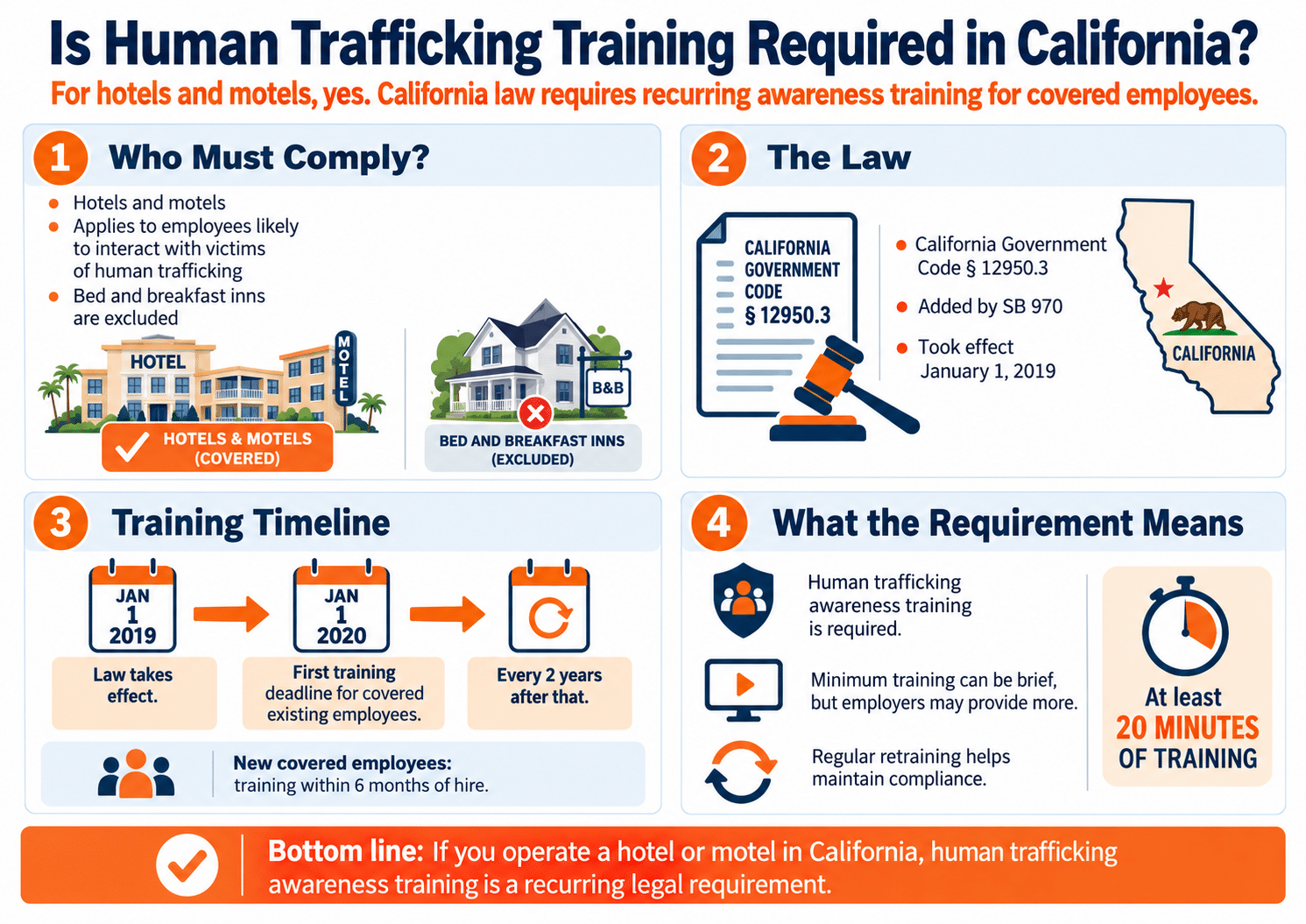
For hotels and motels, yes. The section was added by SB 970 in 2018 and took effect January 1, 2019. Subdivision (a) defines the “employer” as a hotel or motel and expressly leaves out bed and breakfast inns. The first round of training was due by January 1, 2020; since then the law runs on a two-year cycle.
Two other details in the text are worth knowing. Subdivision (e) says an employee’s failure to report a trafficking case does not, by itself, make the employer or the employee liable to the victim. And subdivision (f) says 20 minutes is a floor, not a target: the Legislature wanted employers to go longer and more often if they choose.
Who Has to Be Trained?
The law covers each employee “who is likely to interact or come into contact with victims of human trafficking.” Subdivision (b)(3) spells out that this includes, but is not limited to, anyone with recurring interactions with the public, and it names four roles:
- Reception and front desk staff
- Housekeeping
- Staff who help guests move their possessions (bell staff and porters)
- Drivers who transport guests
In practice I tell properties to train more people than that list, not fewer. Night audit, security, maintenance and food and beverage staff all see the same hallways and parking lots. Contract housekeepers and staffing-agency workers are a judgment call your counsel should make, but labor trafficking in contracted crews is one of the things the training is meant to catch.
How Often and by When?
- New hires: within six months of starting in a covered role.
- Everyone covered: once every two years after the initial round.
- Length: at least 20 minutes of “classroom or other effective interactive training and education.”
The interactive wording matters. A video played in a break room with nobody checking whether anyone watched is a weak record. Pair the video with a quiz, a short discussion, or an LMS course that tracks completion, and keep the result.
What Does the Training Have to Cover?
Subdivision (c) lists five topics. Any program you use should hit every one of them:
- The definition of human trafficking and commercial exploitation of children.
- Guidance on how to identify individuals who are most at risk for human trafficking.
- The difference between labor and sex trafficking specific to the hotel sector.
- Guidance on the role of hospitality employees in reporting and responding to this issue.
- Contact information for appropriate agencies, including the National Human Trafficking Hotline (1-888-373-7888, text 233733) and the telephone numbers of local law enforcement.
Item 3 is where a lot of generic courses fall short. Labor trafficking in a hotel looks like a contract crew that is driven in and out together, lives where it works and never handles its own pay. It deserves as much screen time as sex trafficking, and California is one of the states that says so in the statute. Item 5 also needs a local number, so post your police non-emergency line next to the hotline. Subdivision (d) lets you add material from the Department of Justice, the DHS Blue Campaign and nonprofit victim organizations.
Is There an Approval Process or Vendor List?
No. California does not pre-approve courses. You can build your own, buy one, or use free material, as long as it covers the five topics in subdivision (c) and runs at least 20 minutes. That puts the burden on you to show the content lines up, which is why our Presenter’s Guide carries a crosswalk mapping each topic to the minute it is covered.
Penalties and Enforcement
The section names the Civil Rights Department as the enforcer. Under subdivision (g), if an employer violates the section, the department “may seek an order requiring the employer to comply.” There is no fixed per-day fine in §12950.3 itself. The real exposure is the order, the investigation that comes with it, and what a missing training record looks like in a civil case after an incident on your property.
Signage and Records
The training law does not have its own sign or recordkeeping section. The posting rule lives in Civil Code §52.6, which requires hotels, motels and bed and breakfast inns (among many other businesses) to post the state’s human trafficking notice in a conspicuous place near the public entrance or where employee notices go. The Attorney General publishes model notices in English, Spanish and the county’s third language where one applies.
For records, keep a sign-in sheet or LMS completion report with each employee’s name, role, date and course title, and track the six-month and two-year dates. That is the file the department will ask for first.
California Transit Stations: Civil Code §52.6
Hotels are not the only California employers with a training rule. Civil Code §52.6 also requires operators of intercity passenger rail, light rail and bus stations to give at least 20 minutes of training to new and existing employees who may come into contact with victims or receive reports from coworkers. The training covers recognizing the signs and reporting to law enforcement. Our General Industry human trafficking training includes a transit and rideshare segment written for that audience.
| Item | California rule |
|---|---|
| Statute | Gov. Code §12950.3 (SB 970, 2018) |
| Who | Hotels and motels (not B&Bs); employees likely to contact victims: reception, housekeeping, bell, drivers |
| New hires | Within 6 months of starting the role |
| Refresher | Once every 2 years |
| Minimum length | 20 minutes, classroom or other effective interactive training |
| Required topics | Five, listed in subdivision (c)(1) to (5) |
| Approval path | None; open curriculum, no state list |
| Penalty | Civil Rights Department may seek a compliance order |
| Sign | Civil Code §52.6 notice near the public entrance |
| Records | Not specified in §12950.3; keep completion records |
Human Trafficking Awareness and Prevention Training for Hotels and Hospitality. About 22 minutes in English (Spanish sold separately), written to the §12950.3 topic list with equal weight on labor and sex trafficking. Kit includes a quiz and answer sheet, a Presenter’s Guide with a compliance crosswalk appendix, an attendance sheet and an editable certificate. USB or DVD $239, or by LMS subscription with a California course copy and a certificate per learner.
Transit operators and mixed-use properties can pair it with the General Industry kit.
Other States
Every hotel training law sets its own clock. See the human trafficking awareness training hub for all ten states, or go straight to Illinois (hotels, restaurants and truck stops), Texas (annual, approved list) and Hawaii (new in 2026). In an emergency call 911. Otherwise call the National Human Trafficking Hotline at 1-888-373-7888 or text 233733.
Frequently Asked Questions
Once every two years for covered employees, and within six months of hire for new employees in a covered role, under Government Code section 12950.3.
No. The section defines the employer as a hotel or motel and expressly excludes bed and breakfast inns. Bed and breakfast inns are still on the Civil Code 52.6 posting list.
No. California is open curriculum. Any course of at least 20 minutes that covers the five topics in subdivision (c) can be used, and the employer is responsible for showing that it does.
The Civil Rights Department. The statute lets the department seek an order requiring a hotel or motel to comply.
Operators of intercity passenger rail, light rail and bus stations are required by Civil Code 52.6 to give at least 20 minutes of training to employees who may come into contact with victims.
