
Texas Human Trafficking Training Requirements for Hotels (Bus. & Com. Code Ch. 114): Who, How Often, What Counts


Quick Answer: What Does Texas Require Hotels to Do About Trafficking Training?
Texas Business and Commerce Code Chapter 114 requires operators of hotels and motels with more than 10 rooms to have every directly employed worker complete an Attorney General approved human trafficking course of at least 20 minutes every year, new hires within 90 days, with a certificate for each and the AG sign posted.
Texas has one of the most detailed hotel training laws in the country, and the Office of the Attorney General (OAG) wrote a standards document that reads like a scoring sheet. I used it as the design spec for our own program because a course built to the Texas list covers most of what the other states ask for. The catch is that Texas only accepts courses the OAG has approved, so the vendor question comes first here.
Is Human Trafficking Training Required in Texas?
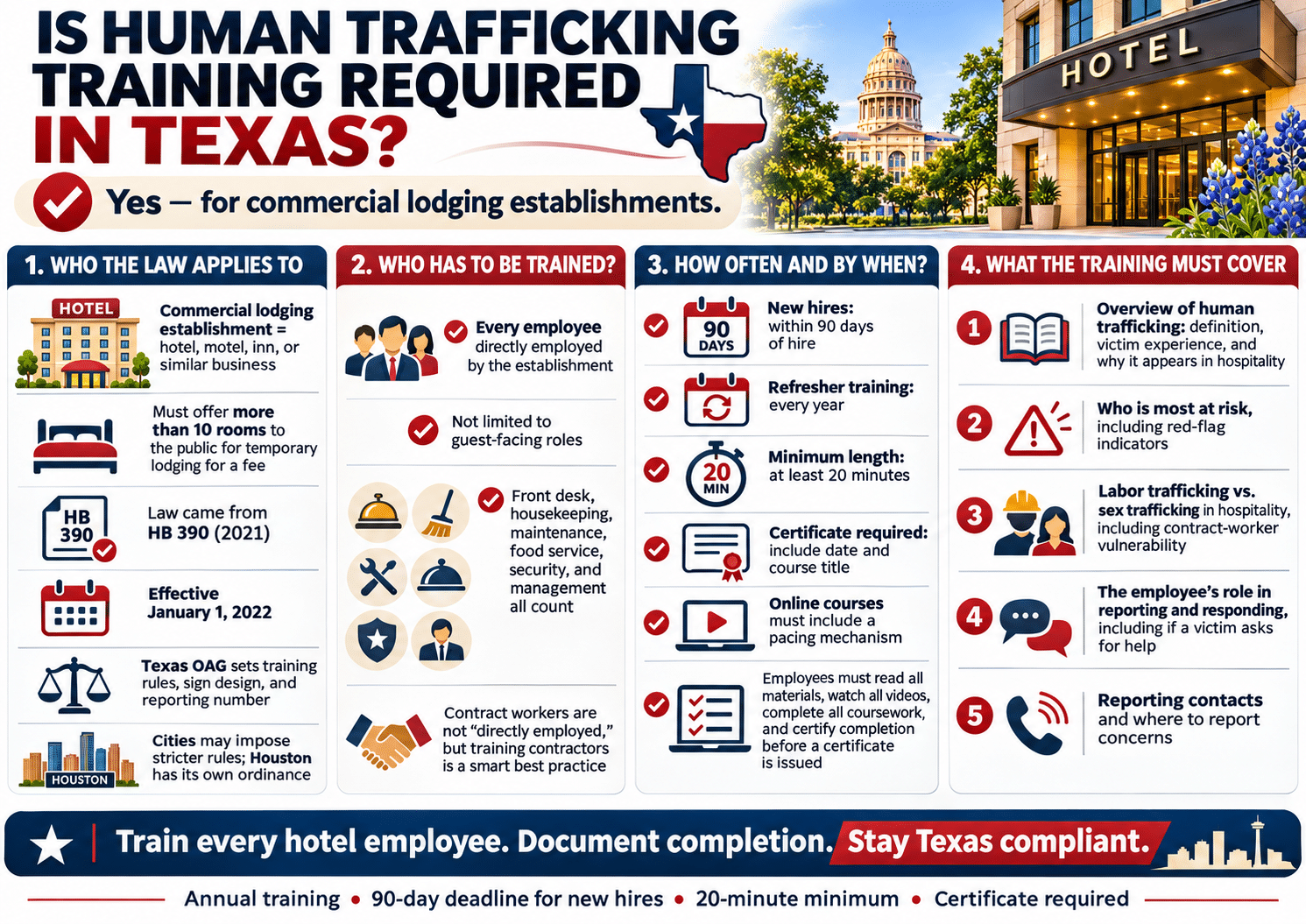
Yes, for a “commercial lodging establishment”: a hotel, motel, inn or similar business that offers more than 10 rooms to the public for temporary lodging for a fee. The law came from HB 390 (2021) and took effect January 1, 2022. The OAG writes the training rules, designs the sign and designates the reporting number. Cities can go further; Houston has its own hotel ordinance.
Who Has to Be Trained?
Section 114.0051 says the operator “shall require each employee who is directly employed by the establishment” to complete the training. That is every employee on your payroll, not only guest-facing staff. Contract workers employed by a staffing company are not “directly employed,” but the OAG standards expect the course to teach staff about contract workers who are vulnerable to labor trafficking, and I would train any contractor you can.
How Often and by When?
- New hires: within 90 days of the hire date.
- Refresher: every year.
- Length: at least 20 minutes, counting any supporting material.
- Certificate: the program issues a certificate of completion to each employee who finishes it, with the date and the course title.
Online courses carry one more rule: a pacing mechanism. The employee has to read all course materials, view all videos, complete all coursework and certify completion before the certificate issues. A video someone can skip to the end of does not qualify.
What Does the Training Have to Cover?
The statute lists the content, and the OAG standards add detail. In short, an approved course covers:
- An overview of human trafficking: how it is defined, the experience of victims, and how and why it happens in the hospitality industry.
- Who is most at risk, with the eight red-flag indicators the OAG names.
- The difference between labor and sex trafficking in the hospitality industry, including contract workers vulnerable to labor trafficking.
- The employee’s role in reporting and responding, including what to do if a victim asks for help.
- Contact information for reporting.
On contacts the OAG is specific. The training directs employees to three places: 911 in an emergency; iWatchTX at 844-643-2251 or iWatchTX.org to give law enforcement information about suspicious activity; and the National Human Trafficking Hotline at 1-888-373-7888 or text 233733 for help for a victim.
The course also has to cover the required sign, the annual training rule, and this sentence, word for word: employees “may not be disciplined, retaliated against, or otherwise discriminated against for making a good faith report of a suspected act of human trafficking.”
The design standards matter as much as the topics. No sensationalized imagery, survivor consultation in the design, every statistic cited with its source and publication date, clear learning objectives, and WCAG 2.1 AA accessibility (captions and a transcript).
How Does Attorney General Approval Work?
A course qualifies only if the Attorney General approved it or it appears on the OAG’s published list of preapproved programs. The OAG application process works like this:
- The provider completes the OAG training application and sends it with a link to the hosted online course (or slides and an instructor outline for in-person training).
- The OAG reviews it against its training standards, in roughly 60 business days from a complete application.
- Approved courses go on the OAG list. A course that falls short gets a written evaluation of what failed, and can be resubmitted.
Our Hotels and Hospitality program was built to the Texas OAG standards, including the Texas state card with iWatchTX and the no-retaliation sentence. Our application to the OAG has not been filed yet, so it is not on the list. Until it is, check the OAG list before you buy any course, ours included, for the annual Texas requirement.
Penalties and Enforcement
After written notice of a violation, the operator has 30 days to cure. If it is not cured, the civil penalty is up to $500 for each violation, and each day counts separately. The Attorney General can bring the action. Peace officers may also enter during business hours to check compliance.
Signage and Records
Sign. The property posts the OAG’s human trafficking sign, at least 11 by 17 inches in at least 16-point type, in English, Spanish and any language spoken by at least 10% of employees. It states the annual training requirement and the no-retaliation protection, and lists indicators and reporting contacts. Download the template from the OAG; do not make your own.
Records. The operator keeps the training documentation and certificates for current and former employees and produces them to the Attorney General within 72 hours of a request. Seventy-two hours is not much time; keep the certificates in one place.
Other Texas Rules
Texas also has human trafficking training rules for rideshare (TNC) drivers and for commercial driver license programs at public colleges and career schools, plus healthcare and cosmetology licensees. Those run through their own agencies and are outside this page.
| Item | Texas rule |
|---|---|
| Statute | Bus. & Com. Code ch. 114 (HB 390, 2021) |
| Who | Hotels, motels, inns with more than 10 rooms; every directly employed worker |
| New hires | Within 90 days of hire |
| Refresher | Every year |
| Minimum length | 20 minutes |
| Approval path | OAG approval or OAG preapproved list; about 60 business days |
| Reporting contacts | 911; iWatchTX 844-643-2251 / iWatchTX.org; national hotline |
| Penalty | 30-day cure, then up to $500 per violation per day |
| Sign | OAG template, 11 x 17 in, 16-point, English, Spanish, 10% languages |
| Records | Certificates kept; to the AG within 72 hours of request |
Human Trafficking Awareness and Prevention Training for Hotels and Hospitality. Built to the Texas OAG training standards, with a Texas state card covering 911, iWatchTX and the national hotline; it is not on the OAG list yet, so check the list before you rely on it. About 22 minutes in English (Spanish sold separately). Kit includes a quiz and answer sheet, a Presenter’s Guide with a compliance crosswalk, an attendance sheet and an editable certificate. USB or DVD $239, or by LMS subscription with a Texas course copy and a certificate per learner.
Other States
See the human trafficking awareness training hub for every state with a hotel law. Florida also requires annual training from an approved list, California is open curriculum every two years, and Illinois now covers restaurants and truck stops too. In an emergency call 911. Otherwise call the National Human Trafficking Hotline at 1-888-373-7888 or text 233733.
Frequently Asked Questions
Yes. Hotels, motels and inns with more than 10 rooms require every directly employed worker to complete an approved course of at least 20 minutes every year, and new hires within 90 days.
Yes. The course has to be approved by the Attorney General or appear on the list of preapproved programs the Attorney General publishes.
Call 911 in an emergency. Report information for law enforcement to iWatchTX at 844-643-2251 or iWatchTX.org. For help for a victim, call the National Human Trafficking Hotline at 1-888-373-7888.
Within 72 hours of a request from the Attorney General. The operator keeps records for current and former employees.
After written notice and a 30-day cure period, a civil penalty of up to 500 dollars per violation, with each day a separate violation.
No. Texas law says employees may not be disciplined, retaliated against, or otherwise discriminated against for making a good faith report of a suspected act of human trafficking.
