
New York Human Trafficking Training Requirements for Hotels (GBL §205): Who, How Often, What Counts


Quick Answer: Do New York Hotels Have to Give Human Trafficking Training?
Yes. New York General Business Law §205 requires every lodging facility to give employees likely to interact with guests a human trafficking recognition training within their first 60 days, on the premises and on paid time, using a program established or approved by DCJS and OTDA, and to keep completion records.
New York’s law has been in force since July 2023, and most of the questions I get about it come down to one: what counts as an approved program? The statute says one thing and the state’s own guidance says something more relaxed. Below is the law as written, then what the Division of Criminal Justice Services actually tells hotels.
Is Human Trafficking Training Required for New York Hotels?
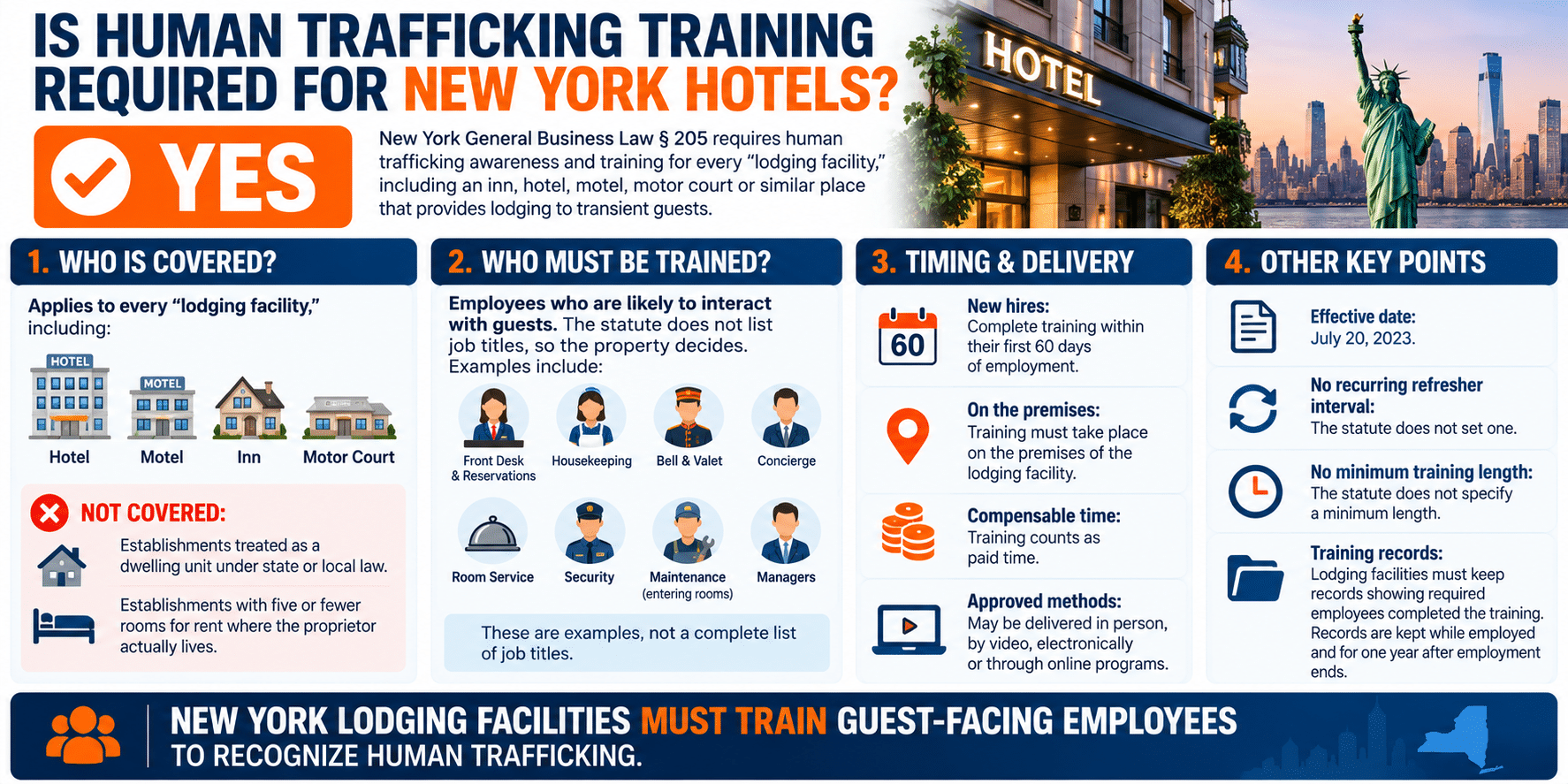
Yes. General Business Law §205, titled human trafficking awareness and training, applies to every “lodging facility”: an inn, hotel, motel, motor court or similar place that serves transient guests. It took effect July 20, 2023. Two kinds of property are left out: anything treated as a dwelling unit under state or local law, and a building with five or fewer rooms for rent that the proprietor actually lives in. A small owner-occupied bed and breakfast may fall outside it; a 20-room motel does not.
Who Has to Be Trained in New York?
Employees who are likely to interact with guests. The statute does not list job titles, so the property decides. I would read it the way a guest experiences a stay: front desk, reservations, bell and valet, concierge, housekeeping, room service, security, maintenance that enters rooms, and the managers who supervise all of them. Contracted housekeeping and laundry crews interact with guests too, and labor trafficking inside contracted crews is one of the things this training is meant to catch.
How Often and by When
- New hires: within their first 60 days of employment.
- Existing staff when the law began: employment law firm Littler reported a deadline of November 20, 2023 for client-facing employees already on staff. The current statute text does not repeat it.
- Refresher: the statute does not set one. Many brands require annual training anyway, and I recommend it.
- Where and when: the training takes place on the premises of the lodging facility and counts as compensable time. It may be delivered in person, by video, electronically or online.
- Minimum length: none stated.
What the Training Has to Cover
Section 205(1)(c) sets four minimum topics:
- The nature of human trafficking
- How human trafficking is defined in law
- How to identify victims of human trafficking
- Whom to contact for relief, recovery, and social and legal services, such as the National Human Trafficking Hotline
DCJS adds that the nature-of-trafficking topic covers both labor and sex trafficking. That is the right reading. In hotels the labor side shows up in contracted cleaning and renovation crews who never handle their own pay, and it is easier to miss than the indicators people expect. The reporting rule is the same for both: observe, document and report through your manager or directly, and never confront, follow or detain anyone. In an emergency call 911. Otherwise call the National Human Trafficking Hotline at 1-888-373-7888 or text 233733.
Approval and Vendor Path
On paper, the program has to be established or approved by the commissioners of DCJS and the Office of Temporary and Disability Assistance, in consultation with the New York State Interagency Task Force on Human Trafficking, and the statute tells them to post a list of approved programs online. It also allows training from federal, state or nonprofit sources, or built into existing programs, as long as it includes everything the section requires.
In practice, the DCJS human trafficking page names one course, the Interagency Task Force video “Understanding Human Trafficking”, as usable for the requirement, lists the minimum topics, and says lodging facilities that use other established trainings are encouraged to verify with their trainers that the training covers what §205 requires. When I checked on October 15, 2026, I found no separate list of approved lodging programs on that page. So the practical test New York applies is the topic list, and the hotel is expected to check its trainer against it.
Our Hotels and Hospitality kit was built to the hotel-sector topic lists in these laws, and we are pursuing listing where the state keeps one. It is not on a New York list. The Presenter’s Guide crosswalk appendix shows where each of the four §205 topics appears in the video, which is the documentation DCJS suggests you get from your trainer.
Penalties and Enforcement
Section 205 does not set a penalty or name an enforcing agency. That is not a reason to skip it. The records requirement is how compliance gets proven, and a lodging facility that cannot produce them after an incident on the property is in a weak position with regulators, insurers and plaintiffs alike.
Signage and Records
- Records: keep records showing that each required employee completed the training, for the length of their employment and for one year after it ends.
- Signage: §205 does not include a posting requirement. Many properties post the National Human Trafficking Hotline in staff areas anyway, and some brands require it.
New York at a Glance
| Item | New York (GBL §205) |
|---|---|
| Statute | General Business Law §205; effective July 20, 2023 |
| Who | Employees of lodging facilities likely to interact with guests (small owner-occupied and dwelling-unit properties excluded) |
| New-hire deadline | Within the first 60 days of employment, on premises, on paid time |
| Refresher | None stated |
| Minimum length | None stated |
| Approval path | Program established or approved by DCJS and OTDA; DCJS names the ITF course and asks hotels to verify other trainings against the topic list |
| Penalty | None stated in the section |
| Sign | Not required by §205 |
| Records | Proof of completion, employment plus 1 year |
Hotels and Hospitality kit: a 22-minute video (about 25 minutes in Spanish), quiz and answer sheet, a Presenter’s Guide with a compliance crosswalk, an attendance sheet and an editable certificate. USB or DVD kits are $239; streaming and LMS by subscription with a certificate per learner.
Other States
New York is one of ten states with a hotel training law; the human trafficking awareness training hub compares them all. Nearby: Connecticut’s annual certification and Rhode Island’s annual training rule. Also worth reading: California’s two-year rule, and my post on the signs of human trafficking in hotels.
Frequently Asked Questions
Yes for lodging facilities. General Business Law section 205 requires employees likely to interact with guests to complete human trafficking recognition training within their first 60 days of employment.
Yes. The statute says the training takes place on the premises of the lodging facility and counts as compensable time.
The statute sets only the 60-day new-hire deadline and no refresher interval. Many brands require annual training, which is a sound practice.
The statute calls for programs established or approved by DCJS and OTDA. DCJS names the Interagency Task Force course and encourages hotels using other trainings to verify with their trainers that the four required topics are covered.
For the length of each employee’s employment and for one year after it ends.
