
Rhode Island Human Trafficking Training Requirements for Hotels (R.I. Gen. Laws Ch. 5-14.1): Who, How Often, What Counts


Quick Answer: Do Rhode Island Hotels Have to Train Staff on Human Trafficking?
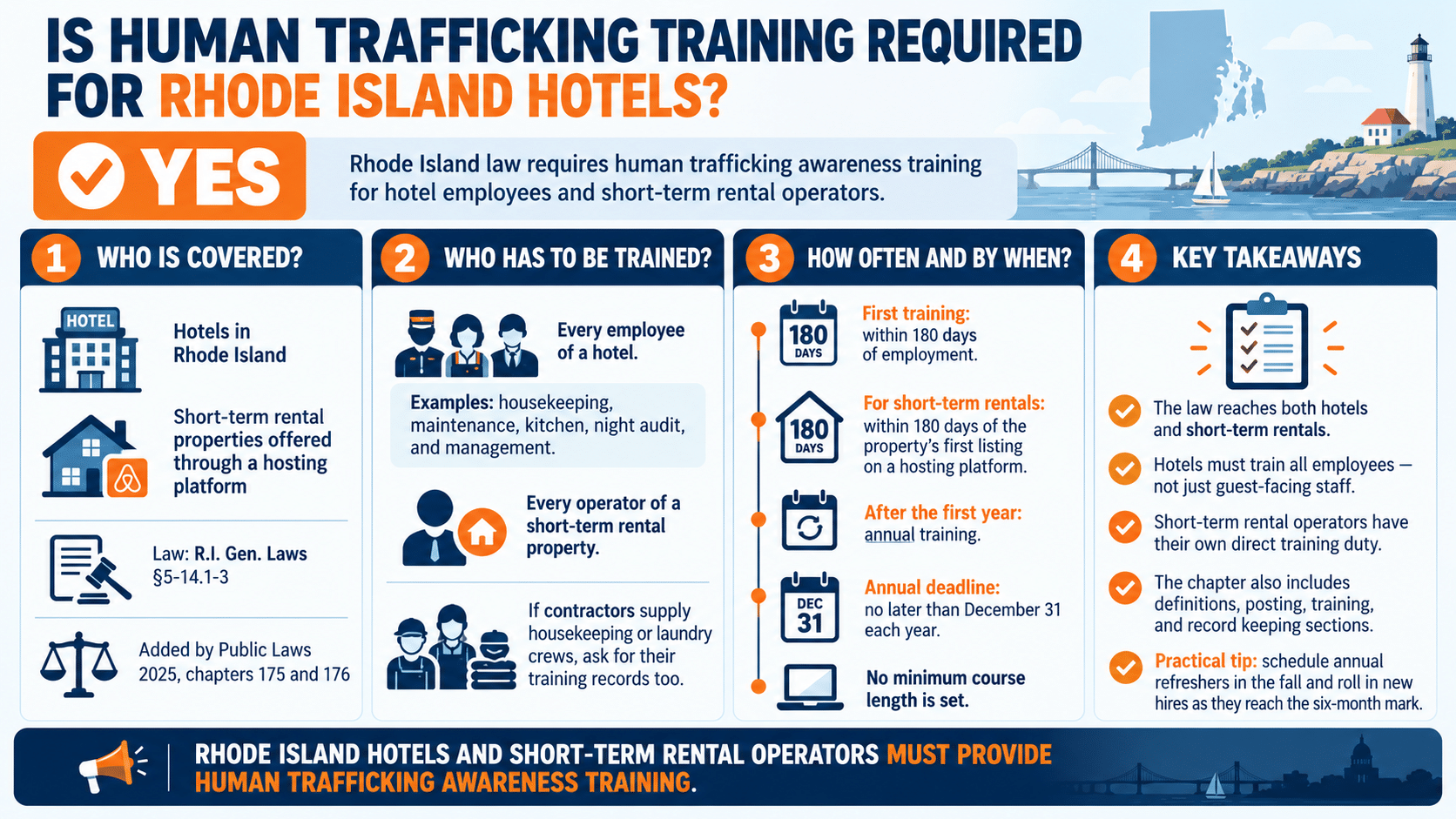
Yes. Since January 1, 2026, Rhode Island General Laws chapter 5-14.1 requires every hotel employee and every short-term rental operator to complete human trafficking awareness training established or approved by the Department of Business Regulation within 180 days, then every year by December 31.
Rhode Island has had a posting law for hotels since 2022. In 2025 the General Assembly turned it into the Human Trafficking Prevention Notice and Training Act, and the training half took effect on January 1, 2026. Here is what the four sections of the chapter require, and the one question the statute leaves to the Department of Business Regulation.
Is Human Trafficking Training Required for Rhode Island Hotels?
Yes. The training rule is R.I. Gen. Laws §5-14.1-3, added by Public Laws 2025, chapters 175 and 176. The chapter index shows four sections: definitions, posting, training and record keeping. “Hotel” means any establishment defined in §5-14-3, and the training duty also reaches short-term rentals offered through a hosting platform.
Who Has to Be Trained in Rhode Island?
- Every employee of a hotel. Not just guest-facing staff. Housekeeping, maintenance, kitchen, night audit and management are all employees.
- Every operator of a short-term rental property. A short-term rental is a residential unit offered for tourist or transient use through a hosting platform. Note the wording: for rentals, it is the operator who trains, not a rental’s staff.
If contractors supply your housekeeping or laundry crews, ask for their training records as well. Labor trafficking inside contracted crews is one of the patterns this training is meant to surface.
How Often and by When
- First training: within 180 days of employment, or for a rental operator, within 180 days of the property’s first listing on a hosting platform.
- After the first year: annual training, completed no later than December 31 each year.
No minimum course length is set. With an annual December 31 deadline, the practical move is to schedule the refresher in the fall, before the holiday season, and roll new hires into it as they pass their six-month mark.
What the Training Has to Cover
Under §5-14.1-1, human trafficking awareness training includes, at a minimum:
- The definition of human trafficking and commercial exploitation of children
- How to identify individuals at risk for trafficking
- How to identify the signs of trafficking and individuals potentially engaged in it
- Differences between labor and sex trafficking, specific to the hotel sector
- The role of hospitality employees in reporting and responding
- Contact information for the National Human Trafficking Hotline toll-free number and text line, or the local law enforcement agency
That list is nearly word for word the one Georgia adopted in 2026, and it is the hotel-sector topic list our Hotels and Hospitality program was written to. The reporting rule never changes: staff observe, document and report, and never confront, follow or detain anyone. In an emergency call 911. Otherwise call the National Human Trafficking Hotline at 1-888-373-7888 or text 233733.
Operators also have to implement procedures and adopt policies for reporting suspected trafficking to the National Human Trafficking Hotline or to local law enforcement. Put that policy in writing and walk staff through it during the training.
Approval and Vendor Path
The statute defines qualifying training as training “established or approved by the department”, meaning the Department of Business Regulation. DBR issued Human Trafficking Bulletin 2025-1 on the new requirements (DBR bulletin). I was not able to open the bulletin itself when I checked on October 15, 2026, and I could not find a published list of approved providers or an application process for vendors. Rhode Island Realtors summarized the rule as training approved or offered by DBR.
Our kit was built to the hotel-sector topic lists in these laws, and we are pursuing listing where the state keeps one, including with DBR. It is not DBR-approved today. Before you rely on any course in Rhode Island, ours included, ask DBR’s Division of Commercial Licensing which trainings it has approved.
Penalties and Enforcement
Chapter 5-14.1 does not set a dollar penalty of its own. Enforcement runs through DBR and the records rule: DBR can ask for training records in writing, and the operator has to produce them within a reasonable time, no later than ten business days. A property that cannot show records for every employee has nothing to hand DBR when it asks.
Signage and Records
- Sign: under §5-14.1-2, every hotel operator posts human trafficking awareness signage in a location conspicuous to employees, in English and any other language spoken by at least 10 percent of employees. The statute sets the wording, built around the hotline at 1-888-373-7888.
- Records: under §5-14.1-4, keep employee and operator training records for the length of employment, or for as long as the operator manages the rental listing, plus one year, and give them to DBR within ten business days of a written request.
Rhode Island at a Glance
| Item | Rhode Island (R.I. Gen. Laws ch. 5-14.1) |
|---|---|
| Statute | Human Trafficking Prevention Notice and Training Act; training sections effective January 1, 2026 (P.L. 2025, ch. 175 and 176) |
| Who | Every hotel employee; every short-term rental operator |
| New-hire deadline | Within 180 days of employment or first listing |
| Refresher | Every year, by December 31 |
| Minimum length | None stated |
| Approval path | Training established or approved by the Department of Business Regulation |
| Penalty | None stated in the chapter; DBR licensing oversight |
| Sign | Employee-facing notice with set wording, English plus any language spoken by 10 percent of staff |
| Records | Employment or listing period plus 1 year; to DBR within 10 business days |
Hotels and Hospitality kit: a 22-minute video (about 25 minutes in Spanish), quiz and answer sheet, a Presenter’s Guide with a compliance crosswalk, an attendance sheet and an editable certificate. USB or DVD kits are $239; streaming and LMS by subscription with a certificate per learner.
Other States
Rhode Island is one of ten states with a hotel training law; the human trafficking awareness training hub compares them all. Neighbors: Connecticut’s annual certification and New York’s 60-day rule. For the closest match to Rhode Island’s topic list, see Georgia. And for what staff actually see on shift, read my post on the signs of human trafficking in hotels.
Frequently Asked Questions
Yes. Since January 1, 2026, every hotel employee and every short-term rental operator must complete awareness training within 180 days and then every year by December 31, under chapter 5-14.1.
The statute defines qualifying training as training established or approved by the Department of Business Regulation. Ask its Division of Commercial Licensing which courses it accepts.
Yes for the operator. Every operator of a short-term rental listed on a hosting platform must complete the training within 180 days of the first listing and then annually.
A human trafficking awareness notice in a place employees can see, in English and any language spoken by at least 10 percent of employees, with the hotline wording set by section 5-14.1-2.
For the length of employment, or the time the operator manages the rental listing, plus one year. DBR can ask for them and the operator has ten business days to respond.
