
Connecticut Human Trafficking Training Requirements for Hotels (PA 16-71): Who, How Often, What Counts


Quick Answer: Is Human Trafficking Training Mandatory for Connecticut Hotel Employees?
Yes. Connecticut General Statutes §44-5, enacted by Public Act 16-71, requires the operator of every hotel, motel, inn or similar lodging to train each employee at the time of hire, run ongoing awareness campaigns, and certify by October 1 each year in every employee’s personnel file that the training was received.
Connecticut has had this rule since 2016, and for most of that time it carried no penalty, which made it easy to let slide. That changed this year. Public Act 26-98, signed May 27, 2026, adds civil penalties enforced by the Department of Consumer Protection starting October 1, 2026, and a registration system for lodging operators starting January 1, 2027. If your annual certifications are not in the personnel files, this is the year to fix it.
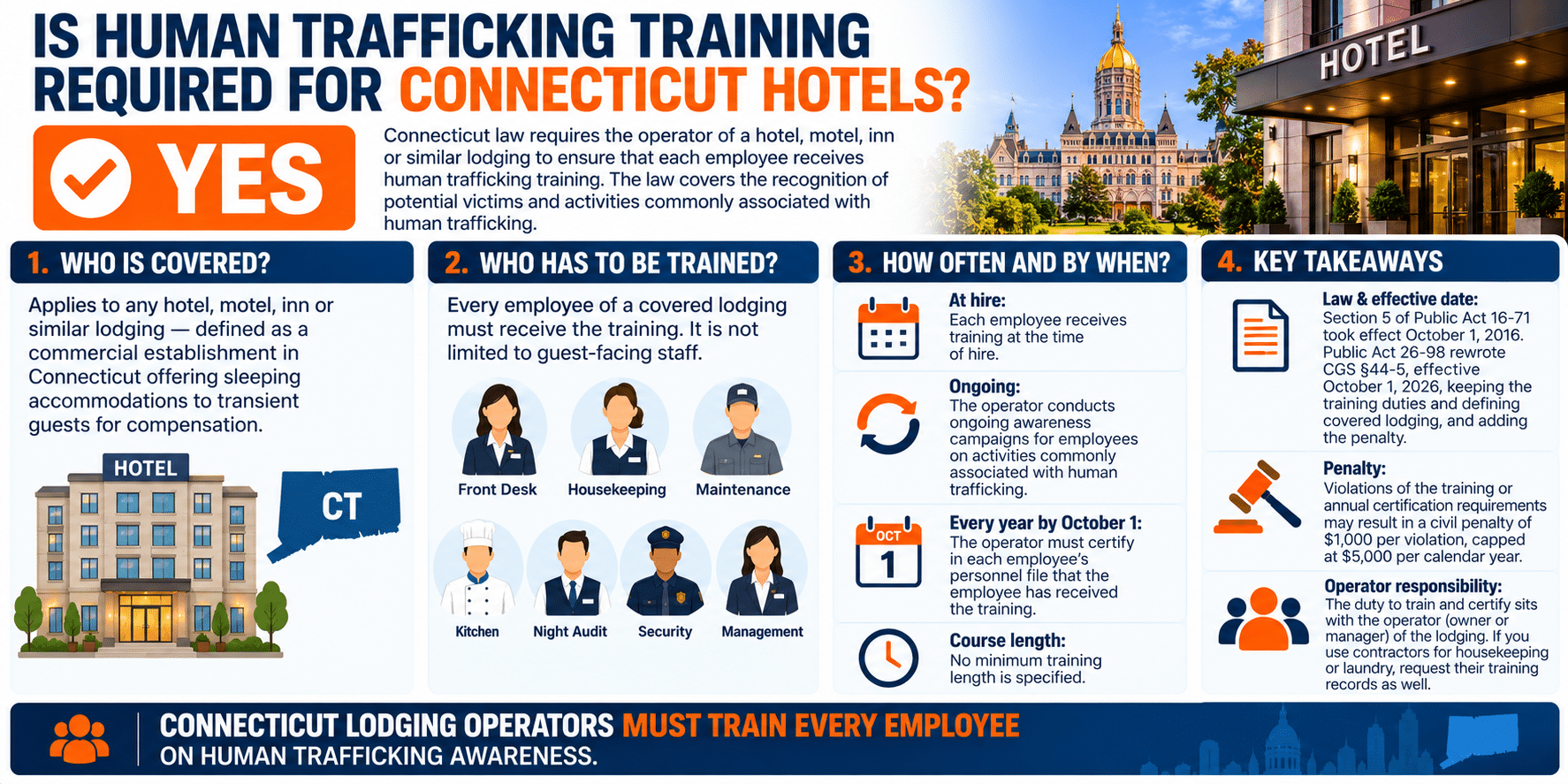
Is Human Trafficking Training Required for Connecticut Hotels?
Yes. Section 5 of Public Act 16-71, An Act Concerning Human Trafficking, took effect October 1, 2016 and is codified as CGS §44-5 in the chapter on hotels and other lodging. Public Act 26-98 rewrites §44-5 effective October 1, 2026. It keeps the training duty the same, defines “hotel, motel, inn or similar lodging” as any commercial establishment in Connecticut offering sleeping accommodations to transient guests for compensation, and adds the penalty.
Who Has to Be Trained in Connecticut?
Each employee. Connecticut does not limit the rule to guest-facing roles the way Virginia and New York do. The front desk, housekeeping, maintenance, kitchen, night audit, security and management all count. The duty sits with the operator, meaning whoever owns or operates the lodging. If a contractor supplies your housekeeping or laundry staff, I would ask for the contractor’s training records too, because labor trafficking in contracted crews is exactly what the training targets.
How Often and by When
- At hire: each employee receives the training at the time of hire.
- Ongoing: the operator conducts ongoing awareness campaigns for employees on activities commonly associated with human trafficking.
- Every year by October 1: the operator certifies in each employee’s personnel file that the employee has received the training.
- Minimum length: none stated.
Read that carefully: the statute requires training at hire and an annual certification, not an annual course. The simple way to cover both ends is to rerun a short course every year as the ongoing awareness campaign, then sign the certification in each file before October 1. That gives you a dated attendance sheet behind every signature.
What the Training Has to Cover
Section 44-5 names two topics:
- Recognition of potential victims of human trafficking
- Activities commonly associated with human trafficking
Public Act 16-71 also directed the commissioners of Children and Families and of Emergency Services and Public Protection to consult with hotel associations and recommend a training program, including a video presentation they develop and approve. That is a recommendation, not a requirement on hotels, and the statute does not tie §44-5 training to it.
Two topics is a short list, so I would build past it: labor trafficking with the same weight as sex trafficking, the indicators your departments actually see, and a clear reporting procedure. Staff observe, document and report. They never confront, follow or detain anyone. In an emergency call 911. Otherwise call the National Human Trafficking Hotline at 1-888-373-7888 or text 233733.
Approval and Vendor Path
There is none. Connecticut is an open-curriculum state: the statute does not require a state-approved course, so the operator chooses the training and certifies it. Our Hotels and Hospitality kit was built to the hotel-sector topic lists in these laws, and it covers both §44-5 topics. The certificate and attendance sheet in the kit are what you file behind each annual certification.
Penalties and Enforcement
From October 1, 2026, under Public Act 26-98:
- A violation of the training or certification duty carries a civil penalty of $1,000 per violation, imposed by the Department of Consumer Protection, capped at $5,000 per operator per calendar year.
- The same penalty structure applies to the guest-records rule in §44-4, the ban on hourly room rates in §44-6, and the hotel notice-posting duty in §54-234a.
- From January 1, 2027, every operator registers with the Department of Consumer Protection each year and shows it is complying with §§44-4 to 44-6 and §54-234a. The fee is $50 per property with fewer than 15 guest rooms and $200 per property with 15 or more.
- Also from January 1, 2027, the Commissioner of Consumer Protection may examine and audit an operator’s records and inspect the property.
Put plainly, the personnel-file certification is now the thing an auditor will ask to see.
Signage and Records
- Sign: under CGS §54-234a, hotels, motels, inns and similar lodging post the state human trafficking notice (developed under §54-222) in plain view in a conspicuous location. Public Act 26-98 moves lodging into its own penalty tier enforced by the Department of Consumer Protection.
- Training records: the annual certification in each employee’s personnel file.
- Guest records: §44-4 separately requires a record-keeping system of all guest transactions and receipts, kept at least six months.
Connecticut at a Glance
| Item | Connecticut (CGS §44-5) |
|---|---|
| Statute | Public Act 16-71 §5 (effective October 1, 2016), amended by Public Act 26-98 §3 (effective October 1, 2026) |
| Who | Each employee of a hotel, motel, inn or similar lodging |
| New-hire deadline | At the time of hire |
| Refresher | Ongoing awareness campaigns; annual certification by October 1 |
| Minimum length | None stated |
| Approval path | None; open curriculum chosen by the operator |
| Penalty | $1,000 per violation, capped at $5,000 per calendar year (Department of Consumer Protection), from October 1, 2026 |
| Sign | State human trafficking notice under §54-234a |
| Records | Annual certification in each personnel file; DCP registration and audits from January 1, 2027 |
Hotels and Hospitality kit: a 22-minute video (about 25 minutes in Spanish), quiz and answer sheet, a Presenter’s Guide with a compliance crosswalk, an attendance sheet and an editable certificate for the personnel file. USB or DVD kits are $239; streaming and LMS by subscription with a certificate per learner.
Other States
Connecticut is one of ten states with a hotel training law, all compared on the human trafficking awareness training hub. Neighbors: New York’s 60-day rule and Rhode Island’s annual rule. Another open-curriculum state is Illinois. For what staff actually see on shift, read my post on the signs of human trafficking in hotels.
Frequently Asked Questions
Yes for lodging. Connecticut General Statutes section 44-5 requires hotel, motel and inn operators to train each employee at hire and certify the training in each personnel file by October 1 every year.
The statute requires training at hire, ongoing awareness campaigns and an annual certification. Many operators rerun a short course each year so the certification has a dated record behind it.
From October 1, 2026, Public Act 26-98 sets a civil penalty of 1,000 dollars per violation, capped at 5,000 dollars per operator per calendar year, imposed by the Department of Consumer Protection.
No. Connecticut does not require a state-approved course. The operator chooses the training and certifies it in each employee file.
Yes, starting January 1, 2027. Public Act 26-98 requires each operator to register with the Department of Consumer Protection each year, at 50 dollars per property under 15 rooms and 200 dollars per larger property.
