
Virginia Human Trafficking Training Requirements for Hotels (Va. Code §35.1-15.1): Who, How Often, What Counts


Quick Answer: Do Virginia Hotels Have to Train Employees on Human Trafficking?
Yes. Virginia Code §35.1-15.1 requires every hotel proprietor to have guest-facing staff, managers and anyone with room access complete a human trafficking course within six months of hire and at least once every two calendar years after that. The course is the free DCJS online course or an alternative DCJS has approved.
Virginia was early to this, and its law is short: three subsections. What makes it different from most states is that the Commonwealth built its own free course and wrote it into the statute. That changes the buying decision, so I will be straight with you about where a commercial kit like ours fits and where it does not.
Is Human Trafficking Training Required for Virginia Hotels?
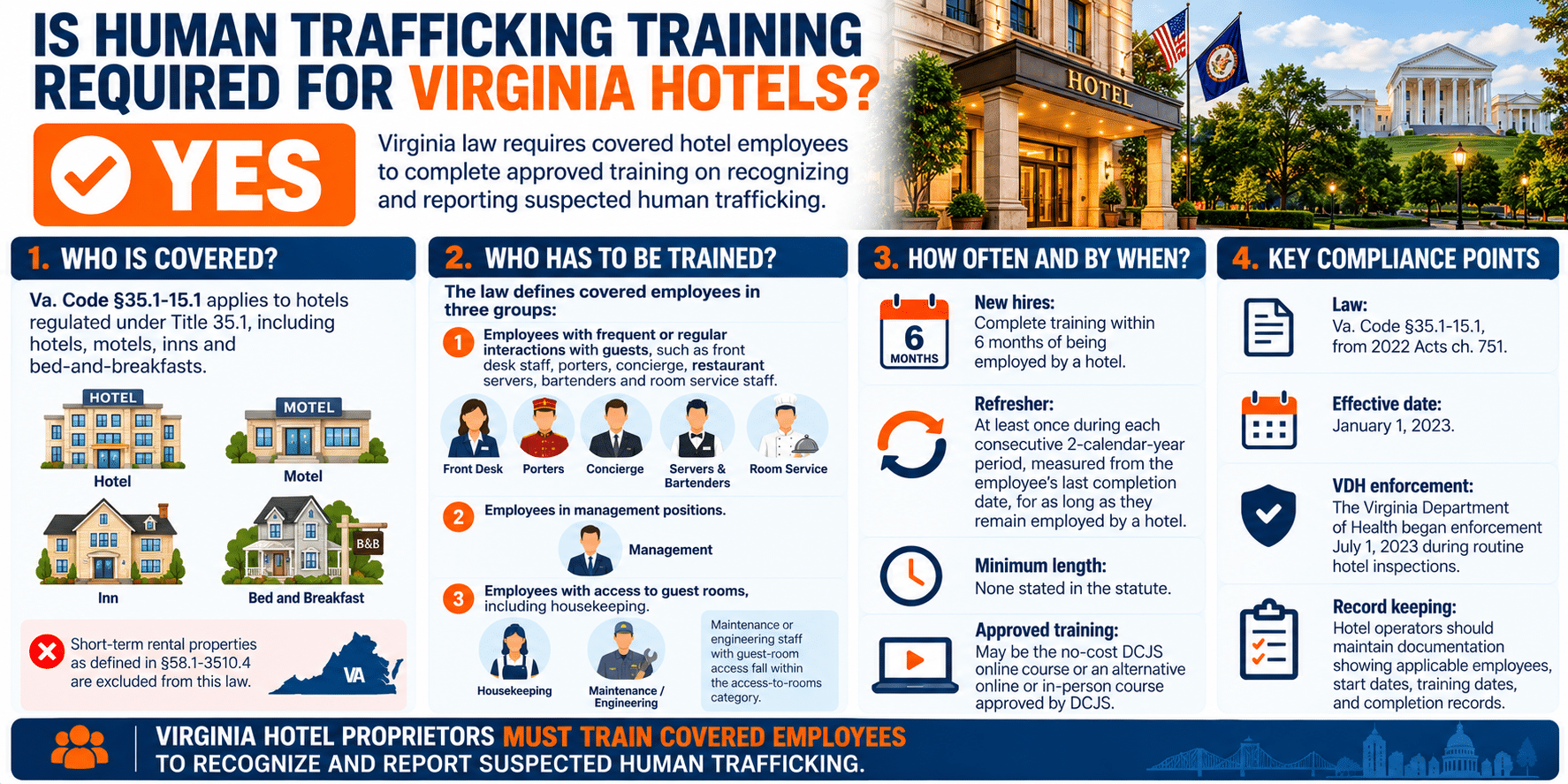
Yes. Va. Code §35.1-15.1 came from House Bill 258, 2022 Acts chapter 751. According to the Virginia Department of Health, the act took effect January 1, 2023 and VDH began enforcing it on July 1, 2023 as part of routine hotel inspections. Subsection B reads plainly: every hotel proprietor shall require its employees to complete a training course on recognizing and reporting suspected human trafficking.
“Hotel” in this section excludes short-term rental properties as defined in the local short-term rental tax statute, §58.1-3510.4. So a home-share host is outside this law; a hotel, motel, inn or bed and breakfast regulated under Title 35.1 is inside it.
Who Has to Be Trained in Virginia?
The statute defines “employee” in three groups. Anyone employed by the hotel who:
- has frequent or regular interactions with guests, such as front desk staff, porters, concierge, restaurant servers and bartenders, or room service staff;
- is in a management position; or
- has access to guest rooms, including housekeeping.
That is most of a full-service roster. Maintenance and engineering staff with keys fall under the third group. Managers fall under the second whether or not they work a desk. If you are unsure about a role, VDH’s inspection guidance asks for a list of “applicable employees”, so make the call in writing and keep it with your records.
How Often and by When
- New hires: within six months of being employed by a hotel.
- Refresher: at least once during each consecutive period of two calendar years, counted from the date the employee last completed the course, for as long as they work at a hotel.
- Minimum length: none set in the statute.
The six-month window is generous. In my experience the risk is not the deadline, it is turnover: a property hiring every month needs a standing process that enrolls each new hire, not a once-a-year push.
What the Training Has to Cover
The statute says only that the course covers recognizing and reporting instances of suspected human trafficking. It does not list topics. DCJS sets the content through its own course and its approval review. A course worth your staff’s time should still cover labor trafficking as fully as sex trafficking, because Virginia’s definition of a covered employee reaches housekeeping and food service, where contracted and seasonal labor is common.
Whatever course you use, the reporting rule is the same: observe, document and report through your manager or directly. Never confront, follow or detain anyone. In an emergency call 911. Otherwise call the National Human Trafficking Hotline at 1-888-373-7888 or text 233733. VDH also points staff to the Virginia State Police tip line.
Approval and Vendor Path
The statute names two options, and only two:
- The DCJS online course, provided at no cost to the hotel and its employees. VDH says it is taken individually, not in a group, and that it is offered in Spanish, Bengali, Gujarati and Hindi.
- An alternative online or in-person course approved by DCJS. DCJS has to approve or disapprove a submitted course within 60 days. The DCJS hotel training page posts its list of approved alternatives and a Curriculum Approval Form, and says any change to an approved course has to be resubmitted.
Here is the honest part. Our Hotels and Hospitality kit was built to the hotel-sector topic lists in these laws, and we are pursuing listing where the state keeps one, including DCJS. It is not on the DCJS list today. Until it is, the course of record for a Virginia hotel is the free DCJS course or a course already on the DCJS list. Where our kit earns its place in Virginia is the group session the DCJS course does not give you: a manager-led walkthrough of your own reporting procedure, with a quiz and an attendance sheet, in English or Spanish.
Penalties and Enforcement
Section 35.1-15.1 contains no penalty of its own. Enforcement runs through the hotel permit. VDH says it enforces the requirement through its sanitary regulations for hotels and checks it during routine inspections, so a gap shows up the way any other inspection finding does. DCJS answers course questions at hoteltraining@dcjs.virginia.gov.
Signage and Records
- Records: VDH asks operators to document a list of applicable employees, each one’s start date, the date each completed the training, and supporting proof such as a certificate or the DCJS transcript. DCJS recommends keeping a certificate for each employee.
- Signage: §35.1-15.1 does not require a sign. DCJS publishes a one-page hotel flyer on indicators and reporting, in several languages, and VDH recommends posting it behind the front desk and in staff areas.
Virginia at a Glance
| Item | Virginia (Va. Code §35.1-15.1) |
|---|---|
| Statute | HB 258, 2022 Acts ch. 751; in effect January 1, 2023; VDH enforcement from July 1, 2023 |
| Who | Guest-facing staff, managers, and anyone with guest-room access (including housekeeping); short-term rentals excluded |
| New-hire deadline | Within 6 months of hire |
| Refresher | At least once every 2 calendar years |
| Minimum length | None stated |
| Approval path | Free DCJS online course, or an alternative approved by DCJS (decision within 60 days) |
| Penalty | None in the section; enforced through VDH hotel inspections |
| Sign | Not required; DCJS flyer recommended for staff areas |
| Records | Employee list, start dates, completion dates, certificate or transcript |
Hotels and Hospitality kit: a 22-minute video (about 25 minutes in Spanish), quiz and answer sheet, a Presenter’s Guide with a compliance crosswalk, an attendance sheet and an editable certificate. USB or DVD kits are $239; streaming and LMS by subscription with a certificate per learner.
Other States
Virginia is one of ten states with a hotel training law, compared side by side on the human trafficking awareness training hub. If you run properties in more than one state, see Georgia’s annual rule, New York’s 60-day rule and California’s two-year rule. For what staff actually see on shift, read my post on the signs of human trafficking in hotels.
Frequently Asked Questions
Yes for hotels. Virginia Code section 35.1-15.1 requires guest-facing staff, managers and anyone with guest-room access to complete a DCJS or DCJS-approved course within six months of hire and at least every two calendar years.
Yes. The Department of Criminal Justice Services offers its online course at no cost to hotels and employees. Each employee takes it individually and can print the transcript for the manager.
The Virginia Department of Health checks training records during routine hotel inspections and has enforced the requirement since July 1, 2023.
No. The section excludes short-term rental properties as defined in Virginia Code section 58.1-3510.4.
Yes, if DCJS has approved it. DCJS reviews submitted courses within 60 days and posts a list of approved alternatives on its hotel training page.
