Good Manufacturing Practices (GMP) Training Video for the Food Industry – [Complete Kit]
$239

What’s Included in This GMP Training Program
This is a complete training program, not a standalone video clip. It is in fact two full programs running 37 minutes in total — the first covering personnel, plants and grounds, and sanitary operations, and the second covering sanitary facilities and controls, equipment and utensils, manufacturing processes and controls, and warehousing and distribution. Between them they work through all seven areas of the FDA’s Good Manufacturing Practice regulation rather than skimming the surface. Every item below is included in the price, and the printable documents are what give you the training records 21 CFR 117.4(d) requires you to keep.
- Two full-length training programs — 37 minutes in total, on DVD or USB stick, in English or Spanish
- Trainee quiz — confirms your employees understood the material rather than simply sat through it
- Answer sheet — for fast, consistent grading
- Presenter’s Guide — so whoever runs the session can lead the discussion and field questions confidently
- Employee sign-in sheet — printable attendance record showing who was trained and when
- Training Completion Certificate — editable, so you fill in each employee’s name and training date, and completely reusable, so you can issue one to every employee for every session you run at no extra cost
Because it is a one-time purchase rather than a per-seat license, you can run the program for as many groups as you need — new hires, seasonal intakes, refresher sessions — without paying again, and issue as many certificates as you need each time.
Do your employees need training on the Good Manufacturing Practices (GMP or CGMP)? Your food industry workers need this important training and this full course will get them set on the right track. As you know, the FDA regulations surrounding Good Manufacturing Practices can be quite complex and that’s where this full training set will get you the results you need.
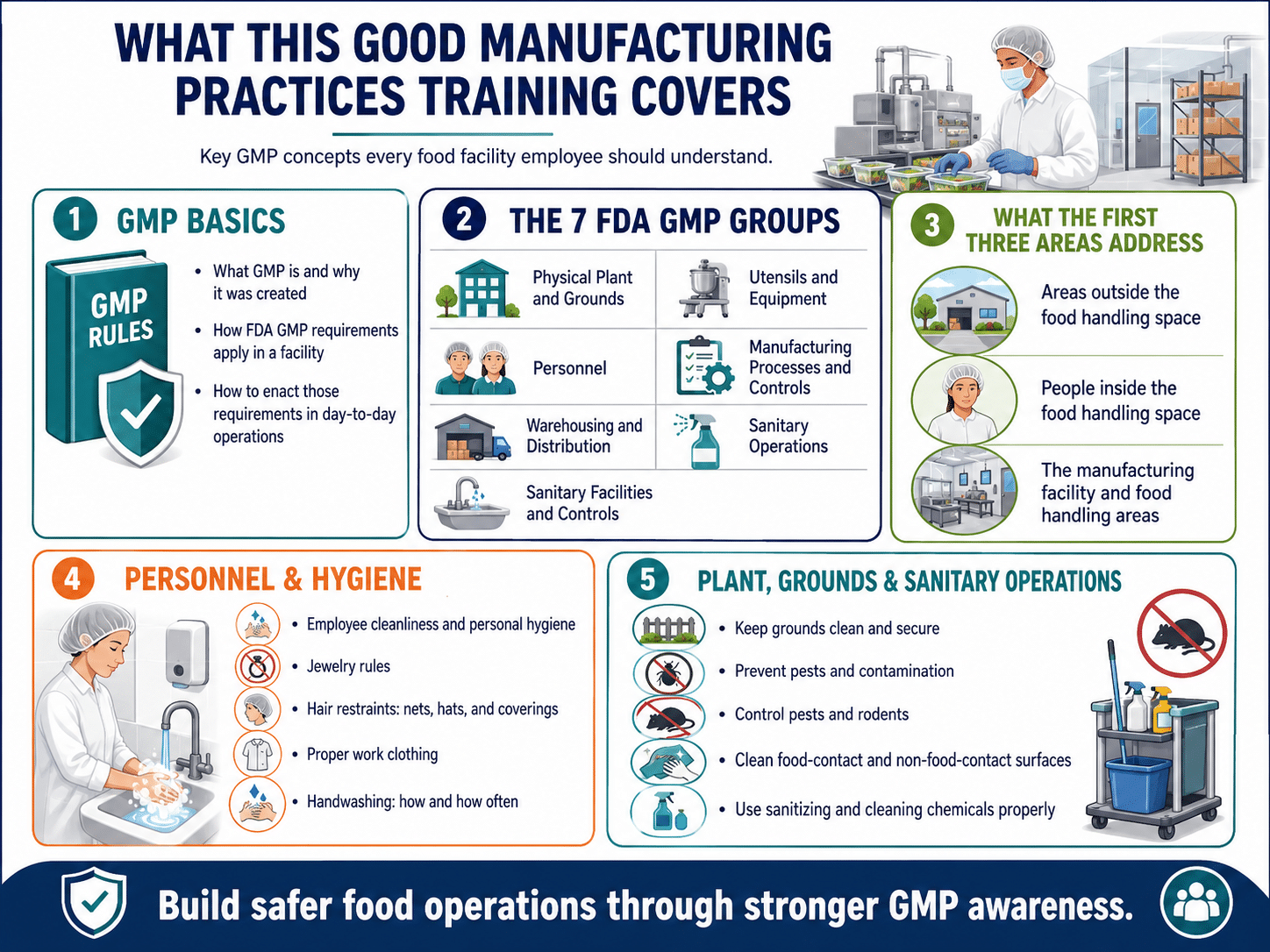
This Good Manufacturing Practices Training Covers the Following:
- What is GMP, and why was it created?
- What are the requirements for GMP set by the FDA, and how should your facility enact those requirements?
- What are the seven groups that are outlined by the FDA:
- Your physical plant and grounds
- Utensils and Equipment
- Personnel
- Manufacturing Processes and Controls
- Warehousing and Distribution
- Sanitary Operations
- Sanitary Facilities and Controls
- What do the first three sections of the FDA regulations address?
- The areas outside of your food handling space
- The people inside your food handling space and
- Your manufacturing facility and food handling areas
- What is the importance of personal hygiene as it relates to your personnel and workers?
- What are some things to keep in mind when addressing your plant and grounds areas? (the GMP must outline the need to keep the ground clean and secure in order to prevent pests; it must also include a plan to protect the facility against contamination and more)
- What things should the “Sanitary Operations” portion include?
- Pest and rodent control
- The process for cleaning surfaces both for food and non-food contact
- How and when to use sanitizing and cleaning chemicals in the facility
- What are some items related to your employees that need to be covered in the GMP plan?:
- Employee cleanliness and hygiene
- Jewelry worn by employees
- Hair restraints like nets, hats, and other coverings
- Clothing that is worn by employees
- Handwashing, including how to properly wash hands and how often they should be washed
Other Important Topics in this GMP Training:
- What are some examples of when employees should wash their hands while at work?:
- When touching something that might be contaminated, like equipment, items on the floor, etc
- After using the bathroom
- After handling chemicals that could contaminate food
- After eating or drinking
- After entering the food manufacturing facility
- What are some items to be considered in the “Plants and Grounds” section?:
- Assuring that waste treatment and disposal are handled properly
- The maintenance of parking areas, storage areas, and other outdoor locations
- The lighting is functional and in good working order
- Proper ventilation is in place throughout the facility
- What is the role of chemicals in the GMP?
- Whenever possible chemicals should be food-safe and non-toxic
- The storage of chemicals must be in place and in order, and all employees must have training on how and when to use those chemicals
- What are the last four sections of the FDA’s GMP regulations:
- Water and its role in your food processing facility
- The utensils and equipment being used
- The environment in which food is stored, processed, and kept
- The operations of food manufacturing and processing occur
- What are the key components of the “Sanitary Facilities and Controls” section of the GMP regulation?:
- This section has everything to do with the facility’s water and waste
- This section discusses how important it is to provide a clean supply of water, at the appropriate temperature and pressure, for the manufacturing that is being performed
- Issues with keeping the water supply free from contaminants
- Making sure the plumbing system is sized appropriately and has a maintenance schedule in place
- A discussion on the important parts of keeping utensils and equipment in good repair, and properly maintained and ensuring that thermometers are present in every freezer and refrigerator on the property
- What is a “food contact surface” under GMP and how is it defined?
- In the “Manufacturing Processes and Controls” employees should understand the “competent person” criteria for food processing quality control and testing, handling raw food materials and ingredients, and keeping food safe for the whole production process
- and much more…
The FDA requirements around food manufacturing — specifically the Good Manufacturing Practices or GMP regulations — are something very important to teach your employees. By giving them this comprehensive training, you will help to educate them on the need for good food handling practices, governmental regulations, and other important details related to their job with you.
GMP Training Delivery Options
At 37 minutes, this training is available as a DVD or on a USB stick, in English or Spanish. This GMP training is also available as an online course, taken either on its own or as part of our online safety training library of more than 250 courses. With either option, employees receive a completion certificate for this training course.
Which route suits you depends on how your facility runs. The DVD or USB kit is the better fit when you are training a whole shift or a seasonal intake in one room at one time, and it comes with the Presenter’s Guide, quiz and sign-in sheet you need to document a group session. The online course suits staggered start dates, multi-site operations and staff who onboard one at a time — each employee works through it at their own pace and their completion is recorded automatically. Plenty of food facilities use both: the group session for the annual refresher, the online course for new hires arriving mid-year.
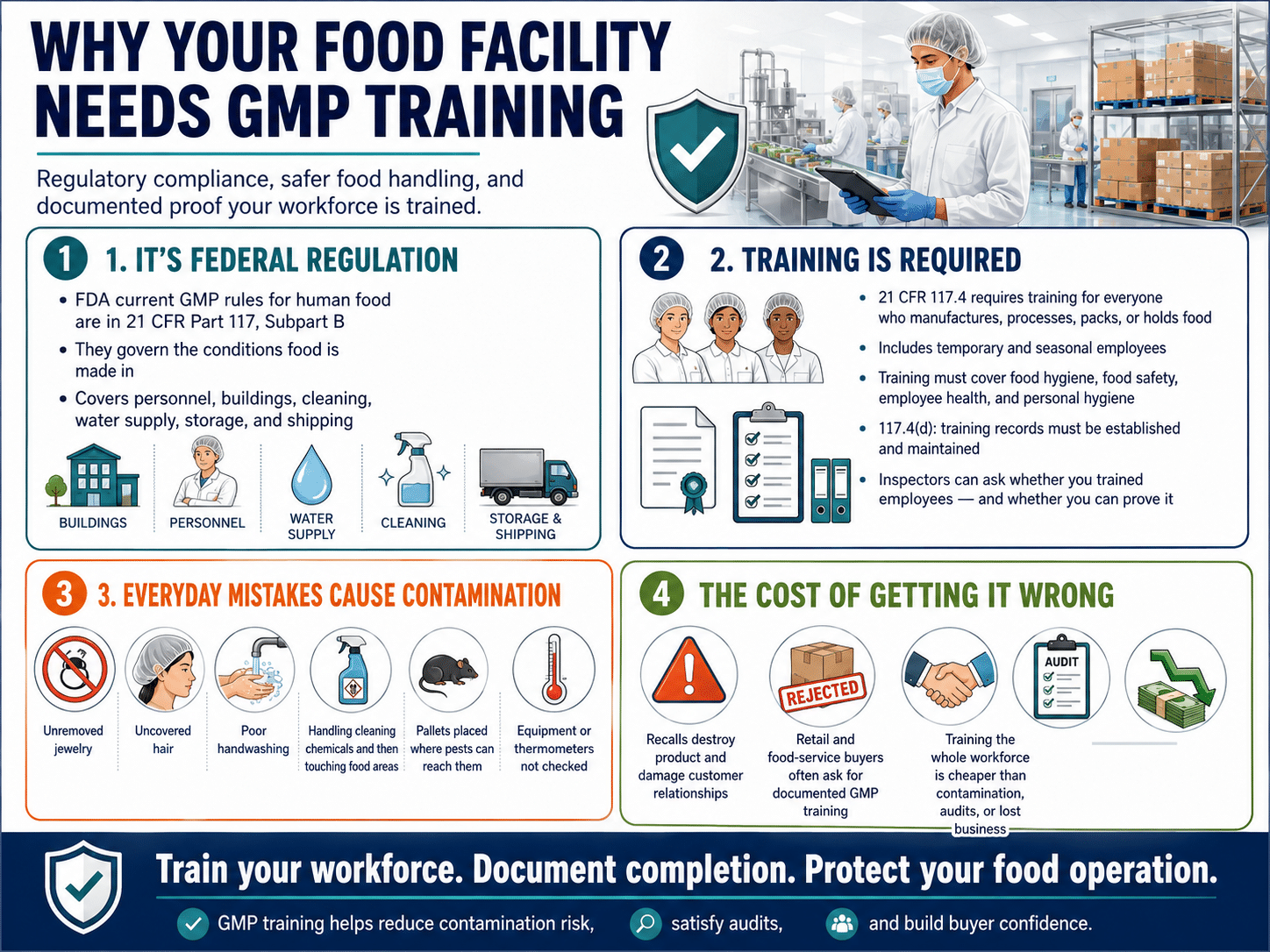
Why Your Food Facility Needs GMP Training
Good Manufacturing Practices are not a best-practice guideline you can adopt when convenient. They are federal regulation. The FDA’s current Good Manufacturing Practice requirements for human food sit in 21 CFR Part 117, Subpart B, which modernized and replaced the older Part 110 rules. They govern the conditions your food is made in: who handles it, what the building is like, how surfaces are cleaned, what the water supply is like, and how the finished product is stored and shipped.
Training is not optional under that rule. 21 CFR 117.4 requires that every individual who manufactures, processes, packs or holds food — including temporary and seasonal staff — receives training in the principles of food hygiene and food safety, covering employee health and personal hygiene, appropriate to the food, the facility and their assigned duties. Section 117.4(d) goes further: the records documenting that training must be established and maintained. In practice that means an inspector can ask not only whether you trained your people, but whether you can prove it.
The practical reason is simpler than the regulatory one. Almost every contamination event traces back to something ordinary — a ring that was not removed, hair that was not covered, hands that were not washed after a bathroom break or after handling a cleaning chemical, a pallet stored where a pest could reach it, a thermometer nobody checked. Your line staff are the people making those decisions dozens of times a shift, and they will only make them correctly if somebody has explained why the rule exists rather than simply posting it.
The cost of getting it wrong has grown. A recall does not just destroy product — it damages a customer relationship that took years to build, and audits from retail and food-service buyers now routinely ask to see documented GMP training for the whole workforce, not just supervisors. Training everyone, and keeping the paperwork, is far cheaper than the alternative.
Who Needs This Training
- Production and line workers in food manufacturing, processing, packing and co-packing facilities
- Warehouse, receiving and shipping staff who handle or store finished food product
- Sanitation crews and anyone responsible for cleaning food-contact surfaces
- Maintenance staff and QA technicians who enter production areas
- Temporary and seasonal workers — 21 CFR 117.4(b) names them explicitly, and they are the group most often missed
- New hires during onboarding, before they set foot on the production floor
- Spanish-speaking crews, using the Spanish-language version so the training is understood rather than merely delivered
- Any facility preparing for an FDA inspection or a third-party customer audit that will ask for documented GMP training
Building a hazard-analysis system on top of your GMP foundation? GMPs are the prerequisite conditions a HACCP plan is built on, so most facilities train on both. See our HACCP training video for that next step, and our food handling safety training for crews who handle food directly.
Good Manufacturing Practices or GMP Training – Full-Length Preview:
FAQs on GMP Training
Answered by our in-house OSHA Authorized Trainer – Jason Hessom

Have a question for us? Call us at 800-859-1870 or Contact Us Via Email
GMP stands for Good Manufacturing Practices — the FDA’s baseline rules for the conditions food is made, packed and held in. For human food they sit in 21 CFR Part 117, Subpart B, which modernized and replaced the older Part 110 regulations. Subpart B covers seven core areas: personnel and personal hygiene, plant and grounds, sanitary operations, sanitary facilities and controls, equipment and utensils, manufacturing processes and controls, and warehousing and distribution. You will also see the term written as cGMP, where the “c” stands for “current” — a reminder that the FDA expects facilities to keep up with current practice rather than treat the rules as a fixed checklist written once. GMPs are the everyday conditions that keep food safe, and they are the foundation any further food-safety system is built on top of.
It directly addresses it. 21 CFR 117.4(b)(2) requires that everyone who manufactures, processes, packs or holds food — including temporary and seasonal staff — receives training in the principles of food hygiene and food safety, including employee health and personal hygiene, appropriate to their duties. Unlike some safety regulations, 117.4 sets no minimum number of hours and no fixed retraining interval, so a documented 37-minute program covering the Subpart B requirements is a legitimate way to meet it. Section 117.4(d) also requires that you keep records of that training, which is what the included quiz, answer sheet, sign-in sheet and Certificate of Completion are for. One important boundary: this is training for a “qualified individual” under 117.4. It is not PCQI training. Becoming a Preventive Controls Qualified Individual is a separate FSMA role requiring training equivalent to the FSPCA standardized curriculum, and no video course provides that. You still need to judge whether this covers the duties specific to your facility and your product.
It runs 37 minutes in total and is actually two complete programs rather than one video, which is what makes it one of the most thorough courses in our catalog. The first program covers personnel, plants and grounds, and sanitary operations; the second covers sanitary facilities and controls, equipment and utensils, manufacturing processes and controls, and warehousing and distribution. Together they start with what GMP is and why the FDA created it, then work through all seven areas of the regulation: your plant and grounds including waste handling, lighting, ventilation and pest control; personnel and personal hygiene covering handwashing, hair restraints, jewelry and clothing; sanitary operations including cleaning and sanitizing chemicals and how to use them; sanitary facilities and controls covering the water supply, plumbing and temperature; equipment, utensils and thermometers; manufacturing processes and controls including food-contact surfaces and handling raw ingredients; and warehousing and distribution. Because it runs longer than a typical toolbox video, most facilities schedule it as a dedicated training session rather than tacking it onto a shift meeting.
Everyone who manufactures, processes, packs or holds food, which is broader than most facilities assume. It covers production and line workers, sanitation crews, warehouse and shipping staff who handle finished product, maintenance and QA staff who enter production areas, and supervisors. 21 CFR 117.4(b) specifically includes temporary and seasonal employees, and in practice they are the group most often skipped — a seasonal packing crew brought in for eight weeks needs the same hygiene training as a permanent employee. New hires should be trained during onboarding, before they start work on the floor. Because this is a one-time purchase you can show as many times as you like, training every new intake costs you nothing extra.
They answer different questions and you generally need both. GMPs are the baseline conditions your facility operates under — clean surfaces, safe water, healthy and hygienic staff, well-maintained equipment, sound storage. They apply all the time, everywhere in the plant. HACCP is a system for identifying the specific hazards in your particular process and building controls at the points where those hazards can be managed. The relationship matters: GMPs are the prerequisite programs a HACCP plan assumes are already in place, so a HACCP plan built on a facility with weak GMPs will not hold up. Most food businesses train their whole workforce on GMP and then train the relevant team on HACCP. If you need the second piece, see our HACCP training video.
Yes. The complete kit is available in English or Spanish, on either DVD or USB stick, and you choose both the language and the format when you order. This matters more in food manufacturing than almost anywhere else: hygiene training only changes behavior if every person on the line actually understands what they are being asked to do and why. A worker who watched a video in a language they read only partially has been shown the training, not given it. Facilities with mixed crews frequently buy both language versions and run two sessions.
The kit is built around that requirement, because 21 CFR 117.4(d) makes training records mandatory rather than optional. It includes a printable employee sign-in sheet to record who attended and when, a trainee quiz with an answer sheet so you can show the material was understood rather than simply played in the room, and a Training Completion Certificate you fill in with each employee’s name and training date. The certificate is completely reusable, so you can issue one to every employee for every session you run at no additional cost. Kept together, those three documents are what you would hand an FDA investigator or a customer auditor who asks to see your GMP training records. The kit also includes a Presenter’s Guide, so whoever runs the session can lead the discussion and answer questions consistently rather than pressing play and leaving the room. Employees who take the course online receive a completion certificate for it as well.
Yes. Alongside the DVD and USB kit, this GMP training is available as an online course, taken either on its own or as part of our online safety training library of more than 250 courses. Employees who complete it online receive a completion certificate for the course. The two routes suit different operations rather than competing: the DVD or USB kit is built for training a whole shift or a seasonal intake together in one room, and comes with the Presenter’s Guide, quiz, answer sheet and sign-in sheet you need to document a group session. The online course suits multi-site operations, staggered start dates and staff who onboard one at a time, since each employee works through it at their own pace. Many food facilities use both — the group session for the annual refresher, and the online course for new hires arriving through the year.
16 reviews for Good Manufacturing Practices (GMP) Training Video for the Food Industry – [Complete Kit]
![Good Manufacturing Practices (GMP) Training Video for the Food Industry – [Complete Kit]](https://www.safetyvideos.com/wp-content/uploads/2023/02/Good-Manufacturing-Practices-in-the-Food-Industry-150x150.png.webp)


Our team really liked this training. The quiz was good too so you know your employees understand the information that is being taught to them.
Makes understanding GMP standards easy. Excellent course.
Breaks down GMP principles clearly. Very practical.
A must-have for food industry professionals. Thorough
An excellent resource for continuous improvement in manufacturing.