
Georgia Human Trafficking Training Requirements for Hotels (SB 570): Who, How Often, What Counts


Quick Answer: Does Georgia Law Make Hotel Staff Take Human Trafficking Training?
Yes. Since July 1, 2026, Georgia’s Human Trafficking Prevention Training Act (SB 570, O.C.G.A. §43-21-16) requires every on-site employee of an inn, and every third-party manager of a short-term rental, to complete a course developed or approved by the Attorney General within 60 days of hire and every year after that.
I have spent 25 years in workplace safety, much of it walking hotel and resort properties, and Georgia’s law is one of the cleanest of the new ones to read. It is four pages long. Below is what it says, line by line, plus the parts that trip up general managers: who counts as on-site staff, how the first-year deadline works, and what “approved” means when the state has not posted a formal list.
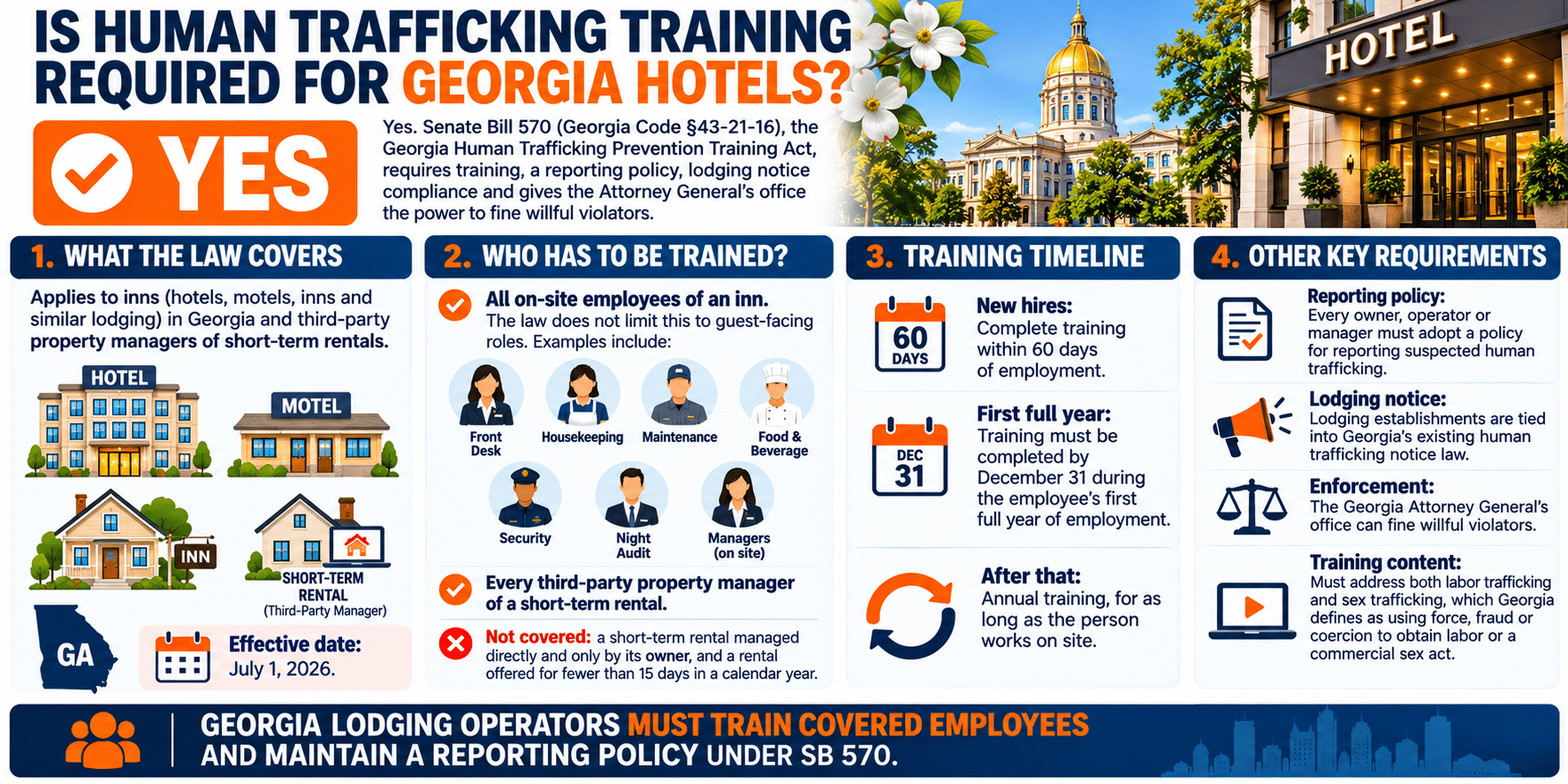
Is Human Trafficking Training Required for Georgia Hotels?
Yes. Senate Bill 570 added a new Code section, §43-21-16, to the innkeepers article of Title 43. The enrolled text (read the as-passed PDF) takes effect July 1, 2026, and its short title is the Georgia Human Trafficking Prevention Training Act. It does four things: it sets a training requirement, it requires every owner, operator or manager to adopt a reporting policy, it ties lodging into the existing human trafficking notice law, and it gives the Attorney General’s office the power to fine willful violators.
The law defines human trafficking by reference to Georgia’s criminal statute and to the federal definition: force, fraud or coercion used to obtain labor or a commercial sex act. That matters for your training choice. A course that only talks about sex trafficking leaves out half of what the statute is about.
Who Has to Be Trained Under SB 570?
- All on-site employees of an inn. The statute does not limit this to guest-facing roles. Front desk, housekeeping, maintenance, food and beverage, security, night audit and managers who work on the property are all on-site employees.
- Every third-party property manager of a short-term rental. The law defines a short-term rental as a unit offered through a hosting platform and managed by a third-party manager, meaning a company or person paid to handle marketing, guest messages, check-in, cleaning or maintenance for the owner.
- Not covered: a short-term rental managed directly and only by its owner, with or without a hosting platform, and a rental offered for fewer than 15 days in a calendar year.
Contracted crews are the gray area. A housekeeping or laundry contractor working on your property every day is on site, and labor trafficking inside contracted crews is one of the things this training exists to catch. I would include them in your roster and ask the contractor for their completion records.
How Often and by When
The statute sets three clocks:
- New hires: within 60 days of employment.
- First full year: the training has to be completed by December 31 during the employee’s first full year of employment.
- After that: annually, for as long as the person works on site.
There was a one-time carve-out at the start. An inn employee or short-term rental manager who completed qualifying training in the 12 months before July 1, 2026, and gave the property a record of completion, did not have to repeat it right away. For everyone else, the 60-day, December 31 and annual clocks above apply. The law sets no minimum course length.
What the Training Has to Cover
Section 43-21-16(c) lists six topics the Attorney General’s office uses when it develops a course or identifies existing ones:
- The definition of human trafficking and commercial exploitation of children
- How to identify individuals at risk for human trafficking
- How to identify the signs of human trafficking and the people potentially engaged in it
- The differences between labor and sex trafficking as they relate to the inn industry
- The role of hospitality employees in reporting and responding
- Contact information for the National Human Trafficking Hotline or the local law enforcement agency
Every one of those six maps to a segment of our Hotels and Hospitality program, and the Presenter’s Guide crosswalk appendix lists the Georgia topics with the time in the video where each is covered. The reporting piece is the one I would test hardest. Staff observe, write down what they saw and report it. They never confront, follow or detain anyone. In an emergency call 911. Otherwise call the National Human Trafficking Hotline at 1-888-373-7888 or text 233733.
Approval and Vendor Path
This is the part to read carefully. Under the statute, qualifying training is a course “developed or approved by” the Attorney General’s office, in consultation with the Georgia Hotel and Lodging Association, the Criminal Justice Coordinating Council and hosting platforms. As of October 15, 2026 I could not find a published course list or a vendor application process on the Attorney General’s site.
The Georgia Hotel and Lodging Association resource page lists the courses it treats as approved, including the Criminal Justice Coordinating Council trainings, BEST’s Inhospitable to Human Trafficking, the AHLA Foundation’s No Room for Trafficking, AAHOA’s course and several PACT courses, and it says a brand course not on the list can be submitted for review. If your brand already assigns one of those, that is your Georgia course of record.
Where our kit fits: it was built to the hotel-sector topic lists in these laws, and we are pursuing listing where the state keeps one. It is not on the Georgia list today. Use it as the longer, property-level session your managers lead, with your own reporting policy walked through in the room, alongside whichever listed course you file as the annual completion.
Penalties and Enforcement
The Attorney General’s office may impose an administrative penalty on an owner, operator or manager who willfully and knowingly violates the section: $500 for a first violation, $1,000 for a second and $2,000 for a third or later one. The statute says it creates no private cause of action against an inn or its employees. In practice, enforcement starts with records: the office can ask in writing, and the property has ten business days to produce them.
Signage and Records
- Reporting policy: every owner, operator or manager has to adopt policies and procedures for reporting suspected trafficking to the National Human Trafficking Hotline or local law enforcement.
- Posted notice: inns and short-term rentals have to comply with the human trafficking notice law, O.C.G.A. §16-5-47 (the GBI model notice; see the GBI notice page). Local sheriffs and police assist with enforcement of the posting.
- Records: keep each employee’s training acknowledgment for as long as they work for you plus one year, and be ready to hand them to the Attorney General’s office within ten business days of a written request.
Georgia at a Glance
| Item | Georgia (O.C.G.A. §43-21-16) |
|---|---|
| Statute | SB 570 (2026), Georgia Human Trafficking Prevention Training Act; effective July 1, 2026 |
| Who | All on-site inn employees; third-party managers of short-term rentals (owner-managed and under-15-day rentals exempt) |
| New-hire deadline | Within 60 days of employment; first full year completed by December 31 |
| Refresher | Every year |
| Minimum length | None stated |
| Approval path | Course developed or approved by the Attorney General’s office; no public vendor process found |
| Penalty | $500 / $1,000 / $2,000 for willful violations (Attorney General) |
| Sign | O.C.G.A. §16-5-47 human trafficking notice |
| Records | Training acknowledgments, employment plus 1 year; produce within 10 business days |
Hotels and Hospitality kit: a 22-minute video (about 25 minutes in Spanish), quiz and answer sheet, a Presenter’s Guide with a compliance crosswalk that includes the Georgia topic list, an attendance sheet and an editable certificate. USB or DVD kits are $239; streaming and LMS by subscription with a certificate per learner.
Other States
Georgia is one of ten states with a hotel training law. The human trafficking awareness training hub compares all ten. Neighbors worth a look: Florida’s annual DBPR requirement, Texas’s Attorney General standards and Virginia’s DCJS rule. For what staff actually see on shift, read my post on the signs of human trafficking in hotels.
Frequently Asked Questions
Yes for lodging. Since July 1, 2026, O.C.G.A. section 43-21-16 requires all on-site inn employees and third-party short-term rental managers to complete an approved course within 60 days of hire and every year after that.
The statute says the course is developed or approved by the Attorney General’s office in consultation with the Georgia Hotel and Lodging Association, the Criminal Justice Coordinating Council and hosting platforms. The GHLA posts the list it treats as approved.
Only where a third-party manager runs the rental. A short-term rental managed directly and only by the owner, or rented fewer than 15 days a year, is exempt.
The Attorney General may impose 500 dollars for a first willful violation, 1,000 dollars for a second and 2,000 dollars for a third or later one.
For the length of the employee’s employment plus one year, and the property has ten business days to produce them after a written request from the Attorney General’s office.
