
Florida Human Trafficking Training Requirements for Hotels (F.S. §509.096): Who, How Often, What Counts


Quick Answer: What Human Trafficking Training Does Florida Require for Hotel Staff?
Florida Statute §509.096 requires public lodging establishments to give housekeeping and front-desk employees DBPR-approved human trafficking awareness training every year, within 60 days of hire for new staff. Each employee signs a dated acknowledgment, the property posts the state sign, and violations carry a $2,000 per day fine.
Florida is stricter than most states in one way that trips people up: the course has to be approved by the Division of Hotels and Restaurants. A good course that is not on the list does not count. The good news is that the approval path is simple and open to anyone, and the rest of the law is easy to run once you set up the annual cycle.
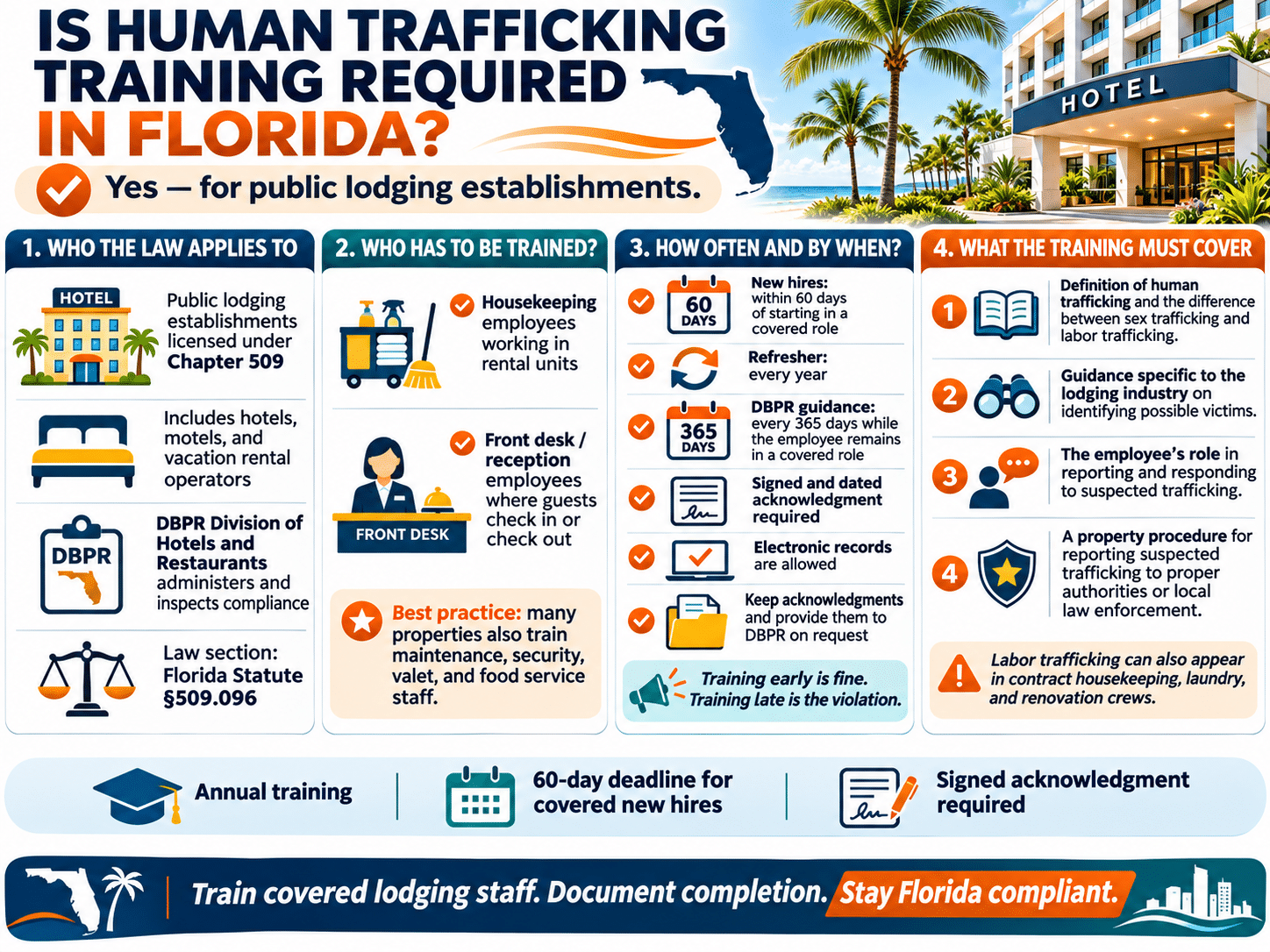
Is Human Trafficking Training Required in Florida?
Yes, for public lodging establishments: hotels, motels, vacation rental operators and the other lodging types licensed under Chapter 509. The training requirement sits in §509.096 alongside a sign requirement, an acknowledgment requirement and a fine. The Department of Business and Professional Regulation (DBPR) Division of Hotels and Restaurants administers it and checks it on inspection.
Who Has to Be Trained?
Two groups, by role:
- Employees who perform housekeeping duties in the rental units.
- Employees who work at the front desk or reception area where guests check in or check out.
That is narrower than California or Illinois. I still tell Florida properties to train maintenance, security, valet and food service staff on the same schedule. It costs nothing extra with a flat-priced kit, and those are the people walking the halls at 2 a.m.
How Often and by When?
- New hires: within 60 days of starting in a covered role.
- Refresher: every year. DBPR’s 2025 industry bulletin reads it as every 365 days while the employee stays in a covered role.
- Acknowledgment: each trained employee signs and dates a written acknowledgment. The property keeps it (electronic is fine) and produces it to DBPR on request.
A 365-day cycle means each employee has their own due date. The simplest way I have seen properties handle it is one property-wide training month, with new hires caught up inside their first 60 days and then rolled into the next annual session early. Training early never hurts; training late is the violation.
What Does the Training Have to Cover?
DBPR’s Industry Bulletin 2025-01 lists three content requirements:
- The definition of human trafficking and the difference between sex trafficking and labor trafficking.
- Guidance specific to the public lodging sector on how to identify individuals who may be victims.
- Guidance on the role of lodging employees in reporting and responding to suspected human trafficking.
The property also needs a basic procedure for reporting suspected trafficking to the proper authorities or local law enforcement. Item 1 is where I would push hardest on any course you evaluate. Florida asks for the difference between sex and labor trafficking, and in a hotel labor trafficking usually hides in contract housekeeping, laundry and renovation crews: workers who are driven in and out together, live where they work, and never handle their own pay or papers. A course that spends twenty minutes on the front desk and thirty seconds on the back of house leaves your housekeepers without the part they are most likely to see. Write it down, keep it to one page, and make sure the night shift knows who the manager on duty is. Your staff should know two numbers: the Florida Human Trafficking Hotline, 1-855-FLA-SAFE (1-855-352-7233), and the national hotline below.
How Does DBPR Approval Work?
This is the step that sets Florida apart. The Division of Hotels and Restaurants keeps a list of approved training, updated monthly, and the training your property uses has to be on it or approved directly. There are two ways to get a curriculum reviewed:
- Email the curriculum as an attachment to DHR.Info@myfloridalicense.com with a short note asking for review.
- Present it to a Division inspector during an inspection.
There is no fee or formal application form that I could find. Our Hotels and Hospitality program was written to the Florida content list, and it is not on the DBPR list yet. We will update this page when that changes. Until then, check the current list before you rely on any course, ours included.
Penalties and Enforcement
The fine is $2,000 per day for an establishment that does not comply. On a first violation the Division gives a correction period if the property provides written documentation that each deficiency will be corrected within 45 days. On a second or later violation there is no correction period; the fine applies. The statute creates no private right of action.
Signage and Records
Since January 1, 2025, every public lodging establishment posts a human trafficking public awareness sign in a conspicuous place employees can reach. The sign is at least 11 by 15 inches, in type of at least 32 points, in English, Spanish and any other language DBPR considers appropriate. The DBPR bulletin gives the required wording, which directs people to 1-855-FLA-SAFE.
Records are the signed, dated acknowledgments, one per employee per year. Keep them by employee with the training date and course title so you can hand an inspector a clean file.
| Item | Florida rule |
|---|---|
| Statute | F.S. §509.096 |
| Who | Public lodging; housekeeping in rental units and front desk or reception staff |
| New hires | Within 60 days of starting the role |
| Refresher | Every year (every 365 days per DBPR) |
| Minimum length | None stated |
| Required topics | Three, per DBPR Bulletin 2025-01 |
| Approval path | DBPR approval: email DHR.Info@myfloridalicense.com or show an inspector |
| Penalty | $2,000 per day; 45-day cure on a first violation only |
| Sign | Since Jan. 1, 2025: 11 x 15 in, 32-point, English and Spanish |
| Records | Signed, dated acknowledgment per employee, produced on request |
Human Trafficking Awareness and Prevention Training for Hotels and Hospitality. Built to the Florida DBPR content list; it is not on the DBPR approved list yet, so check the list before you rely on it. About 22 minutes in English (Spanish sold separately). Kit includes a quiz and answer sheet, a Presenter’s Guide with a compliance crosswalk and a training acknowledgment form, an attendance sheet and an editable certificate. USB or DVD $239, or by LMS subscription with a Florida course copy.
Other States
The human trafficking awareness training hub compares all ten hotel training states. The closest relatives to Florida are Texas (annual, Attorney General list), Georgia (annual, 60 days) and California (open curriculum, every two years). In an emergency call 911. Otherwise call the National Human Trafficking Hotline at 1-888-373-7888 or text 233733.
Frequently Asked Questions
Employees who perform housekeeping in rental units and employees who work at the front desk or reception area where guests check in or out, under Florida Statute 509.096.
Every year. New employees in covered roles train within 60 days, and DBPR reads the annual cycle as every 365 days.
Email the curriculum to the Division of Hotels and Restaurants at DHR.Info@myfloridalicense.com with a request for review, or present it to an inspector during an inspection.
The Division imposes a fine of 2,000 dollars per day. A first violation can be corrected within 45 days with written documentation; later violations get no correction period.
The Florida Human Trafficking Hotline is 1-855-FLA-SAFE, which is 1-855-352-7233. The National Human Trafficking Hotline is 1-888-373-7888.
