
OSHA Hand and Power Tool Safety Rules: What Subpart P Requires and the Five Rules I Teach Every Crew


Quick Answer: What Are OSHA’s Safety Guidelines for Hand and Power Tools?
OSHA’s hand and power tool rules are 29 CFR 1910 Subpart P for general industry and 1926 Subpart I for construction. The employer is responsible for the safe condition of every tool, including tools employees bring from home (1910.242(a)); guards stay on portable powered tools (1910.243); and compressed air used for cleaning must be below 30 psi (1910.242(b)).
I have walked more maintenance shops, hotel engineering rooms and job sites than I can count in 25 years, and I can tell you where the tool injuries come from. It is almost never the exotic stuff. It is the angle grinder with the guard pulled off because it “got in the way,” the cold chisel with a head mushroomed out like a cauliflower, and the crew blowing sawdust off their shirts with an unregulated air hose at the end of the shift. OSHA’s hand and power tool rules are short, they are old, and they are ignored constantly.
So let me walk through what the standard actually says, the five rules OSHA itself boils the subject down to, and what I look for when I audit a shop. If you run weekly safety meetings, the chart below is a ready-made outline for the tool safety week, and my toolbox talk topics list covers the other weeks.
What Are the Five Basic Safety Rules for Hand and Power Tools?
| The rule | Where it lives in the standard | What it looks like on the floor |
|---|---|---|
| 1Keep all tools in good condition with regular maintenance | 29 CFR 1910.242(a) and 1926.300(a): the employer is responsible for the safe condition of every tool, including tools employees bring from home | Sharp blades, tight handles, intact cords, guards that move freely. A tool crib with a repair tag system, not a drawer of broken drills. |
| 2Use the right tool for the job | 1926.301 (sprung wrenches, mushroomed heads, cracked handles) and the manufacturer’s rated use | No screwdrivers as chisels, no pliers as wrenches, no cheater pipes on a ratchet, no cutoff wheel on a grinder rated for grinding only. |
| 3Examine each tool for damage before use, and do not use damaged tools | 1910.243(a)(4) cracked saws removed from service; 1910.243(c)(5) ring test before mounting an abrasive wheel; 1926.302(e)(2) daily test of powder-actuated tools | A 30-second look before the trigger is pulled. Damaged tools come out of service and get a “Do Not Use” tag, not a spot back on the shelf. |
| 4Operate tools according to the manufacturer’s instructions | 1910.243(a)(2) constant-pressure switches; 1926.302(e)(1) only trained employees run powder-actuated tools | Guards on, lock-on used only where the tool allows it, no zip tie holding the trigger, no bypassed muzzle safety on a nailer. |
| 5Provide and use the right personal protective equipment | 1910.132 and 1926 Subpart E (PPE); 1910.132(f) training; 1910.242(b) chip guarding and PPE whenever compressed air is used for cleaning | Safety glasses on everyone within range, face shield for grinding and chipping, hearing protection, gloves matched to the task (and no gloves near a rotating bit). |
- Cord and plug: no cuts, no exposed conductors, ground pin present (or the tool is marked double insulated), no tape repairs.
- Guards: present, unmodified, and the lower guard on a circular saw snaps back on its own when you release it.
- Switch: the tool stops when you let go. No zip ties, tape or wedges holding a trigger on.
- Blade, bit or wheel: sharp, seated, and rated for the tool’s speed. Ring test a new abrasive wheel before you mount it.
- Housing and handles: no cracks, no missing screws, side handle installed on a grinder, wooden handles tight and splinter-free.
- Air tools: hose rated for the pressure, positive connection to the whip, safety clip or retainer on impact tools, cleaning nozzle regulated below 30 psi.
- Hand tools: no mushroomed heads on chisels and punches, no sprung wrench jaws, no loose hammer heads.
- Anything fails? Tag it “Do Not Use,” pull it from the crib, and write it up. A damaged tool never goes back on the shelf untagged.
Sources: OSHA 3080 Hand and Power Tools; 29 CFR 1910 Subpart P; 29 CFR 1926 Subpart I. Verify the citations against the current text at osha.gov.
OSHA’s own booklet, Hand and Power Tools (OSHA 3080), boils the whole subject down to five rules: keep tools in good condition with regular maintenance, use the right tool for the job, examine each tool for damage before use and take damaged tools out of service, operate tools according to the manufacturer’s instructions, and provide and use the right personal protective equipment. I use those five as the outline for every tool safety talk I give, because they are easy to remember and every one of them maps to a citation I have watched get written.
Rule three is where most shops fail, and it is the cheapest one to fix. A pre-use inspection takes thirty seconds. The problem is what happens after it: the drill with the taped cord gets set back on the shelf instead of tagged out, and the next person picks it up. If your crib has no “Do Not Use” tags in it, nobody is taking tools out of service, and that tells me more about the program than any binder does.
Rule two is the screwdriver-as-pry-bar problem. I still see pliers used as wrenches, a length of pipe slid over a ratchet handle for leverage, and cutoff wheels chucked into grinders that were never rated for cutting. Rule five is the one that gets argued with the most, so I will say it plainly: safety glasses go on everyone within range of the work, not just the person holding the tool. A chip off a chisel does not check who is swinging the hammer.
What Does 29 CFR 1910 Subpart P Actually Require?
Subpart P is four sections long: 1910.241 (definitions), 1910.242 (general requirements), 1910.243 (guarding of portable powered tools) and 1910.244 (other portable tools, mostly jacks and abrasive blasting). Most of what an inspector cites on a shop floor comes from the middle two.
1910.242: The Employer Owns the Condition of Every Tool
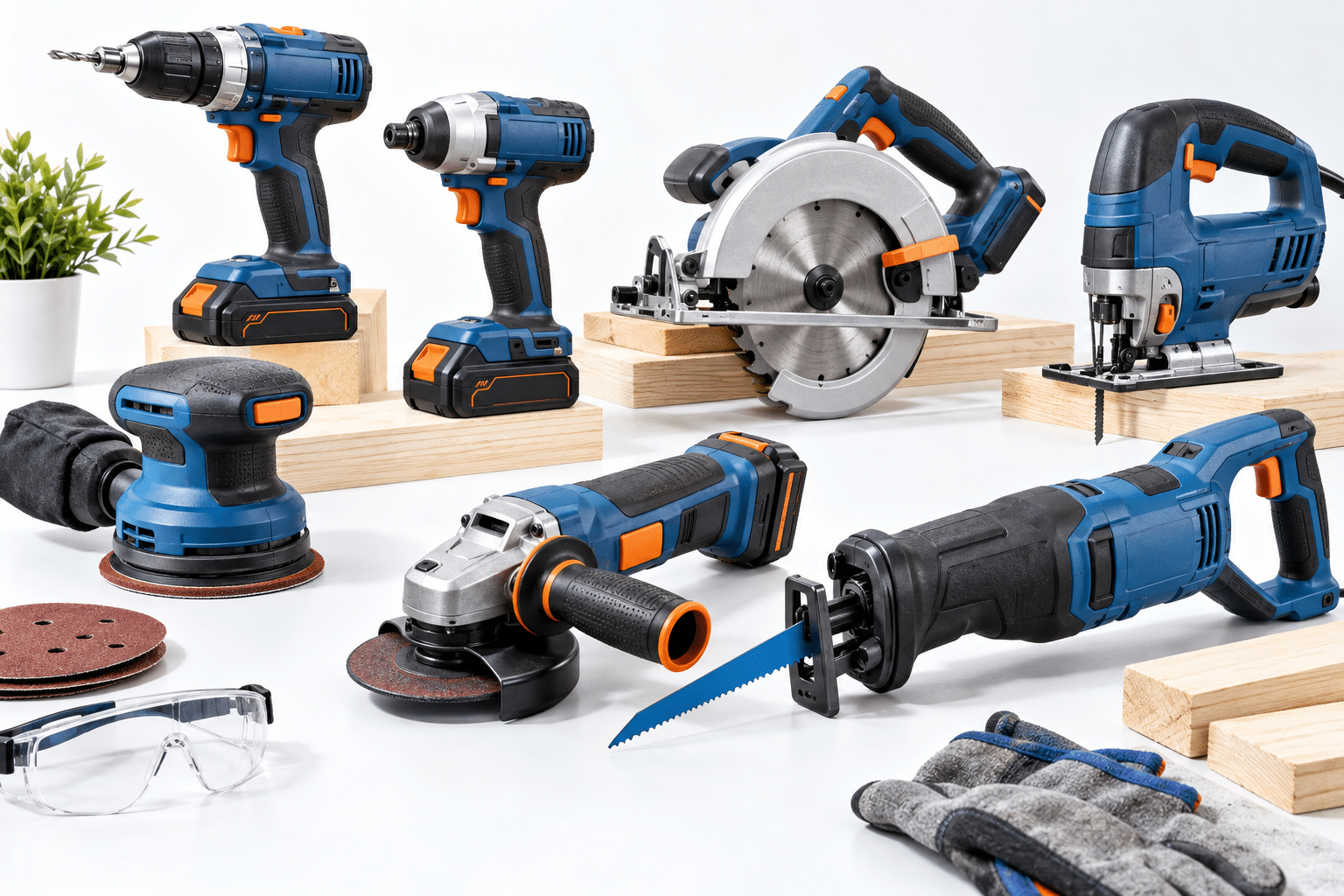
Paragraph (a) is one sentence, and it is the sentence most employers have never read: each employer is responsible for the safe condition of tools and equipment used by employees, “including tools and equipment which may be furnished by employees.” That means your mechanic’s personal cordless drill with the taped-up battery pack is your problem the moment he uses it on your floor. I tell employers to decide one of two things: either inspect employee-owned tools on the same schedule as company tools, or do not allow them. What you cannot do is pretend they are not there.
Paragraph (b) is the compressed air rule. Air used for cleaning has to be reduced to less than 30 psi, and even then only with effective chip guarding and personal protective equipment. Every shop I have ever visited violates this at least once a day, usually at the end of the shift when someone blows the dust off their clothes. Thirty psi is not much; a shop air line typically runs 90 to 120. If the nozzle on your blow gun does not have a pressure-relieving tip or a regulator ahead of it, you are out of compliance every time it is pulled, and blowing dust off skin and clothing is exactly the use the rule is aimed at.
1910.243: Guards, Switches, Air Tools, Wheels and Powder-Actuated Tools
- Portable circular saws with blades over 2 inches need guards above and below the base plate. The lower guard has to return to the covering position on its own the instant the saw comes out of the cut (1910.243(a)(1)). A lower guard wedged open with a screw is the classic violation.
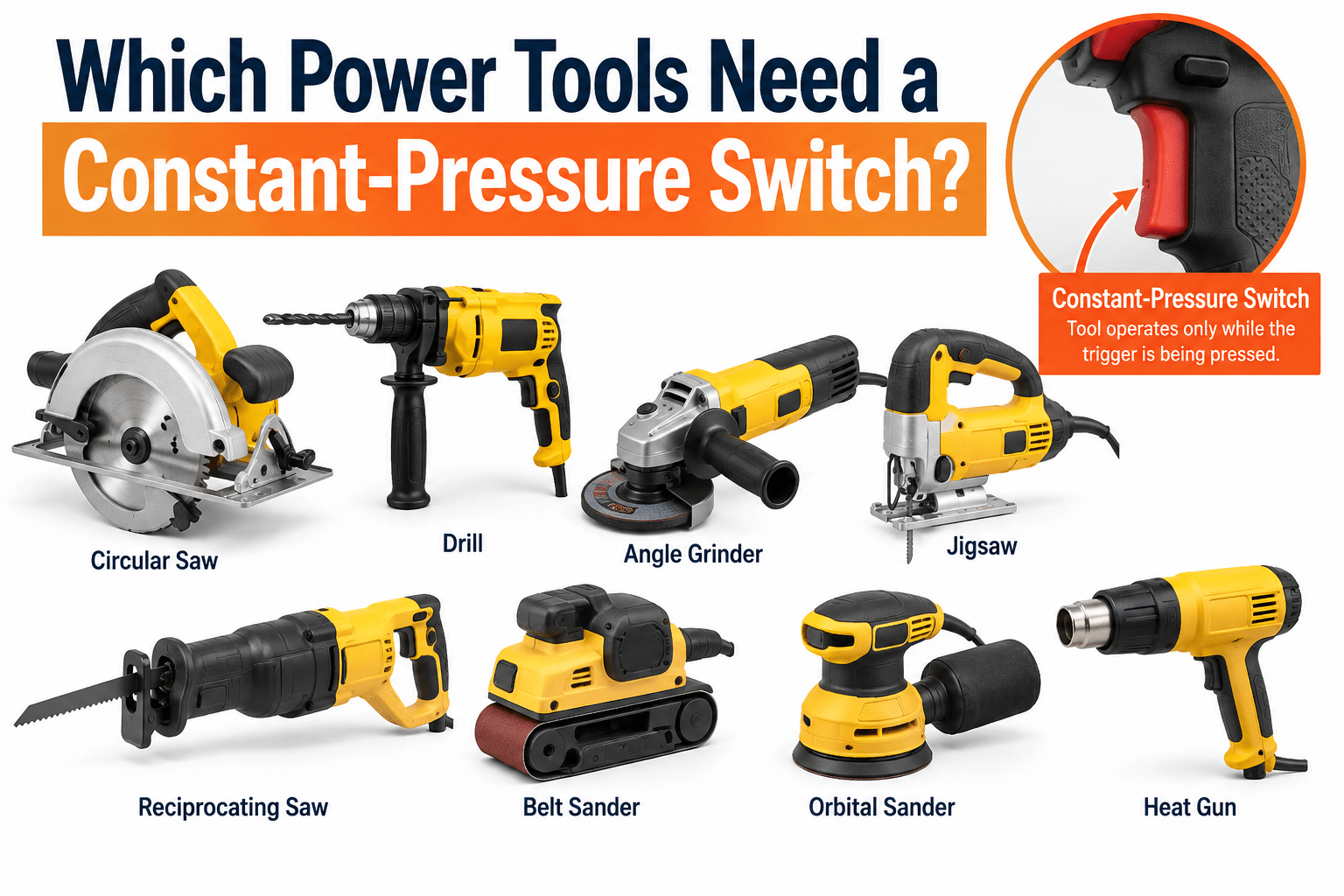
- Switches. Drills, tappers, fastener drivers, grinders with wheels over 2 inches, disc sanders over 2 inches, belt sanders, reciprocating saws, and saber, scroll and jig saws with heavier blade shanks all need a constant-pressure switch that shuts the tool off when you let go (1910.243(a)(2)). A lock-on is allowed only if a single motion of the same finger can shut it off.
- Belt sanders need guards at each nip point where the belt runs onto a pulley (1910.243(a)(3)), and any cracked saw comes out of service (1910.243(a)(4)).
- Pneumatic tools need a tool retainer on any tool that could eject its attachment, and hoses and connections rated for the pressure (1910.243(b)).
- Portable abrasive wheels run only with safety guards, and every wheel gets closely inspected and ring tested before it is mounted, with the spindle speed checked against the maximum marked on the wheel (1910.243(c)(5)). A wheel run over its rated speed does not slow down; it comes apart.
- Explosive-actuated (powder-actuated) tools require eye protection for operators and assistants, an inspection before use, a defective tool pulled immediately, a 30-second hold in the firing position after a misfire, and no fasteners driven into cast iron, glazed tile, face brick or similar hard or brittle material (1910.243(d)).
Here is what Subpart P does not contain, because people ask me constantly: a training section, a retraining interval, or any kind of operator certification. I cover where the training duty actually comes from further down.
Which Power Tools Need a Constant-Pressure Switch?
This is the rule the zip tie defeats, and the zip tie around a grinder trigger is the single most common Subpart P violation I find. 1910.243(a)(2) sorts hand-held powered tools into three groups:
- Constant-pressure switch, no lock-on: hand-held circular saws with blades over 2 inches, electric, hydraulic or pneumatic chain saws, and percussion tools without positive accessory holding means. Gasoline chain saws need a constant-pressure throttle.
- Constant-pressure switch, lock-on permitted if one motion of the same finger turns it off: drills, tappers, fastener drivers, horizontal, vertical and angle grinders with wheels over 2 inches, disc sanders over 2 inches, belt sanders, reciprocating saws, and saber, scroll and jig saws with blade shanks over a nominal 1/4 inch.
- Positive on-off control allowed: platen sanders, grinders and disc sanders 2 inches or smaller, routers, planers, laminate trimmers, nibblers, shears, and saber, scroll and jig saws with blade shanks 1/4 inch or narrower.
The point of the rule is simple. When a grinder kicks out of your hands, it has to stop. When the operator drops a saw, it has to stop. If you have a tool in the crib that stays on after the trigger is released and it is not on that third list, take it out of service today.
How Do the Construction Rules in 1926 Subpart I Differ?
Construction has its own version of the same ideas, 1926.300 through 1926.307, and in a few places it is more specific than general industry. The pieces I quote most often on a job site:
- 1926.300(a) repeats the safe-condition duty and says outright that it covers tools “whether furnished by the employer or the employee.” 1926.300(b)(1) adds that when a power tool is designed to accommodate guards, it is used with them.
- 1926.301 is the hand tool section, and it is refreshingly concrete: no unsafe hand tools issued or permitted, no wrenches with jaws sprung to the point of slipping, no mushroomed heads on drift pins, wedges and chisels, and wooden handles kept free of splinters and cracks and tight in the tool.
- 1926.302(a) requires electric tools to be double insulated or grounded under Subpart K, and prohibits hoisting or lowering a tool by its cord. On a construction site, 1926.404(b)(1) layers the GFCI or assured equipment grounding conductor program on top of that.
- 1926.302(b) covers pneumatic tools: secured to the hose by a positive means, safety clips or retainers on impact tools, a muzzle safety device on nailers and staplers running over 100 psi, the same 30 psi cleaning limit, and no hoisting by the hose.
- 1926.302(c) requires fuel-powered tools to be shut off while being refueled, serviced or maintained, and brings in the toxic gas and PPE rules when they run in enclosed spaces.
- 1926.302(e) is the only tool-specific training rule in either subpart: only employees trained on the particular powder-actuated tool in use may operate it, the tool is tested each day before loading, and it is never left loaded or unattended.
- 1926.303 covers abrasive wheels and tools, 1926.304 woodworking tools, 1926.305 jacks, 1926.306 air receivers and 1926.307 mechanical power-transmission apparatus.
My experience is that construction crews know 1926.302(e) because powder-actuated tools scare people, and they should. The rules that get missed on site are the boring ones: the sprung crescent wrench, the framing hammer with the loose head, and the compressor blow gun with no regulator.
What Is the Most Common Hazard When Using Hand Tools?
Misuse and improper maintenance. That is OSHA’s answer in the 3080 booklet, and after 25 years it is mine too. Hand tools do not fail in interesting ways. They fail because a wrench with sprung jaws slips under load and the knuckles hit the frame, because a chisel with a mushroomed head sheds a steel chip into somebody’s eye, because a hammer head works loose on a cracked handle and flies, because a screwdriver used as a chisel snaps at the tip, or because a dull knife needs enough force that it slips when it finally cuts.
Two hand tool rules I add to every talk. First, cut and strike away from your body, and keep the other hand out of the line of travel; most hand tool lacerations I have investigated happened to the hand that was not holding the tool. Second, in an area where flammable vapors can collect, iron and steel hand tools are an ignition source. OSHA 3080 calls for spark-resistant tools made of brass, plastic, aluminum or wood in those areas, and I have seen exactly one shop that actually stocked them.
What Are the Biggest Risks With Power Tools?
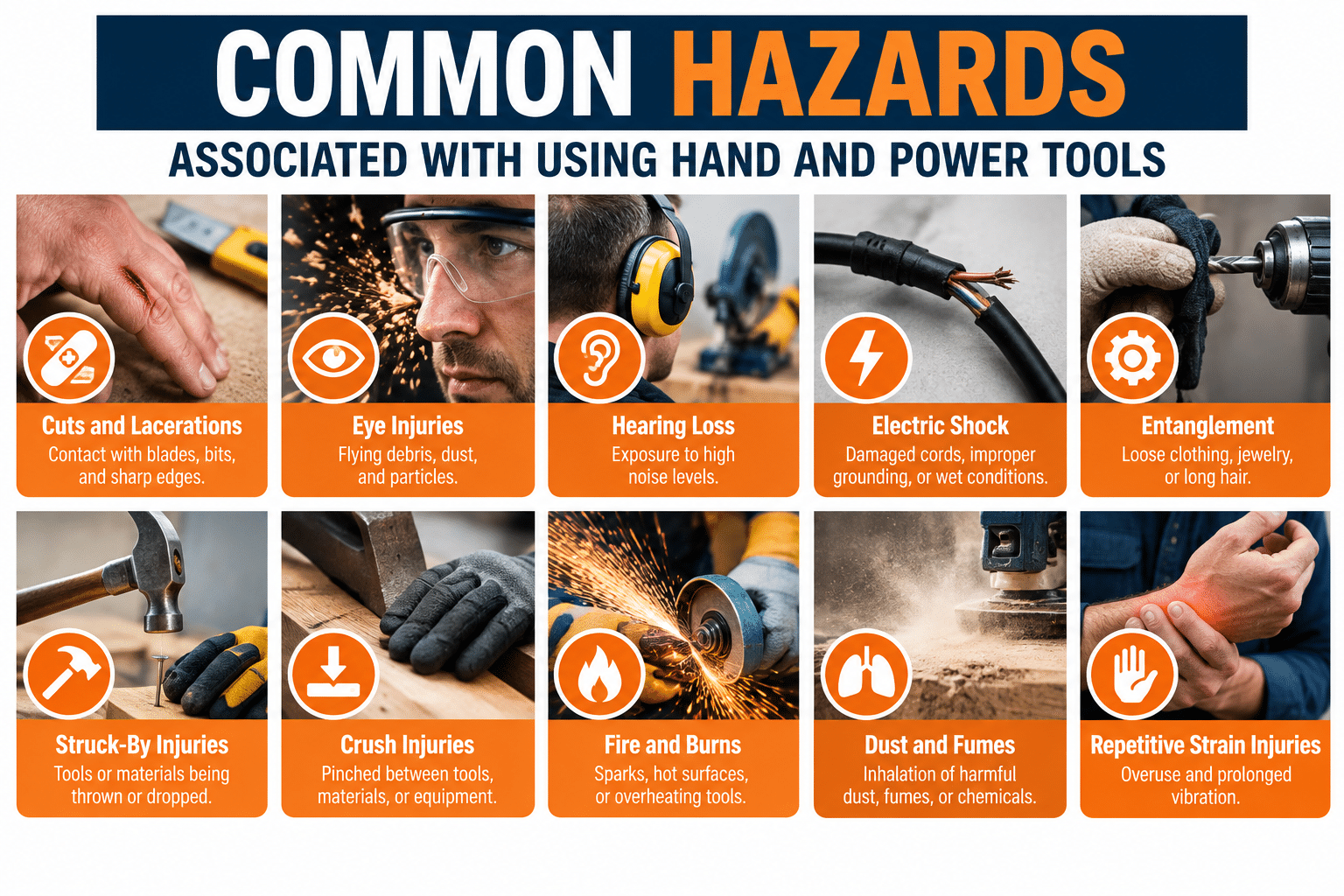
People search for “five risks” of power tools, so here are the five that account for the injuries I see, followed by the general precautions OSHA lists for all of them.
- Electric shock. Frayed cords, ground pins snapped off so the plug fits a two-prong extension, tools used in wet locations. The fix is a double-insulated or properly grounded tool, a GFCI, and a cord inspection before every use.
- Flying particles and eye injuries. Grinding, chipping, nailing, drilling overhead. Safety glasses for everyone in range, and a face shield over them for grinding and chipping.
- Contact with the blade, bit or wheel. Lacerations and amputations, kickback from a bound circular saw, and abrasive wheels that burst because they were cracked or run over their rated speed. Guards, the constant-pressure switch, the ring test and clamping the work handle most of it.
- Noise and vibration. A grinder or chipping hammer will put an operator over the 85 dBA action level in 1910.95 in a normal shift, and long exposure to vibrating tools is how hand-arm vibration syndrome starts.
- Fire and explosion. Sparks from a grinder near flammables, gasoline-powered tools run in enclosed spaces, and refueling a hot tool. Fuel-powered tools stay shut off while refueling and stay outside or ventilated.
OSHA 3080’s general precautions for all power tools are worth reading out loud at a toolbox talk: never carry a tool by the cord or hose, never yank the cord to disconnect it, keep cords and hoses away from heat, oil and sharp edges, disconnect the tool when it is not in use and before servicing or changing accessories, keep bystanders at a safe distance, secure the work with clamps or a vise so both hands are free, avoid accidental starting by keeping your finger off the switch while carrying a plugged-in tool, keep tools sharp and clean, keep good footing and balance, skip the loose clothing and jewelry, and tag damaged tools “Do Not Use” and pull them from service.
Is Hand and Power Tool Safety Training Required by OSHA?
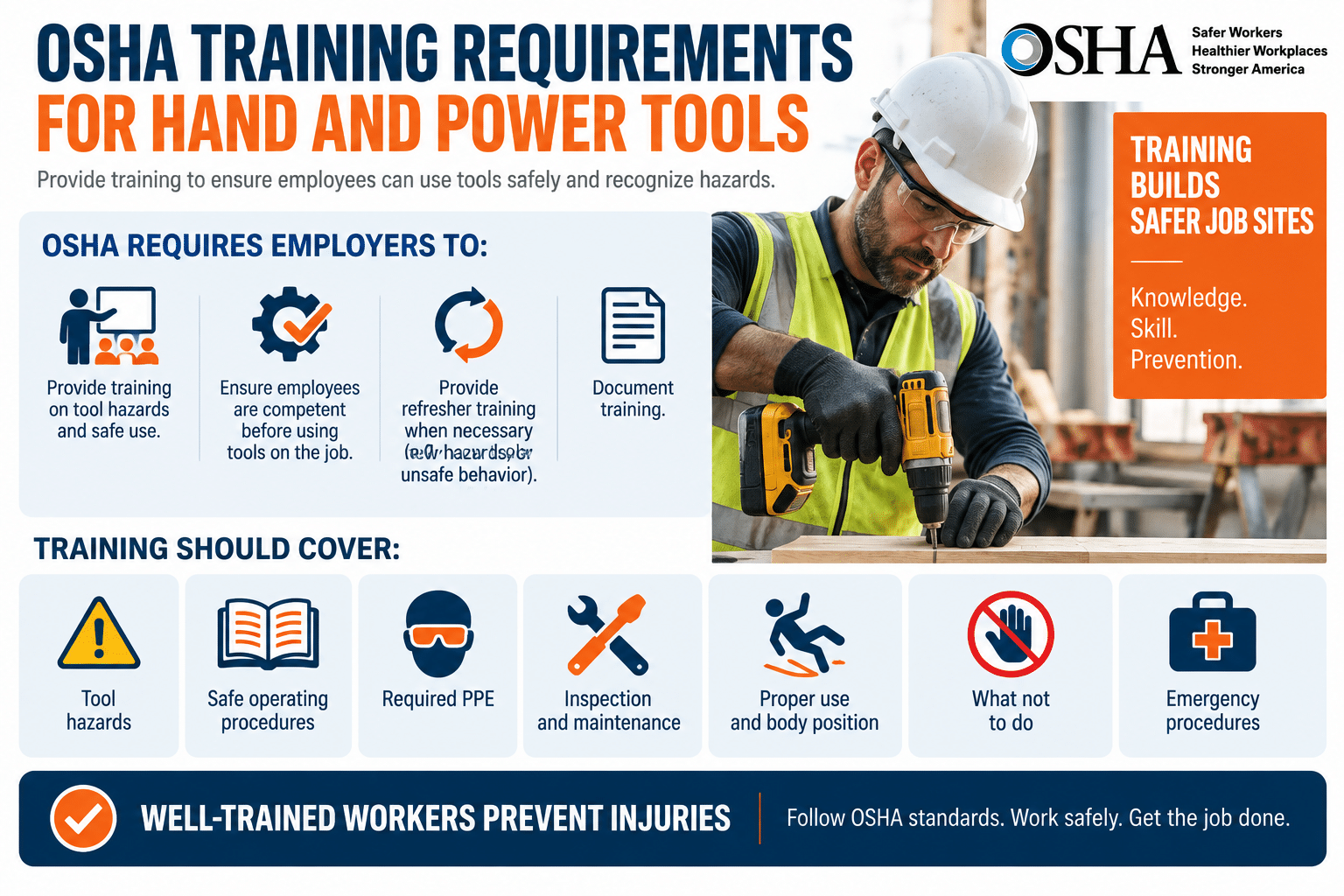
Here is the honest answer, because I do not want you telling an inspector something I said that is not true. There is no standalone hand and power tool training section in 1910 Subpart P. The only tool-specific training rule in 1926 Subpart I is 1926.302(e)(1) for powder-actuated tools. There is no OSHA certification for hand or power tools, and anyone selling you one is selling you a training certificate with a fancier name.
The training duty is real anyway; it just comes from the standards around the tools. 1910.132(f) requires training for every employee who must use PPE, which is every employee who picks up a grinder. 1926.21(b)(2) requires construction employers to instruct each employee in recognizing and avoiding unsafe conditions and the regulations applicable to the work. 1910.95 brings in hearing conservation training once the noise is there. In California, Title 8 Section 3203 requires training on the hazards specific to each employee’s job assignment, which puts tools squarely back in scope. And Section 5(a)(1), the General Duty Clause, covers a recognized hazard you knew about and did nothing to train against. A hand and power tool safety session supports all of those requirements; it does not satisfy a standard on its own, because no such standard exists.
The way I run it: a short video, the five rules and the inspection checklist above, a walk through the crib with the actual tools, a quiz, and a sign-in sheet in the file. Retrain when a new tool or task shows up, after any tool-related injury or near miss, when you see someone working without a guard or the required PPE, and once a year as a refresher, which is common practice rather than a rule.
Train your crew on these rules in 16 minutes. Our hand and power tool safety training video kit covers inspection, guards, PPE, cords and grounding, kickback and the hand tool injuries nobody expects, with a quiz, a PowerPoint and a reusable completion certificate. Construction crews have their own version built around 1926 Subpart I: the construction hand and power tool safety training kit. If you only need slides for a toolbox talk, the hand and power tool safety PowerPoint is a separate download.
Frequently Asked Questions About OSHA Hand and Power Tool Safety Rules
OSHA’s Hand and Power Tools booklet (OSHA 3080) lists five: keep all tools in good condition with regular maintenance; use the right tool for the job; examine each tool for damage before use and do not use damaged tools; operate tools according to the manufacturer’s instructions; and provide and use the right personal protective equipment. Every one of them maps to a line in 29 CFR 1910 Subpart P or 1926 Subpart I.
In general industry, 29 CFR 1910.242(a) makes the employer responsible for the safe condition of every tool employees use, including employee-owned tools, and 1910.242(b) limits compressed air used for cleaning to less than 30 psi with chip guarding and PPE. 1910.243 requires guards above and below the base plate on portable circular saws with blades over 2 inches, constant-pressure switches on drills, grinders, sanders and reciprocating saws, tool retainers on pneumatic tools, guards and a ring test on portable abrasive wheels, and eye protection plus a pre-use inspection for powder-actuated tools. Construction sites follow 1926.300 through 1926.307.
Misuse and improper maintenance. OSHA’s own guidance says the greatest hazards posed by hand tools result from those two things: a wrench with sprung jaws that slips, a chisel with a mushroomed head that sheds a chip into someone’s eye, a cracked or loose wooden handle that lets the head fly, a screwdriver used as a chisel that snaps, or a dull blade that needs enough force to slip. 1926.301 names the sprung wrench, the mushroomed head and the cracked handle by name.
The big five are electric shock from damaged cords and missing grounds, flying particles that cause eye injuries, contact with the moving blade, bit or wheel (lacerations, amputations, kickback and bursting abrasive wheels), noise and vibration, and fire or explosion from sparks near flammables or from fuel-powered tools used indoors. Pneumatic tools add the ejected attachment, which is why OSHA requires a tool retainer, and powder-actuated tools add a projectile hazard when a fastener passes through thin material.
There is no standalone training section in 1910 Subpart P, and the only tool-specific training rule in 1926 Subpart I is 1926.302(e)(1), which allows only trained employees to operate a powder-actuated tool. The training duty comes from the standards around the tools: 1910.132(f) requires training for every employee who must wear PPE, 1926.21(b)(2) requires construction employers to instruct each employee in recognizing and avoiding unsafe conditions, and the General Duty Clause covers the rest. Training a crew on these rules supports those requirements; it is not an OSHA certification, because no such certification exists for hand or power tools.
